
Vandaag of morgen in huis

Kwaliteit gegarandeerd

Welkomstaanbiedingen ontgrendelen: GRATIS bezorging | Tot 80% korting | Gratis 30 dagen JoyPlus-proefperiode
Download de app
A motion sensor light can be useful in a hallway, bedroom, cupboard, bathroom, garden or by the front door. It switches on when it detects movement and stays off when no one is around. This can help prevent unnecessary lighting, but not every model is right for every space.
The product name alone doesn’t tell you much, either. A sensor light for a dark wardrobe has different requirements from an outdoor motion sensor light by the driveway. So, keep an eye out for these common pitfalls.
A lamp with a high lumen rating gives off a lot of light, but that isn’t always practical. Bright light can be uncomfortable in a bedroom or nursery. For a driveway or large garden, though, more light may be exactly what you need. So consider the combination of brightness, colour temperature and placement.
An IP rating indicates what the casing is protected against. In practice, IP44 means protection against water splashes, but not immersion or powerful jets of water. This may be enough for a sheltered entrance. For an exposed wall or garden, a higher rating such as IP65 often makes more sense.
A motion sensor usually responds to movement and changes in temperature. Detection range, viewing angle and light threshold vary by model. As a result, a light may not respond as well if it’s mounted behind an obstacle, pointing towards a busy road or installed too high up. Also check whether it only switches on in the dark.
A range of a few metres is often enough for indoor lighting. Specifications for different models may list a range of 3 to 5 metres, for example. A longer range can be useful for outdoor lighting, especially by a driveway or rear path.
Look for a dusk sensor or light sensor, too. Some lights only switch on when the ambient light drops below a certain level. This stops them coming on repeatedly during the day. For example, the touch-dimmable model with motion detection is listed as activating at up to 20 lux.
The power supply determines where and how often you can use the light.
For example, a rechargeable night light with a built-in 500 mAh battery lists an operating time of up to 10 hours in sensor mode. This is a product specification, not a guarantee for every situation. Operating time depends on factors such as how often the light switches on and the brightness setting you choose.
An LED night light with warm white light around 2700 to 3200 K is often a good fit for a bedroom or entrance. Neutral or cooler light around 4000 to 5500 K can be more practical in a cupboard, kitchen or bathroom.
Dimmable LED lights are useful when one light needs to serve several purposes. Check the type of control: some models have set dimming levels, while others use touch controls. Also check the lumen rating. A compact night light with 30 lumens is designed to help you find your way, while an outdoor light with 800 to 1000 lumens can illuminate a larger area.

Why it suits this profile: This set provides flexible lighting for a bedroom, nursery or hallway, for example, without needing fixed installation or a socket right where you want it.
The rechargeable battery means you don’t need disposable batteries, and the sensor can switch the light on automatically in dark conditions. Just remember to recharge it.
500mAh battery, USB charging, three colour temperatures and five brightness settings; stated brightness is 30 lumens.
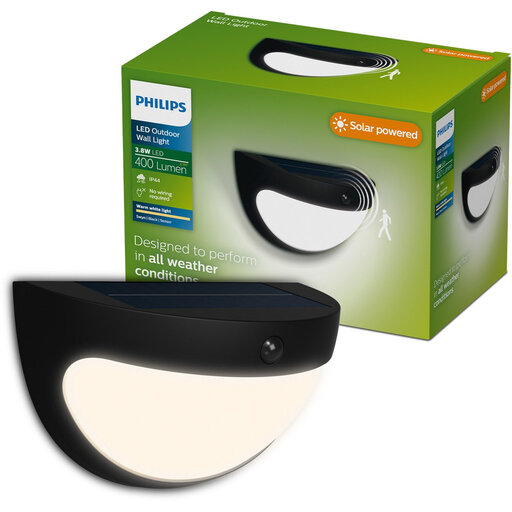
Why it suits this profile: A good choice if you want a permanent wall light by a balcony, in the garden or at the entrance, without connecting it to the mains.
The IP44 rating makes clear that this light is protected against splashes, not suitable for submersion. Positioning it in direct sunlight is still important.
Solar-powered, two lighting modes, integrated motion and daylight sensors, and 400 lumens per light.

Why it suits this profile: Designed for larger outdoor spaces such as a driveway, garden, garage or courtyard where wide light coverage is needed.
The product specifications state IP65, but correct installation and regular cleaning of the solar panel and sensor are still important.
Three adjustable light heads, 302 LEDs, stated output of 3000 lumens, a 180-degree detection angle and three lighting modes.

Why it suits this profile: These slim sensor lights are designed for kitchen cupboards, wardrobes, shelves and other tight spaces.
Measuring 300 x 38 x 10 mm, the light fits into narrow spaces. Its stated protection rating isn’t intended for damp outdoor areas.
Two lights per set, 41 LEDs per light, three colour temperatures, USB charging and a PIR range of 3 to 5 metres.
We’ve put together a complete, up-to-date list of products that meet these strict selection criteria and current European safety regulations.
Install the light so its detection area isn’t blocked by a wall, cupboard door or plants. A solar outdoor light needs to receive direct daylight. Once installed, test the height, viewing angle and light threshold before tightening the fixture permanently.
Operating time depends on the type of light. A mains-powered light doesn’t need charging, while a battery or USB model depends on battery capacity and how often it switches on. For a solar outdoor light, sunlight, the season and dirt on the panel also make a difference.
A sensor light only comes on when it detects movement, but its energy use depends on wattage, how long it stays on and its power source. So don’t just look for the words “energy-efficient”; check the wattage, lumens, battery capacity and lighting time too. That gives you a better idea of the practical running costs.
