
Vandaag of morgen in huis

Kwaliteit gegarandeerd

Welkomstaanbiedingen ontgrendelen: GRATIS bezorging | Tot 80% korting | Gratis 30 dagen JoyPlus-proefperiode
Download de app
A motion sensor light switches on automatically when someone approaches. It’s useful in a hallway, bedroom, bathroom, garden, driveway or by the front door. However, products vary considerably in their power supply, brightness, detection range and protection against moisture.
As a Joybuy Product Recommendation Officer, I focus on verifiable specifications. This helps you avoid paying for little more than an attractive product photo or a broad marketing claim.
A sensor might have a range of several metres on paper, but its performance can be affected by mounting height, direction and obstacles. So check more than just the maximum range: look at the detection angle, light sensitivity and whether the sensor only activates in the dark.
For a hallway night light, a range of 3 to 5 metres is often enough. A wider angle may be more practical for a driveway or garden.
IP44 outdoor lighting is protected against solid objects larger than 1 millimetre and splashing water. This doesn’t mean the light can withstand a direct jet of water, immersion or prolonged exposure to heavy rain.
IP44 may be suitable for a sheltered exterior wall, balcony or covered area. Don’t install the light where water can run directly onto the connections or housing. For more exposed locations, a higher IP rating, such as IP65, may be more suitable.
A solar outdoor light with a motion sensor doesn’t need a fixed power connection, but its solar panel needs to receive enough daylight. A shaded wall, short winter days and dirt on the panel can all affect how long the light stays on.
Also consider the difference between a light that shines brightly for a short time when it detects movement and one that stays on for longer. Some brands claim that their solar outdoor lights offer a certain lumen output or higher solar panel conversion efficiency. These are brand claims; the actual lighting time depends on the location, weather and usage.
Check whether the sensor uses PIR motion detection and at what light level the lamp activates. Some models only switch on when the ambient light falls below, for example, 20 lux. This stops the light from coming on unnecessarily during the day.
These points are also important for everyday use:
A standalone motion sensor, such as the Aigostar PIR-360, is a different solution from a complete light. According to the product specifications, this model has adjustable light sensitivity from 10 to 2000 lux, an adjustable delay from 10 seconds to 7 minutes and a maximum load of 1200 W. Always have fixed electrical installations carried out in accordance with the instructions and applicable safety regulations.
Lumens indicate how much light a lamp gives off. A small LED night light with a motion sensor usually needs fewer lumens, while a security light for a driveway needs to be brighter.
Colour temperature affects the look of the light:
For an indoor light, check whether it can be dimmed too. According to the product information, the set of two touch-control night lights produces 20 lumens, uses 1 W and has a memory function that recalls the last brightness setting. That’s a different use case from an outdoor light producing hundreds of lumens.
A 230 V light doesn’t need charging, but it does need a suitable socket or fixed connection. A rechargeable night light is more flexible to position, but needs to be charged regularly via USB. Check the stated operating time and type of connection.
Also consider:
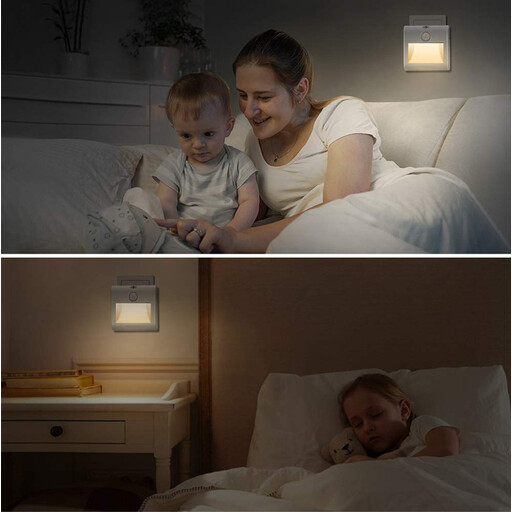
Why it suits this need: You can use the two lights together in places such as a bedroom, hallway or bathroom. They plug straight into a standard socket, with no installation required.
The product specifications state a sensor range of 3 to 5 metres and activation at a maximum of 20 lux. This makes it clearer where and when the light will respond automatically.
Set of two, 1 W per light, stepless touch dimming and a memory function that recalls the last brightness setting.
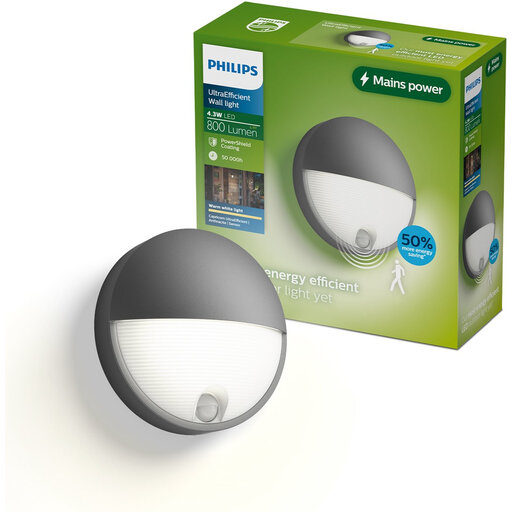
Why it suits this need: This wall light with a motion sensor is designed for an exterior wall, balcony or garden. It combines a fixed connection with an integrated LED light source.
The stated IP44 rating makes its limitations clear: it’s suitable for splashing water, but isn’t designed to be fully waterproof.
800 lumens, warm white light at 2700 K, aluminium housing and integrated motion and dusk sensors.

Why it suits this need: This solar security light is designed for a driveway, large garden, garage or patio where wide light coverage is needed without fixed wiring.
The product specifications list IP65, a 180-degree detection angle and three lighting modes. However, check that the installation spot gets enough direct sunlight.
Three adjustable light heads, a stated output of 3000 lumens, solar power and an 1800mAh lithium-ion battery.
We’ve put together a complete, up-to-date list of products that meet these strict selection criteria and comply with the applicable European safety regulations.
Point the sensor towards the route people will take and avoid obstacles such as walls, large plants or furniture. Install an outdoor light according to the instructions and make sure the sensor isn’t constantly triggered by a busy road or moving branches. For solar lighting, the panel should receive as much direct daylight as possible.
Operating time depends on the type of power supply, how often the light switches on and its brightness. A mains-powered light doesn’t need charging. A rechargeable night light, however, has a limited operating time per charge. According to the product information for the relevant model, a 500mAh battery can last for up to 10 hours in sensor mode. This is a stated figure and may vary depending on conditions of use.
The light usually only comes on when it detects movement, so it may use less electricity than continuous lighting. Check the wattage and average time spent switched on. A 1 W indoor light uses less energy per hour than an 8,2 W outdoor light, but their light output and operating times also differ. So compare wattage, lumens and the expected number of activations together.
