
Vandaag of morgen in huis

Kwaliteit gegarandeerd

Welkomstaanbiedingen ontgrendelen: GRATIS bezorging | Tot 80% korting | Gratis 30 dagen JoyPlus-proefperiode
Download de app
A motion sensor light switches on automatically when someone walks past. This is useful in a hallway, bedroom, nursery, bathroom, garden, driveway or by the front door. However, not every sensor light is suitable for every situation. A low price means little if the light is too dim, the sensor reacts incorrectly or the casing cannot withstand the British weather.
In this buying guide, you’ll find out which specifications matter, which marketing claims to look at critically and which models suit different uses.
A powerful outdoor light isn’t automatically a good choice next to your bed. A 3,000-lumen light may suit a driveway, but could be unnecessarily bright in a narrow hallway. A lower light level is often more practical for an LED night light. So consider the space first, then look at the number of lumens.
A motion sensor may be less reliable if it’s positioned behind furniture, faces a busy road or has little contrast to work with outdoors. Check the detection range, the detection angle and whether the light only activates in the dark. Some models specify a light threshold, such as a maximum of 20 lux.
An IP rating indicates how much protection the casing offers against dust and moisture. IP44 protects against splashing water, but isn’t designed for immersion or powerful water jets. IP65 offers greater protection against dust and water jets. Check the mounting location too: a sheltered wall has different requirements from a completely exposed driveway.
For an indoor sensor light, 20 to 100 lumens is often enough for orientation. You’ll generally need more light for a driveway or garden. A product with 800 to 1,000 lumens can light up an entrance or exterior wall; a model with 3,000 lumens is more suited to a large outdoor area.
Colour temperature affects the look of the light:
Also consider the difference between a fixed light and a model with a dimming function. An LED motion sensor light with several brightness settings is more versatile for bedrooms and passageways.
A fixed outdoor light connected to the mains works independently of sunlight, but requires wiring. A wireless wall light with a rechargeable battery or disposable batteries is easier to install. If you choose one, check the runtime, charging time and connection type.
A rechargeable night light is practical for a wardrobe, hallway or bedroom. A solar outdoor light uses a built-in battery that charges via the solar panel during the day. Its actual run time depends on the amount of direct sunlight, the season and how often the sensor is activated. So don’t place a solar wall light under a deep overhang or on a north-facing wall if it gets little sun.
Before buying, check:
A secure fixing is important for an outdoor motion sensor light. For magnetic models, the mounting plate must be suitable for the weight and fitted to a flat surface.

Why it suits this profile: This set is designed for bedrooms, nurseries and hallways where you don’t want a permanent installation. Both lights have a built-in rechargeable battery and charge via USB.
The product specifications state a range of 3–5 metres, a light threshold of up to 20 lux and five brightness settings. This gives you a clear idea of what to expect.
Two lights, 30 lumens, three colour temperatures, five dimming settings and a built-in 500mAh battery.
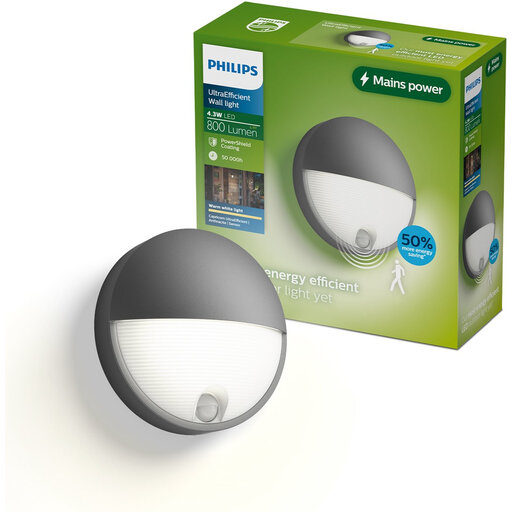
Why it suits this profile: This fixed outdoor light is a good fit for an entrance, balcony or garden wall where you want a permanent connection and a neutral look.
The stated IP44 rating makes it clear that the light is protected against splashing water, not immersion. It’s therefore suitable for an appropriate outdoor wall, but not every exposed location.
800 lumens, warm 2700 K light, integrated dusk and motion sensors, and an aluminium casing.

Why it suits this profile: This solar outdoor light is designed for a driveway, garage, large garden or patio where you want a wide beam and a fitting that doesn’t need wiring.
The IP65 rating, stated 180-degree detection angle and recommendation to expose the panel to direct sunlight make the installation requirements clear.
302 LEDs, stated light output of 3,000 lumens, three lighting modes, three adjustable heads and a detection range of 60 feet according to the product description.
We’ve put together a complete, up-to-date list of products that meet these strict selection criteria and the applicable European safety requirements.
Point the sensor towards the route people will take, and don’t place it directly behind an obstacle. For outdoor lighting, it’s a good idea to mount the light so rainwater doesn’t collect around the connections. For solar lighting, the panel should receive as much direct sunlight as possible during the day.
Its lifespan depends on the type of light, the electronics, the battery and how often it’s activated. An integrated LED usually won’t need replacing straight away, but a rechargeable battery has a limited number of charging cycles. So check whether the battery is replaceable and how long the light operates per charge according to the product specifications.
An LED light generally uses little energy, especially when the motion sensor limits how long it stays on. A solar wall light doesn’t use mains electricity, but depends on sunlight. For a fixed light, you can estimate its energy use from the wattage and total time it’s switched on. A dimmable setting or a shorter sensor timer can help reduce consumption further.
