
Vandaag of morgen in huis

Kwaliteit gegarandeerd

Welkomstaanbiedingen ontgrendelen: GRATIS bezorging | Tot 80% korting | Gratis 30 dagen JoyPlus-proefperiode
Download de app
Coming home in the dark, fumbling for the keyhole. Or an outdoor light that switches on with every gust of wind, waking up the entire neighbourhood. A motion sensor light seems like a simple solution for convenience and security, but the reality is often more challenging. Many models overpromise and underdeliver, leaving you with a rusty wall light or a dead battery just when you need light the most.
As a Joybuy Product Recommendation Officer, I see where things go wrong every day. Before you make a choice, it's wise to understand the most common pitfalls that can lead to unnecessary expenses.
solar-powered light with sensor is an appealing idea, but many budget models have a solar panel that's too small and a weak battery. The result: after a few overcast days, it's completely useless.To avoid these problems, you don't need to comb through a technical manual. Pay attention to the following three key points, and you're guaranteed to make a better choice.
The IP (Ingress Protection) rating indicates how well a device is protected against dust and moisture. This is the most important specification for any outdoor light with sensor.
Always choose an outdoor wall light with sensor with a minimum rating of IP44. For locations fully exposed to wind and rain, IP65 is a wiser investment.
The power source determines not only the installation process but also its reliability.
security light. It requires installation (sometimes by an electrician) but delivers consistent power and often a higher light output.rechargeable light with sensor offers maximum flexibility. Perfect for places without a power outlet, such as in a shed or as a closet light with sensor. The downside is that you need to recharge the battery periodically.LED lighting with motion detector is performing better than ever, but its effectiveness depends on the amount of direct sunlight the panel receives. Pay attention to the battery capacity (expressed in mAh) and the panel's efficiency.Not every light needs to be a floodlight. The right brightness and colour depend on the purpose.
night light with sensor in a hallway, 50-100 lumens is sufficient. For illuminating a driveway or garden path, 300-800 lumens is a good guideline. A true security light often has 1000 lumens or more.Below is a selection of products tailored to specific needs that successfully avoid the pitfalls mentioned earlier.
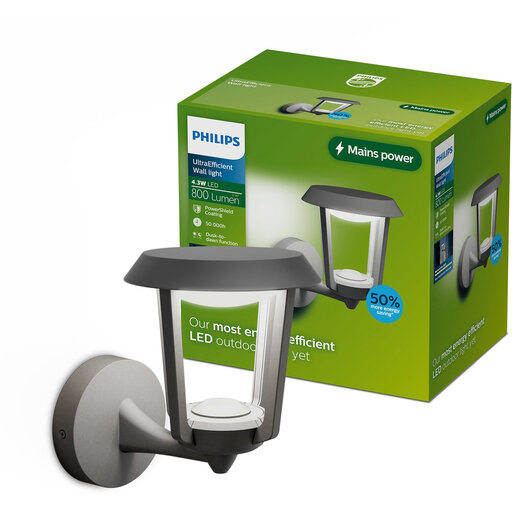
Why This Fits Their Persona: They are looking for a reliable, stylish, and low-maintenance solution for their front or back door. This light combines a classic lantern design with modern LED technology and a solid build. No fuss, just good light when it's needed.
The housing is made of high-quality aluminium with a corrosion-resistant PowerShield coating and an IP44 rating. This model is built to withstand the elements and avoids the rust pitfall.
Long lifespan (up to 50,000 hours, according to Philips) and an energy-efficient integrated LED. The dusk-to-dawn sensor ensures the light only activates in the dark, preventing unnecessary energy consumption.

Why This Fits Their Persona: Wants an effective security light without the hassle of cables or extra energy costs. Ideal for illuminating a driveway, garden, or shed where there's no nearby power outlet. Installation is as simple as mounting it in a sunny spot.
This model bypasses the 'weak solar panel' pitfall. Philips states that the light converts solar energy efficiently, ensuring a longer runtime. The two light modes ('Auto' and 'On') give the user control and prevent the 'mind of its own' sensor issue.
High light output of 1000 lumens, which is exceptional for a solar light and highly effective for security. Installation is extremely simple as no wiring is required.

Why This Fits Their Persona: Needs a quick and simple lighting solution for dark corners indoors, such as a wardrobe, drawer, kitchen cabinet, or utility closet. Drilling holes or running cables is not an option. It needs to work out of the box and have a sleek look.
As this is an indoor product, the pitfalls of weather resistance and weak solar panels do not apply. The sensor is specifically designed to react to a door or drawer opening, thus avoiding the 'oversensitive sensor' trap.
Extremely simple installation thanks to its magnetic mount. The light is rechargeable via USB-C, slim, and discreet. You just snap it into place, and it works.
We have compiled a complete, up-to-date list of products that meet these strict selection criteria and safety standards.
This varies by model. Simpler lights often have no adjustment options. More advanced models, particularly security lights, have small dials on the sensor housing. These allow you to adjust the sensitivity (SENS), the time the light stays on after detection (TIME), and sometimes the light level at which the sensor activates (LUX). Always check the product description or manual to see if these features are available.
Winter performance is the ultimate test. A high-quality light with an efficient panel and a powerful battery can still function even after a series of overcast days. Manufacturers like Philips sometimes state that their lights can last for several nights on a full charge. However, cheaper models may give up after just one or two dark days. The key is the combination of a large solar panel, high battery capacity (mAh), and an energy-efficient LED.
Generally, no. Most motion sensors in consumer lighting are the PIR (Passive Infrared) type. These sensors detect the heat radiation from a person or animal. Glass blocks this infrared radiation, so the sensor will not detect movement on the other side of a window. Therefore, always position the light so that the sensor has an unobstructed 'view' of the area to be monitored.
