
Shoppers comparing loaf sizes
You buy white bread regularly and want to know how much you get when comparing a whole loaf with a half loaf.


For a small Mother’s Day breakfast, choose an amount that suits the number of people eating: a half loaf, a whole loaf and a pack of rolls don’t automatically serve the same purpose. Check the allergens and storage instructions on the label of the product you choose, too; don’t assume it contains baker’s salt.
You buy white bread regularly and want to know how much you get when comparing a whole loaf with a half loaf.
You’re looking for bread for a small Mother’s Day breakfast and want to match the shape and quantity to the occasion and the number of people eating.
Before you buy, you want to check the ingredients, allergens or whether baker’s salt is listed for the specific loaf.
First decide whether you need a half loaf, a whole loaf or rolls. Then consider the occasion, any leftovers and the label on the product you choose.
| What to consider | Check | Who it matters to |
|---|---|---|
| Comparable size | Check whether it’s a whole loaf, half loaf or rolls, and look at the stated weight. | For everyday use, I want to know how much bread I’m getting when comparing different sizes. Around 37% of consumers say comparable size is their top priority. |
| Breakfast or brunch | Choose a bread shape that suits the occasion and check availability with the retailer. | For a Mother’s Day breakfast, I want bread that suits how and when I’ll serve it. Around 27% of consumers put this choice first. |
| Quantity and storage | Choose a size that suits the number of people eating; only follow freezing instructions if they apply to the specific product. | For a small group, I don’t want to be left with more bread than we’ll use. That’s why around 18% of consumers put quantity and storage first. |
| Ingredients and labelling | Read the latest allergen information and check whether baker’s salt or iodised salt is listed. | If the ingredients are a deciding factor for me, I want to be able to check the packaging itself. This is the top priority for around 18% of consumers. |
According to the Netherlands Nutrition Centre, using baker’s salt when baking is not compulsory. So the ingredients can vary from one loaf to another.
For packaged bread, look for baker’s salt or iodised salt in the ingredients list. For unpackaged bread, ask which ingredients have been used.
The products reviewed don’t all have the same ingredients. PLUS lists wheat, soya, milk and lactose, among other ingredients, for Boeren wit heel.
Check the latest allergen information on the packaging you’re actually buying, even if you’re familiar with another white loaf from the same brand.
The Netherlands Nutrition Centre recommends replacing white bread with brown or wholemeal bread wherever possible.
Choose your bread type carefully for the occasion, and check the nutritional information if it’s relevant to your choice.
AH Wit heel is a whole white loaf that, according to Albert Heijn, is only available in store.
Jumbo features a whole white wheat loaf alongside other whole and half-sized white loaves.
Lidl lists an 800 g white loaf in its freshly baked range.
Aldi features a fresh, whole white loaf baked in a tin.
PLUS Boeren wit heel is an 800 g loaf.
Dirk features Bakker van der Akker Casino wit half, a half loaf for anyone who doesn’t need a whole one.
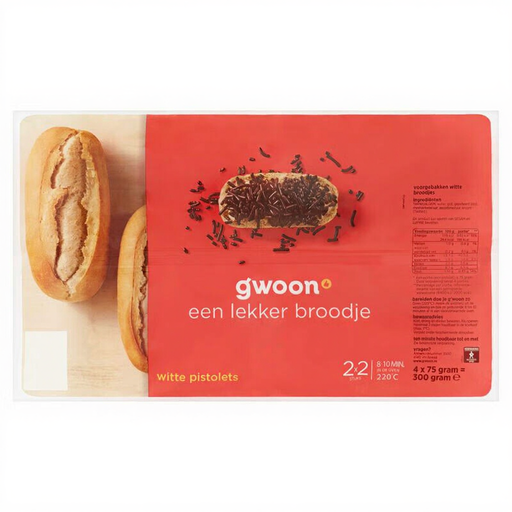
This selection features white rolls for breakfast or brunch, rather than a whole white loaf. Check the pack size when deciding how many you need.
 No image available
Four white rolls could be just right for a breakfast where you want to serve individual rolls. The pack contains 4 rolls and weighs 300 g.
If you have an allergy, check the information on the exact packaging, paying particular attention to sesame. Also check the storage instructions if you plan to freeze the rolls.
No, you can’t assume that: according to the Netherlands Nutrition Centre, using baker’s salt when baking is not compulsory. Check the ingredients list for the loaf you choose for baker’s salt or iodised salt.
It depends on the instructions for the specific loaf. For the whole white loaves reviewed, Albert Heijn and PLUS say to freeze them on the day of purchase; PLUS also says to use the loaf within one month. Don’t assume these instructions apply to other products without checking.
No. The Netherlands Nutrition Centre recommends replacing white bread with brown or wholemeal bread wherever possible. Check the nutritional information for the type of bread you choose if its ingredients are important to your decision.