
Brunch host catering for different tastes
You want to serve a light roll for Mother’s Day without leaving out guests who prefer wholemeal. Choose each type based on its product description, not just its colour.


For a Mother’s Day brunch with a range of preferences, you could serve a white roll alongside one labelled wholemeal. A brown roll may contain a mixture of wholemeal flour and white flour; if you’re considering a multigrain option, check the product description and ingredients before choosing it as a wholemeal option. Also check how many rolls are in each pack and how long they take to prepare.
You want to serve a light roll for Mother’s Day without leaving out guests who prefer wholemeal. Choose each type based on its product description, not just its colour.
You’re looking for a verifiable wholemeal option and comparing the fibre in specific rolls on a like-for-like basis: per 100 g.
You want to prepare the rolls just before serving. That means checking the instructions for your chosen product, making sure you have enough oven or air fryer space, and following any defrosting instructions.
White, brown and wholemeal rolls can each suit different tastes. Decide which types you want to serve, then compare the labels and preparation instructions for the specific products.
Choose it when: A guest would prefer a familiar, light roll.
Consider: You’ll need a separate product labelled wholemeal if you also want to offer a wholemeal option.
Choose it when: A mix of wholemeal flour and white flour suits what your guests are looking for.
Consider: The brown colour alone doesn’t confirm that the roll is wholemeal.
Choose it when: You want a roll whose wholemeal status you can check on the product label.
Consider: The label won’t tell you which flavour every guest prefers.
| What to consider | What to check when buying | Who it matters to |
|---|---|---|
| Wholemeal and fibre | Look for the wholemeal label, read the ingredients and compare fibre per 100 g. | If I want to serve wholemeal rolls, I want to be able to see which flour they contain. For around 44% of consumers, being able to check that a product is wholemeal is the top priority. |
| Guests’ preferences | Compare white, brown and wholemeal options, and check how many rolls are in each pack. | When catering for fussy eaters, I don’t want everyone to have to choose from just one type. Around 33% of consumers put guests’ preferences first. |
| Serving warm | Check whether the rolls are fresh, part-baked or frozen, and follow the preparation and storage instructions. | For a hot brunch, I need to know whether the rolls will be ready in time. Having them ready on time matters most to around 23% of consumers. |
A brown roll may contain both wholemeal flour and white flour. Having several grains or seeds doesn’t, in itself, confirm that a roll is wholemeal either.
Check the product description and ingredients. If you want to compare fibre between products, use the nutritional information per 100 g.
A wholemeal option and a light option cater for different preferences. The colour of a brown roll won’t tell you whether it’s a suitable replacement for a wholemeal option.
Choose the types to suit your guests’ preferences and check the quantities against the pack sizes.
Part-baked and frozen rolls need different planning from fresh ones. Jumbo says its frozen white rolls must not be refrozen after defrosting.
Before buying, read the instructions for the exact product and allow enough time and space to prepare it.
According to the Voedingscentrum, bakers aren’t required to use baker’s salt. The allergens listed can also vary from one roll to another.
Check the current ingredients and allergen information on the pack for each type you choose, especially if it matters to one of your guests.
These brands offer examples of different types of rolls. The details below apply to the products mentioned and not necessarily to the entire range.
Albert Heijn lists both a wholemeal roll and part-baked brown rolls.
Jumbo offers, among other products, part-baked white rolls and frozen white rolls.
PLUS Pistolets meergranen are part-baked rolls described as wholemeal multigrain rolls.
Dirk describes a pack of four own-brand multigrain rolls for baking at home.
ALDI describes an individual white roll as freshly baked.
These white rolls are a good fit for guests who prefer a lighter option at brunch. If you also want to serve wholemeal rolls, choose a separate product with a wholemeal label you can check.
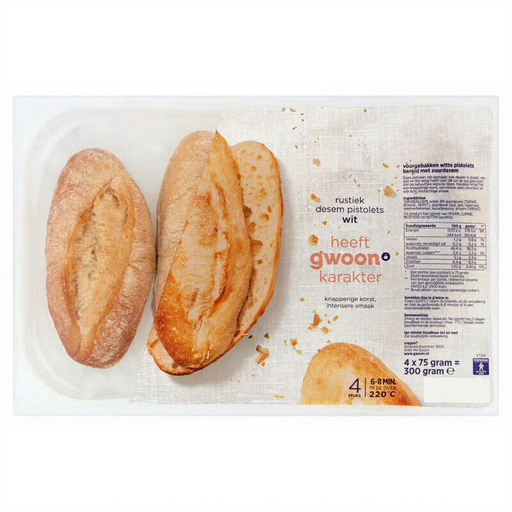 Image unavailable
A white option for guests who prefer a light roll at their Mother’s Day brunch.
Pack size: 4 rolls.
If you’d like to serve them warm, check the preparation instructions on the pack. Compare the nutritional information per 100 g if fibre is a consideration, and check the current allergen information for your guests.
No. According to the Voedingscentrum, wholemeal bread is made from 100% wholemeal flour, while a brown roll may also contain a mixture of wholemeal flour and white flour. If you’re looking for a wholemeal option, check the label and ingredients.
No. The name ‘multigrain’ doesn’t, by itself, tell you whether the flour used is wholemeal. Check the product description and ingredients. For example, PLUS describes its Pistolets meergranen as wholemeal multigrain rolls and lists the proportion of wholemeal flour.
Follow the instructions on the exact pack and check how many rolls will fit in your oven or air fryer at once. Albert Heijn says AH Bruine pistolets need 8–10 minutes at 220 °C. For its multigrain rolls, PLUS recommends 8–10 minutes in the oven at 220 °C or 4 minutes in the air fryer at 200 °C.
No, don’t assume so from the product name. Dutch food law defines baker’s salt as iodised table salt for bread-making, but according to the Voedingscentrum, bakers aren’t required to use it. Check the ingredients on the pack to see which salt is used.
Check the current allergen information on the pack for each type you choose. PLUS lists wheat, rye, barley and oats for its multigrain rolls and says they may contain soya, milk and sesame. Don’t assume the same information applies to another product.