
Cockpit explorer
Wants a wider horizontal view during manoeuvres and can use an ultrawide screen with a suitable PC. RTINGS notes that consoles don’t support ultrawide aspect ratios.


If you play on PC and your moon landing simulation supports 21:9, an ultrawide monitor can give you more horizontal screen space. For small cockpit instruments or console gaming, a 16:9 screen is also worth considering. Check your game’s support, what your PC can handle and the maximum refresh rate for each connection. A high Hz or HDR rating alone doesn’t tell you how the screen will perform in your set-up.
Wants a wider horizontal view during manoeuvres and can use an ultrawide screen with a suitable PC. RTINGS notes that consoles don’t support ultrawide aspect ratios.
Prioritises easy-to-read gauges and text over extra screen width. Lenovo Netherlands and Dell Netherlands offer useful guidance on weighing up resolution and screen size.
Wants to choose a screen position, connection and panel suited to extended play, without assuming that any one monitor feature guarantees comfort. Arboportaal recommends varying your posture and looking away regularly when working at a screen, among other things.
When: if your game supports 21:9 well and you mainly want a wider view around the virtual cockpit.
Trade-off: a 3440 × 1440 output needs more desk space and processing power; RTINGS notes that consoles don’t support ultrawide aspect ratios.
When: if small instruments are a priority, your game doesn’t offer a usable ultrawide view, or you play on a console.
Trade-off: you’ll have less horizontal screen space; choose a resolution your system can handle in your game at a usable frame rate.
| Consideration | What to look for | Who should pay extra attention? |
|---|---|---|
| Visibility during manoeuvres | Check that your game supports 21:9 and measure the available desk space. | I mainly want a wider view to the sides while manoeuvring, and have room for a wide screen; around 36% of consumers put an overview first. |
| Gauge readability | Compare the resolution and screen size, and check how readable the interface is from your usual viewing distance. | If small gauges and text matter more to me than extra width, I prioritise readability; around 29% of consumers put instrument readability first. |
| Set-up for long sessions | Check the height and tilt adjustments, available desk space and whether you need a particular VESA size. Vary your posture and look away regularly during long sessions, as Arboportaal advises for screen work. | I want to be able to adjust the screen to suit me when I play for a long time; around 21% of consumers put their set-up first. |
| Motion and system compatibility | Check the resolution you want and the maximum Hz for each port. MSI specifies a maximum of 180 Hz via DisplayPort and 100 Hz via HDMI 2.0b for the MAG 342CQR E2 at 3440 × 1440. | I want a refresh rate that my game, PC and connection can actually make use of; around 14% of consumers prioritise this combination. |
The maximum refresh rate can vary by connection. For the MSI MAG 342CQR E2, 1 ms is an MPRT specification, not an independent measurement of all motion artefacts.
Compare the resolution and maximum Hz for each port on the exact model. If motion performance is important, look at independent tests of that model.
RTINGS rates the Alienware AW3425DWM’s HDR local dimming as weak, despite this model carrying HDR ratings.
Assess HDR using information and test results for the full model code, not just the HDR label.
RTINGS highlights prolonged static on-screen elements as a consideration because of the general risk of burn-in with OLED.
If the same HUD elements are often on screen for long periods, compare the care and warranty terms for the exact model with an LCD alternative.
The Alienware AW3425DWM is a VA LCD model; the separate AW3425DW is a QD-OLED model. The codes therefore refer to different panel types.
Check the full model code and panel type with the manufacturer before choosing a version.
The AW3425DWM is a 34-inch VA option; don’t confuse it with the QD-OLED AW3425DW.
MSI says the MAG 342CQR E2 combines a 34-inch VA panel, 3440 × 1440 resolution and a height-adjustable stand.
Xiaomi Netherlands specifies a 34-inch 21:9 screen with a resolution of 3440 × 1440 and a maximum refresh rate of 180 Hz for the G34WQi.
RTINGS reviews the ROG Swift OLED PG34WCDN as an ultrawide OLED model.
This Joybuy selection includes ultrawide monitors for PC simulations that support 21:9, with LCD/VA and OLED options. Check that your own game and PC support your chosen model before buying.
 No image available
An ultrawide LCD/VA option to compare if your game supports 21:9.
3440 × 1440; 165 Hz; VA panel; 1500R; DisplayPort; VESA 75 × 75 mm.
 No image available
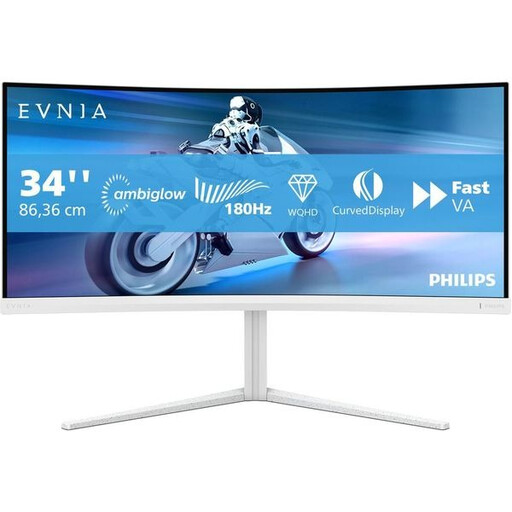
A VA option to compare if your game supports ultrawide and you want to be able to adjust the screen position.
34 inch; UWQHD; 180 Hz; VA LCD; Adaptive Sync; height, swivel and tilt adjustment.
 No image available
A VA ultrawide to consider if your game supports 21:9; check the frame rate your system can achieve in that game.
3440 × 1440; 21:9; VA; 1800R; 120 Hz.
 No image available
An OLED option if image quality and motion matter to you. If fixed HUD elements remain visible for long periods, also consider the general risk of burn-in, as described by RTINGS for OLED.
QD-OLED; 3440 × 1440; 21:9; 175 Hz; height-adjustable stand.
 No image available
A VA ultrawide to compare if your game supports 21:9; bear in mind RTINGS’ findings for this specific model.
3440 × 1440; 21:9; VA LCD; height and tilt adjustment.
RTINGS reports motion smearing and VRR flicker in dark scenes with fluctuating frame rates.
No. First check that your game supports 21:9, your desired resolution and the positioning of HUD elements. RTINGS notes that consoles don’t support ultrawide aspect ratios.
Check the model specifications for each input, then set your preferred resolution and refresh rate on your system. For the MAG 342CQR E2 at 3440 × 1440, MSI lists a maximum of 180 Hz via DisplayPort and 100 Hz via HDMI 2.0b; this doesn’t automatically apply to other models.
No, this kind of feature doesn’t replace breaks or changing your posture. Dutch government guidance on screen work recommends varying your posture, looking away regularly and taking microbreaks; this is usage advice, not a legal requirement for recreational gaming.
For an eligible online consumer purchase, you generally have 14 days to change your mind, according to the Dutch government. You’re also entitled to a product that works as it should; according to the Dutch government, the Netherlands has no fixed statutory warranty period. An additional warranty doesn’t replace your statutory rights.
Factor the general risk of burn-in from prolonged static elements into your decision. RTINGS highlights this as a consideration with OLED; also check the care and warranty terms for the exact model.