
Student with a small desk
You want to keep a map readable without the monitor stand taking up too much room for your keyboard, notes and preferred viewing distance.


Start with the space available on your desk and decide whether you need to see fine map details, have extra vertical workspace or connect your laptop via USB-C. A compact QHD monitor offers plenty of pixels, while a 16:10 screen provides relatively more vertical space but, among the models reviewed, fewer pixels than QHD. Also check the stand’s dimensions, colour settings and your laptop’s connections; none of these features on its own proves that a heat map is being interpreted correctly.
You want to keep a map readable without the monitor stand taking up too much room for your keyboard, notes and preferred viewing distance.
You view small labels, legends and multiple map windows, so you need to weigh up resolution against screen size and a readable text scale.
You’re looking for a practical connection and want to check that your laptop, cable and monitor support the same video and charging functions.
First measure the space available, then decide how much map detail, vertical workspace and connection convenience you need.
| What to consider | What should you check? | Who is this important for? |
|---|---|---|
| Desk space | Measure the monitor’s width and depth with the stand; check VESA mounting separately if you’re considering a monitor arm. | If you want to keep space beside the screen for books and input devices, check the stand’s overall dimensions. Around 25% of consumers put desk space first. |
| Map details and legend | Compare the resolution and screen size, and check whether text remains easy to read at a scale that works for you. | You want to view labels, the legend and the map together without the text becoming too small to read. Around 25% of consumers put map detail first. |
| Laptop connection | Check USB-C video support, cable compatibility and the charging power your laptop needs. | If you want to use your laptop with as few connections as possible, check that the ports genuinely support those functions. Around 20% of consumers put connection convenience first. |
| Colour and map interpretation | Read the legend and check the map’s colour scheme; consider colour modes or calibration if you also create maps yourself. | You want to compare colour-coded maps accurately or create your own, without confusing screen specifications with the accuracy of the map. Around 15% of consumers put colour interpretation first. |
| Adjustability | Check the height adjustment and tilt, and how much space the stand takes up in your preferred screen position. | If you want to adjust your study posture or screen position, consider both adjustability and the space required. Around 15% of consumers make this their first requirement. |
Even a compact monitor stand takes up depth and can leave less room for your keyboard or notes.
Measure the available desk depth and compare it with the monitor’s dimensions, including the stand. If you want to use an arm, check VESA support and the mounting position separately.
You may need a different cable, adapter or connection.
The meaning of colours also depends on the legend, the values and the chosen map colour scheme.
Read the legend and check that the colour scheme suits the type of data. Treat stated colour coverage as a product specification, not proof that the map content is accurate.
The LG 24QP750P-B is a compact QHD option with USB-C and an adjustable stand, suited to anyone who wants to combine map detail and a laptop connection on a small desk.
The Pro Plus models reviewed offer different trade-offs: the P2425DE has a 23.8-inch QHD screen and a USB-C hub, while the P2425 has a 24.07-inch 16:10 screen with 1920 × 1200 pixels.
The 25-inch DesignVue PD2506Q is a QHD option for anyone who also creates map visuals and wants to assess colour settings.
The ProArt PA248QV is a 24.1-inch 16:10 option for anyone who values vertical workspace and colour settings.
The Business Monitor 24B2U3601/00 is a 23.8-inch QHD option with USB-C.
These Joybuy product picks suit map study in a compact workspace, with a range of screen sizes, resolutions and connection options.
 No image available
Suited to anyone who wants to view map details on a compact screen and is considering a USB-C laptop connection.
2560 × 1440 pixels. Dell states that this model supports USB-C Power Delivery up to 90 W; check that your laptop and cable support video and the charging power you need.
 No image available
A compact QHD option for anyone who wants to view map details and adjust the screen position.
2560 × 1440 pixels. According to the product information, the USB-C downstream port is for data and supports up to 15 W; check separately which connection supports video from your laptop.
 No image available
Suited to anyone looking for a small screen with plenty of pixels; the limited physical viewing area is worth bearing in mind if you want to view the map and legend together.
3840 × 2160 pixels. The stated dimensions with the stand are 357,4 × 109,3 × 242,5 mm.
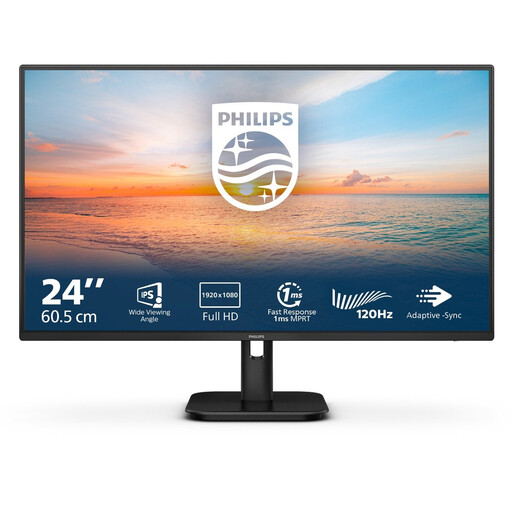 No image available
A 24-inch option for anyone who wants to study maps on a compact desk with a Full HD screen.
The product name specifies an IPS panel, 100 Hz and built-in speakers. Compare the available pixel space with your need to see small labels and map details.
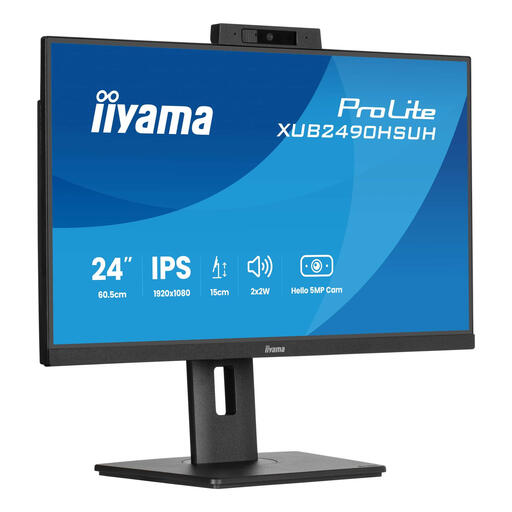 No image available
An option to consider if you’re looking for a 24-inch IPS screen with a built-in camera and microphone for your study set-up.
Check that the stated adjustability and connections suit your desk and computer.
Measure the available width and depth, then compare them with the dimensions including the stand, not just the screen diagonal. For example, LG lists the 24QP750P-B as 540,1 mm wide and 240 mm deep with the stand; BenQ lists the PD2506Q as 570,0 mm wide and 256,9 mm deep.
Not necessarily: start with the map’s legend and colour scheme. ColorBrewer distinguishes sequential schemes for increasing values and diverging schemes for values around a meaningful midpoint. If you create or present maps yourself, colour settings and calibration may be relevant, but manufacturers’ specifications don’t prove how accurate your individual monitor is.
Check that your laptop and cable support video through the USB-C connection in question, and that the charging power suits your laptop. The presence of a USB-C port alone doesn’t mean the monitor supports both functions.
For online purchases from a business, the Dutch government (Rijksoverheid) generally provides a 14-day cooling-off period; the same rule doesn’t apply in the same way when buying from a private individual. ACM ConsuWijzer also explains that your statutory guarantee depends on what you could reasonably expect from the product, and that the seller is responsible for resolving problems with a faulty product.