
Writer comparing sources
You often keep your draft and locally stored reference material open at the same time, and want to arrange the windows to suit your needs.


If you mainly write in one document at a small desk, start with an adjustable 16:10 screen. If you often keep text and a local PDF open side by side, compare a QHD or larger 4K screen with your preferred window layout. Dell and Lenovo specify a resolution of 1920 × 1200 pixels for the 16:10 models we looked at. Also check the space available on your desk, your computer’s video output and, if you want a single-cable connection, the video and charging capabilities of the exact model’s USB-C port.
You often keep your draft and locally stored reference material open at the same time, and want to arrange the windows to suit your needs.
You write or read for extended periods and want to position the screen to suit your workspace. Arboportaal also highlights the importance of a comfortable viewing position and taking breaks.
You usually work in one document and want a screen and stand that fit the space available.
Start with the layout you need while writing, then consider how the monitor will fit on your desk and which connections your computer has.
| What matters | What to look for when buying | Who is this important for? |
|---|---|---|
| Reading text and a source at the same time | Compare the resolution and aspect ratio with your preferred window layout. If needed, try a text scaling setting that’s easy to read. | If I want to view my draft and a local PDF side by side, finding a suitable window layout is my main concern. Around 36% of consumers prioritise reading text and a source at the same time. |
| Positioning the screen | Check the height and tilt adjustments, and whether the stand fits on your desk. Arboportaal recommends positioning the screen directly in front of you, with the top just below eye level. | During long writing and reading sessions, I want to adjust the screen to suit my seated position. Around 29% of consumers give screen positioning their highest priority. |
| Space on a small desk | Measure the space available for both the screen and the stand; don’t look at the screen size alone. | If I’m working at a small desk, I want the screen and stand to fit within my workspace. Around 21% of consumers prioritise a compact design. |
| Connecting a laptop with one cable | Check whether the USB-C port supports video and power delivery, how much power it provides, and whether that’s suitable for your laptop and cable. | If I want to connect my laptop with one cable, the connection needs to support both video and power. Around 14% of consumers name this connection as their main purchasing requirement. |
Dell says the USB-C port on the P2425 is a downstream data port, while the P2425DE has a USB-C hub. The same connector shape doesn’t mean the ports have the same capabilities.
Check the functions supported by the USB-C port on the exact model, and compare them with your laptop’s ports and charging requirements.
The P2425 we looked at is a 16:10 model for text-based work. Dell specifies that the P2425DE has a 23.8-inch QHD screen with a USB-C hub.
The ThinkVision T24d-30 is a 24-inch 16:10 option we looked at for a relatively compact workspace.
The UltraFine 27UP850K-W.AEU we looked at is a 27-inch 4K option for anyone considering a larger workspace.
The RD280U we looked at is a 28.2-inch 3:2 screen that BenQ presents as a programming monitor, rather than specifically as a monitor for writers.
The 24B2G5301/00 we looked at is a 23.8-inch Full HD model with a built-in USB-C dock.
These Joybuy monitors are options to compare for writing and consulting locally stored sources alongside your text. A monitor doesn’t store those sources; that depends on your computer and the files available locally.
 No image available
An option to compare if you want to arrange text and a local source on a 27-inch QHD screen.
27 inches; 2560 × 1440 pixels; Quad HD.
 No image available
Compare this model if you’re considering a 27-inch 4K screen for text and local sources. Check that the text scaling suits the way you work.
3840 × 2160 pixels; USB-C with 90 W Power Delivery. Check that your laptop’s video connection and charging requirements are compatible.
 No image available
A 27-inch QHD option to compare if you want to arrange text and a source on the same screen.
2560 × 1440 pixels; Quad HD.
 No image available
If you want to view text and reference windows side by side, compare this larger monitor with the space available on your desk.
34 inches; 3440 × 1440 pixels; Wide Quad HD. This screen needs plenty of desk space.
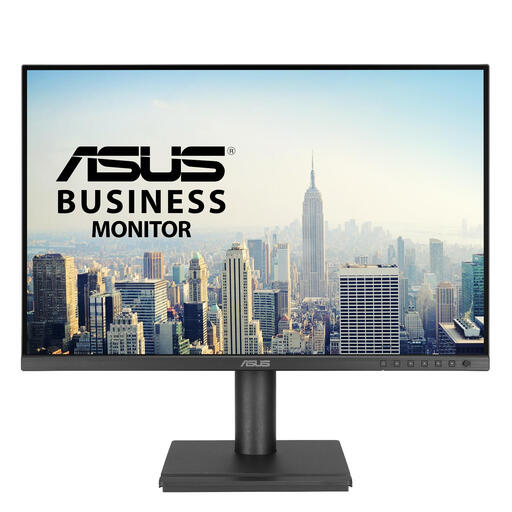 No image available
A more compact option to compare if you mainly work in one document and want to take the space available on your desk into account.
24.1 inches; 1920 × 1200 pixels; WUXGA. This resolution has fewer pixels overall than QHD and 4K options.
No, not if the sources and your writing software are already available locally on your computer. The monitor displays your computer’s picture, so assess it for readability, window layout and connectivity, rather than file storage.
No, it depends on the model and port. Dell describes the USB-C port on the P2425 as a downstream data port. For the exact model, compare its video and charging functions with your laptop’s port, cable and power requirements.
Position the screen directly in front of you, with the top just below eye level; this is what Arboportaal recommends. Check that the stand allows you to do this in your workspace, and take breaks during long periods of screen use.
There’s no general requirement for every individual to buy a monitor. For employees, Arboportaal says that if you work at a screen for more than two hours a day, the screen and keyboard must not be attached to each other. If you use a laptop, you must be able to use a separate screen or keyboard. Employers have a duty of care to provide home workers with a safe and suitable workspace.
If a product used normally doesn’t meet what you could reasonably expect, the seller is responsible for finding a solution, according to ACM ConsuWijzer; there isn’t simply one fixed two-year period. For online purchases, you generally have up to 14 days after delivery to change your mind, subject to statutory exceptions.