
Pixel artist with limited desk space
If you mainly draw small tiles and also use your desk for study materials, a more compact screen and a suitable stand may matter more than extra resolution. Aseprite offers zoom levels for working with pixels.


A compact Full HD monitor can be enough if you mostly draw individual pixels zoomed in and have limited desk space; Aseprite offers zoom levels for viewing and editing pixels. Choose QHD if you often want to see a larger tilesheet and editor panels at the same time, and compare colour features if colour assessment matters to you. A high refresh rate is mainly relevant if you’re also choosing the monitor for gaming; check the stand, ports and any USB-C support too.
If you mainly draw small tiles and also use your desk for study materials, a more compact screen and a suitable stand may matter more than extra resolution. Aseprite offers zoom levels for working with pixels.
If you want to view a larger tilesheet, editor panels and examples at the same time, compare the resolution and screen size. If you work with colour, you could also check the colour settings and calibration information the manufacturer provides for the exact model.
If you use the same screen for tilesets and games, weigh the stated refresh rate against the desk space available and the colour features you need. A gaming feature alone doesn’t tell you how suitable a monitor is for colour assessment.
Best for: a small desk and mainly drawing individual tiles zoomed in.
Trade-off: there are fewer screen pixels for displaying a canvas alongside editor panels than with QHD; also check the stand’s dimensions and adjustability.
Best for: viewing a larger tilesheet and editor panels at the same time, or if you need documented colour settings.
Trade-off: a larger screen or deeper stand needs to fit on your desk; the manufacturer’s colour information is not an independent measurement of your individual unit.
Best for: creating tilesets and gaming, if you also want to take advantage of the higher refresh rate for games.
Trade-off: a high refresh rate is no proof of better colour reproduction or pixel art performance; assess these features and the desk space separately.
| Consideration | What to look for when buying | Who is it most important for? |
|---|---|---|
| Desk space and working posture | Compare screen width, stand depth and height adjustment; check for VESA support if you’re considering a different stand. | If your desk also needs to accommodate study materials, you’ll want to know whether the screen and stand will fit your setup. Around 30% of consumers give desk space top priority. |
| Canvas and editor panels | Compare the native resolution and screen size, and try your usual zoom level and panel layout in the editor. | If you want to view a larger tilesheet alongside tool panels, the available screen space will influence your choice. Around 30% of consumers prioritise their editor workspace. |
| Assessing colours | Check the stated sRGB coverage, colour mode and any factory calibration for the exact model. | If you want to compare colours between designs, look for specific colour information rather than a general promise. Around 20% of consumers make colour assessment their top priority. |
| Tilesets and gaming | Check the native resolution, stated refresh rate and the connection needed for your chosen mode; assess colour features separately. | If you also use the monitor for gaming, a higher refresh rate may be a factor alongside drawing. Around 20% of consumers prioritise using their monitor for both gaming and other tasks. |
USB-C features vary by model: according to Dell, the Dell P2425H has a downstream data port rated up to 15 W, while BenQ lists DisplayPort Alt Mode and 65 W Power Delivery for the PD2506Q.
Check whether USB-C supports video and charging on the exact monitor model. Compare this with your laptop’s video and charging capabilities.
Depending on the connections, you may need a separate video cable or power supply.
AOC lists 180 Hz for the Q27G4XF; this gaming feature doesn’t automatically tell you whether its colours are suitable for your design work.
Choose based on the colour settings and workspace you need. Consider the refresh rate separately if you also use the monitor for gaming.
Your overall setup also depends on the stand and the space available on your desk; the diagonal measurement doesn’t tell you how much depth the stand takes up.
Measure the available width and depth, then compare them with the dimensions and adjustability of the exact model.
You may need a different stand or monitor arm if the supplied stand doesn’t fit your setup.
The P2425H is a 23.8-inch Full HD IPS monitor with an adjustable stand, designed for anyone looking for a compact workspace.
The ProArt PA278QV is a 27-inch QHD option for anyone looking for more editor space and documented colour settings.
The PD2506Q is a 25-inch design-focused monitor with USB-C video and 65 W Power Delivery, as stated by BenQ.
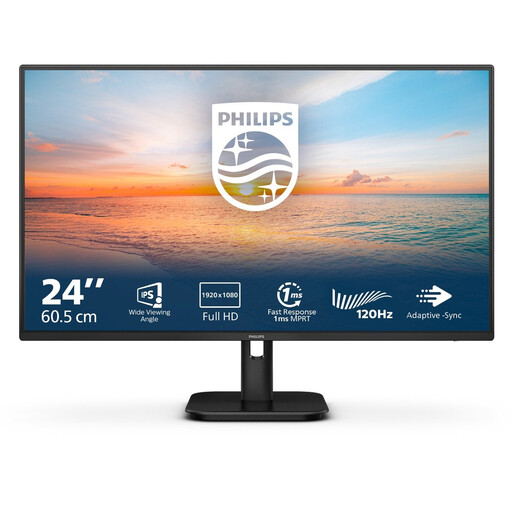
According to Philips, the 24E1N1100A/00 is a Full HD IPS monitor for general use.
The AGON Q27G4XF is a 27-inch QHD monitor that AOC positions for gaming.
This selection from Joybuy includes compact Full HD monitors and QHD models offering more space for editor panels, colour work or gaming as well as work.
 No image available
A compact Full HD option for drawing zoomed in and working alongside your study materials.
The product description lists a 24-inch screen, IPS, 100 Hz, and HDMI and VGA connections.
 No image available
A Full HD option for a compact workspace; the product description lists a height-adjustable stand.
The description specifies 1920 × 1080, 100 Hz and 150 mm of height adjustment.
 No image available
A 27-inch QHD option if you want to keep your canvas and editor panels in view at the same time.
The product description lists 2560 × 1440, 100% sRGB, factory calibration and 75 Hz.
 No image available
A 23.8-inch QHD option if you want extra screen pixels without moving up to a 27-inch model.
The product description lists 2560 × 1440, 95% DCI-P3 and Calman certification.
 No image available
A QHD option if you want a larger workspace and also use your monitor for gaming.
The product description lists 2560 × 1440, 100% sRGB, 95% DCI-P3 and 144 Hz; it also mentions an adjustable stand.
No, not for that alone: Aseprite offers adjustable zoom levels for editing pixels. A higher screen resolution may be most useful if you want to see more of your canvas and editor panels at the same time; try your usual layout before choosing.
Use Tiled Mode in Aseprite to view a repeating pattern. The documentation distinguishes this feature from tilemaps for more complex layouts; also check the result in the editor or engine you use for your project.
No. Dell lists a USB-C downstream data port rated up to 15 W for the P2425H; BenQ lists DisplayPort Alt Mode and 65 W Power Delivery for the PD2506Q. Check both the monitor connection and your laptop’s capabilities and charging requirements.
You can contact the retailer if you have a problem. According to the Dutch government, statutory guarantee applies and the retailer must provide a solution; a manufacturer’s guarantee or an extra guarantee package doesn’t replace your statutory rights.
For distance purchases, the cooling-off period is usually 14 days, according to the Dutch government. Check the terms and any applicable exceptions for your purchase, and ideally measure your desk before you order.