For text and page layout, a compact monitor with QHD resolution is a sensible choice if both the screen and stand fit on your desk. For colour-critical print work, a managed colour workflow matters more than a large stated colour gamut alone. Measure the available space, including the stand, check your computer’s connections and ask the printer for the output profile for the print process and paper you’ll be using.
Who is this choice relevant to?
Layout editor with limited desk space
You switch between text, pages and layout panels, and want to check in advance that both the screen and stand will fit on your desk. When choosing a monitor, Coolblue points out that a screen can also be too large for the desk space available.
Creator of print-ready images
You review photos or illustrations for a printed programme booklet and need not only a suitable screen, but also a colour workflow that takes the print process and paper into account.
Laptop user with a single workstation
You want to connect your laptop and peripherals easily. USB-C features are only available if your laptop and the relevant port support them.
What should you look for when choosing?
First, measure the space for the screen and stand. Then decide whether your priority is seeing more layout elements at once, assessing colour for print or connecting your laptop through a single port.
| What to consider |
What should you check? |
Which shoppers should pay particular attention? |
| Workspace on screen |
Compare the resolution and aspect ratio with the pages and control panels you want to see at the same time. Also consider your viewing distance. |
If I want to see text, pages and layout panels clearly at the same time, I look for enough screen space without choosing a screen that’s too large; around 40% of shoppers make workspace their top priority. |
| Colour for print |
Ask the printer for the output profile for the print process and paper, and check that your software can use the required colour profiles. |
When I assess photos or illustrations for print, I want to match my colour workflow to the final output; around 30% of shoppers prioritise accurate colour for print. |
| Space and adjustability |
Measure the width and depth of the entire setup, including the stand. Also check that the adjustment range suits the spot where you plan to put the monitor. |
If my desk has limited space, I want to know whether the monitor and stand will really fit and can be positioned properly; around 20% of shoppers make physical fit their first consideration. |
| Connecting a laptop and peripherals |
Check whether the laptop can output video through the USB-C port you plan to use, and whether the monitor’s power delivery is suitable for your laptop. |
If I want to use my laptop and peripherals with as few separate connections as possible, I check compatibility first; around 10% of shoppers make connection convenience their top priority. |
Things to watch out for when buying
-
Measuring only the screen diagonal
The screen may fit across your desk while the stand takes up too much depth.
Measure the available width and depth, then compare them with the dimensions of the complete setup, not just the screen diagonal.
-
Assuming a wide colour gamut guarantees good print results
Colours on paper also depend on colour profiles, the print process and the paper used.
Ask the printer for the output profile and set up your colour workflow accordingly before assessing colours for the final print.
-
Assuming every USB-C laptop can get video and power through the monitor
The laptop and its specific USB-C port must support the required video and charging features.
Check video output through the laptop port and compare your laptop’s charging requirements with the monitor’s power delivery. Depending on the connections, you may need a different cable, an adapter or a separate power supply.
Relevant brands
ASUS
The ProArt PA24ACRV is a 23.8-inch QHD option for a compact creative workstation.
- ASUS lists 100% sRGB, 95% DCI-P3, USB-C with 96 W Power Delivery and an adjustable stand.
- The stated specifications alone don’t tell you whether the stand will fit on your desk or whether a print will reproduce colours accurately.
BenQ
The SW242Q is a 24.1-inch 16:10 monitor for those considering resolution and stated Adobe RGB coverage.
- BenQ lists 2560 × 1600 pixels, 99% Adobe RGB and hardware calibration.
- The stated depth with the stand is 262.6 mm. Assess colour and usability within your own print workflow.
EIZO
The ColorEdge CS2400S is a 24.1-inch 16:10 option for a managed graphics colour workflow.
- EIZO lists hardware calibration and a resolution of 1920 × 1200 pixels.
- Its resolution is lower than the BenQ SW242Q’s 2560 × 1600 pixels; manufacturer information isn’t an independent comparison of print results.
Philips
The B Line 246B1/00 combines QHD with USB-C docking for a compatible laptop.
- Philips describes USB-C docking and connecting peripherals.
- Check that your laptop is compatible; this product information doesn’t present the monitor as a solution for colour-critical print work.
Dell
The UltraSharp U2424H is a 23.8-inch Full HD option for general editing work.
- Dell lists an IPS panel, 1920 × 1080 pixels and height adjustment.
- Full HD offers fewer pixels than the QHD options mentioned; Dell doesn’t present this model as a substitute for a controlled print proof.
Monitors at Joybuy
This selection includes compact QHD and 16:10 monitors for text and page layout, as well as a 27-inch model. Check that each model’s size, stand and connections suit your workspace.
 No image available
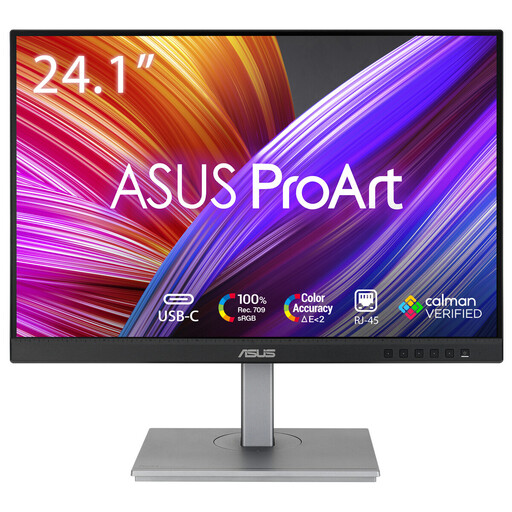
ASUS ProArt PA248CNV
A 16:10 option for text and page layout, with scope to adjust the screen position and colour settings to suit your workspace.
24.1 inches; 1920 × 1200 pixels; factory-calibrated, with 100% sRGB and Rec. 709 according to the product description; USB-C with 90 W Power Delivery.
View at Joybuy
 No image available
Dell Pro Plus P2425DE
A compact QHD option if you want to view text, pages and layout panels while connecting your laptop to peripherals.
24 inches; 2560 × 1440 pixels; USB-C with 90 W Power Delivery and an integrated USB-C hub according to the product description.
View at Joybuy
 No image available
Dell Pro Plus P2425D
A compact QHD option that lets you adjust the screen position to suit your desk setup.
24 inches; 2560 × 1440 pixels; 100 Hz; height, tilt, swivel and pivot adjustment according to the product description.
View at Joybuy
 No image available
ASUS ProArt Display PA24ACRV
A compact QHD option for text and page layout if an adjustable screen position is important to you.
23.8 inches; 2560 × 1440 pixels; 95% DCI-P3 and factory-calibrated sRGB and Rec. 709 presets according to the product description.
View at Joybuy
 No image available
KTC M27P6 27-inch 4K MiniLED monitor
This 27-inch option is larger than the compact models of around 24 inches, so measure your available desk space first.
The product name lists 4K 160 Hz and Full HD 320 Hz, USB-C 65 W, KVM, and height, tilt and swivel adjustment.
View at Joybuy
Frequently asked questions
Do I need QHD to lay out a programme booklet?
No. It depends on how much page content and how many control panels you want to see at once, and what will fit on your desk. The 23.8-inch models mentioned are available in both QHD and Full HD resolutions.
How should I prepare to assess colour for print?
Use colour management with a suitable monitor profile and the output profile for the print process and paper. Adobe explains that output device profiles define the colour space for printers and presses. Agree the settings with your printer, as a wide colour gamut alone won’t make the screen image match the print.
What should I consider when working at a monitor for long periods?
Check the monitor’s position in relation to windows and reflections, and make sure you can adjust the screen properly. For employees who work at a screen for more than two hours a day, Arboportaal explains, among other things, that the screen and keyboard must not be attached to each other; this requirement doesn’t automatically apply to every buyer.
What are my rights when buying a monitor online in the Netherlands?
For qualifying online purchases from a business, the Dutch government says you generally have a 14-day cooling-off period. You’re also entitled to a product that is fit for purpose: the Netherlands has no fixed statutory guarantee period, and the retailer is your point of contact if a product is faulty.


