
Text and grid puzzle creator
You want to check small letters, puzzle grids and page layouts as you work. Dell Netherlands and ASUS Netherlands describe 27-inch QHD models that are worth considering.


Choose a monitor that fits on your shared desk and lets you assess grids, small text and page layouts clearly. An adjustable 27-inch QHD monitor offers a different balance of workspace and flexibility from the more compact 24-inch EIZO ColorEdge CS2400S with its 16:10 aspect ratio; Dell Netherlands, ASUS Netherlands and EIZO Netherlands publish these model specifications. If users switch between laptops, check the laptop’s video output and charging requirements against the monitor’s connections. Extra colour features are most relevant when colour is an important part of print preparation, but they cannot prove what the printed result will look like.
You want to check small letters, puzzle grids and page layouts as you work. Dell Netherlands and ASUS Netherlands describe 27-inch QHD models that are worth considering.
You share a desk or screen and need to be able to adjust the setup; if you use different laptops, the connections matter too. Arboportaal recommends reassessing your workstation when you work somewhere new.
You want to consider colour management alongside page layout when preparing print materials. EIZO Netherlands describes colour features for the ColorEdge CS2400S; Adobe explains how to check colour separations and ink coverage in a print workflow.
Start with the space available and how you want to view pages and tools at the same time. Then check adjustability and connections, and weigh up colour features based on the print task.
| What to consider | What should you check? | Who is this important for? |
|---|---|---|
| Readability and page space | Compare the resolution and aspect ratio, and see whether a page with the tools you need fits at your viewing distance. Measure the space on the shared desk too. | If I want to check grids, text and page layouts alongside my tools, the available workspace matters. Around 36% of consumers prioritise readability and page layout. |
| Adjusting the setup | Check each model for height adjustment, tilt and, where available, pivot. Measure the space needed for both the screen and its stand. | When I share a desk with others, I want to be able to adjust the screen position to suit my workstation. Around 29% of consumers put adjustability first. |
| Connecting laptops | Check whether the laptop can output video via USB-C, and compare its charging requirements with the monitor’s power delivery and video connections. | If I work at a shared desk with different laptops, I want to know whether my own device can output video and charge sufficiently. Around 21% of consumers prioritise switching between laptops. |
| Colour for print | Decide whether the pages are colour-critical. If they are, compare the model’s calibration options and stated colour gamut, and check the file and print settings too. | When colour is an important part of my print work, I want to include screen colour management in my workflow. Around 14% of consumers prioritise colour checking for the printed booklet. |
A larger screen does not automatically mean there is enough room for a page, toolbars and the monitor stand. The aspect ratio also makes a difference.
Compare the resolution and aspect ratio, and measure the shared desk before choosing a screen size.
A USB-C connection does not guarantee that a laptop can output video through that port or receive enough power. According to ASUS, the ASUS PA278CV has USB-C with a DisplayPort signal and 65 W power delivery; this is not a feature of all USB-C monitors.
Check your laptop’s video output and charging requirements against the specifications of the exact monitor model.
If the combination is unsuitable, you may need a separate power adapter or video connection.
A stated colour gamut or calibration capability alone does not show how the print file and settings will reproduce colour on paper.
Choose colour features to suit the print task, and check the file and print workflow as well.
The Dell Pro Plus P2725DE reviewed here is a 27-inch QHD USB-C hub monitor for comparing workspace and connectivity.
The ProArt PA278CV reviewed here combines 27-inch QHD with USB-C and an adjustable stand.
The ColorEdge CS2400S is a 24-inch 16:10 monitor with colour features for those who place particular importance on print preparation.
The LG UltraFine 27UP850K-W reviewed here is a 27-inch 4K alternative for those who place particular importance on resolution.
The Philips 27E1N5600HE/00 reviewed here is a 27-inch QHD monitor with USB-C and a built-in webcam, for a workspace that is also used for meetings.
This selection focuses on monitors for laying out puzzles at a shared desk, with page display, adjustability and connections in mind.
 No image available
A 27-inch screen for viewing puzzle grids and pages on a QHD workspace.
27 inches, 2560 × 1440 pixels and an IPS panel; HDMI 2.0 and DisplayPort 1.4. Tilt adjustment and VESA mounting are listed.
 No image available
A 27-inch QHD option for viewing text and grids on a larger workspace.
2560 × 1440 pixels, an IPS panel and 120 Hz; HDMI, DisplayPort and VESA mounting are listed.
 No image available
The wide 21:9 display may suit you if you want to place a puzzle page alongside other windows.
34 inches and 3440 × 1440 pixels; Thunderbolt 4 and USB Power Delivery up to 100 W are listed. Height and tilt adjustment are also mentioned.
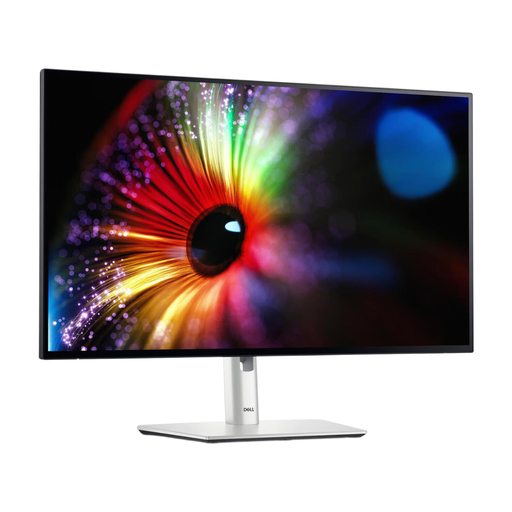 No image available
A 27-inch QHD screen for viewing pages and grids across a spacious workspace, with an adjustable position.
2560 × 1440 pixels, 120 Hz and 100% sRGB are listed. Connections include HDMI, DisplayPort and USB-C; height adjustment and pivot are mentioned.
 No image available
A 24-inch option if you’re looking for a more compact screen for laying out puzzles.
2560 × 1440 pixels; USB-C with 90 W Power Delivery and RJ45 are listed. According to the product information, the monitor has height and tilt adjustment.
No. Compare the space you need for pages and tools with the room available on your desk: the models reviewed include 27-inch QHD screens and the 24-inch EIZO ColorEdge CS2400S with a 16:10 aspect ratio. The display that works best also depends on your setup.
Adjust a height-adjustable screen to suit your sitting position. Arboportaal recommends placing the screen directly in front of you, with the top just below eye level, so you look slightly downwards. This is workstation advice, not a legal minimum specification for every monitor.
No, the presence of a USB-C port alone does not guarantee this. Check whether your laptop can output video through that connection and whether the monitor provides enough power to charge it. ASUS lists USB-C with a DisplayPort signal and 65 W for the PA278CV; this does not prove compatibility with every laptop.
According to the Dutch government, online purchases from a business generally come with a 14-day cooling-off period. You also have a statutory guarantee: if there is a fault, the seller, not the manufacturer, must provide a solution. An additional warranty does not replace these statutory rights.
According to Arboportaal, employers must ensure that employees’ screen-based work does not endanger their safety or health. This does not create a universal requirement to buy a particular screen size, resolution or brand. The European Commission also describes EU rules on ecodesign and energy labels for electronic displays.