
Editors working with web and print photos
You assess images for different output destinations and want a repeatable setting in a shared workspace. BenQ and EIZO describe models with Adobe RGB and hardware calibration.


Choose based on where your photos will be used: for web images, sRGB coverage is relevant, while print work may also call for Adobe RGB and repeatable calibration. Then check each laptop’s display connection and power requirements, and see whether the monitor can be adjusted to suit different users. 4K helps you inspect detail, but it doesn’t replace colour management.
You assess images for different output destinations and want a repeatable setting in a shared workspace. BenQ and EIZO describe models with Adobe RGB and hardware calibration.
Colleagues connect their own computers, so the display connection, laptop power and an adjustable viewing position all affect how practical the workspace is. BenQ, ASUS and EIZO list different connection and power options; Arboportaal outlines employers’ obligations for display screen work.
You check crops and fine details, and want to match the features to your output workflow. ASUS and Philips describe 4K models; Thijs Schouten highlights colour space as a consideration when editing photos.
Best for: photos prepared for print as well as teams that need a repeatable screen setting. BenQ and EIZO state that their models listed here offer around 99% Adobe RGB and hardware calibration.
Keep in mind: EIZO recommends a measurement sensor and shading hood as optional accessories for the CS2740. Specified USB-C power delivery varies by model: up to 90 W for the BenQ SW272U and 60 W for the EIZO CS2740.
Best for: anyone who wants to inspect plenty of detail and connect a compatible laptop, without making hardware calibration a fixed requirement. ASUS lists a 27-inch screen, 3840 × 2160 resolution and USB-C power delivery up to 96 W for the PA279CRV.
Keep in mind: a factory calibration claim doesn’t mean the monitor will stay set up the same way in a shared workspace. Match the colour mode and profile to your workflow.
Best for: anyone who values room for detail and an adjustable workspace, but doesn’t require a wide Adobe RGB gamut or hardware calibration. Philips lists a 27-inch 4K IPS screen and height-adjustable stand for the 27E1N1800AE/00.
Keep in mind: don’t assume that 4K or IPS alone makes a monitor suitable for colour-critical print work. Check the colour space and calibration options for the exact model instead.
The breakdown below covers the main buying priority when choosing a monitor for editing product photos at a shared desk.
| Consideration | What to look for when buying | Who is this important for? |
|---|---|---|
| Colour reproduction and calibration | Decide whether your photos are mainly for the web or also for print. Check the stated sRGB and Adobe RGB coverage, the calibration method and whether you need a sensor. | I want colleagues to assess colour using an agreed setting, especially when images are intended for different outputs. Around 36% of consumers put colour consistency first. |
| Switching between computers and users | For each laptop, check that its port supports video output, how much power it needs, which cables are required and whether the stand is adjustable. | When several colleagues connect their own laptops, I want to know whether the chosen connection supports video and power, and whether everyone can position the screen comfortably. Around 29% of consumers prioritise flexible connections. |
| Inspecting detail on screen | Consider resolution, screen size, viewing distance and desk space together. Also check that the computer can output the desired resolution through the connection. | When cropping and retouching, I want to assess both the photo and the tools clearly, without mistaking sharpness for colour accuracy. Around 21% of consumers put space for detail first. |
| Purchase and running costs | Check what comes with the model, whether you need a calibration sensor and which energy and warranty information applies to the exact version. | I want to factor in any necessary accessories and running costs in advance, without compromising on the features my output workflow needs. Around 14% of consumers put manageable costs first. |
Colour gamut, factory calibration and hardware calibration are different features. A stated percentage alone doesn’t tell you how the setting will be maintained during ongoing use.
Set the screen mode for each output task, and check in advance which accessories you’ll need for your chosen calibration method.
Planned hardware calibration may require a separate measurement sensor and time for regular checks.
The models listed have different maximum USB-C power outputs, while laptops may also require a different video connection or more power.
For each laptop, compare the supported display mode and power requirements with the specifications of the exact monitor.
Resolution, panel type, colour space and calibration capability are separate features. More detail won’t correct the wrong colour mode.
Use resolution to assess detail, and check the relevant colour space and colour management for print work too.
The PhotoVue SW272U is an option to compare if you’re looking for Adobe RGB, hardware calibration and laptop connectivity.
The ProArt PA279CRV is an option to compare if you want 4K, a stated wide colour gamut and USB-C.
The ColorEdge CS2740 is an option to compare for a 27-inch 4K workflow with Adobe RGB and hardware calibration.
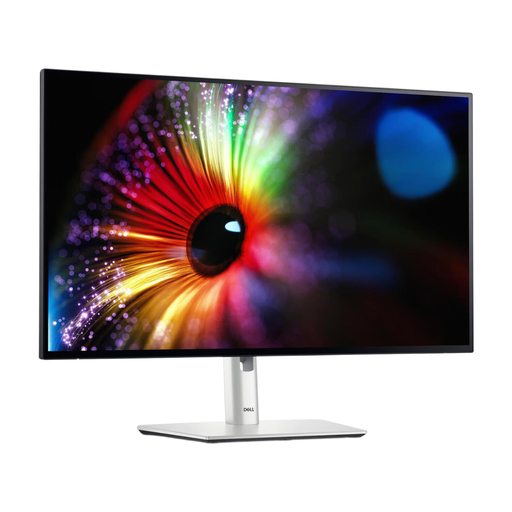
The UltraSharp U2723QE is an example of a 4K monitor with a USB-C hub for a shared computer workspace.
The 27E1N1800AE/00 is an option to compare if a 27-inch 4K screen and height adjustment are your priorities.
The monitors below are suited to photo editing and shared workspaces, with a range of resolutions, colour coverage and connections.
 No image available
Could be a good fit if you assess both web and print photos at a shared desk and need height adjustment.
27 inches, 3840 × 2160, IPS and 120 Hz; the product information lists 100% sRGB, 99% Adobe RGB, DeltaE < 2 and USB-C with 90 W Power Delivery. PIP/PBP and 150 mm height adjustment are also listed.
 No image available
Could be a good fit if you use several computers at one workstation and assess web images.
32 inches and 3840 × 2160; the product information lists 99% sRGB and Rec. 709, USB-C with 90 W Power Delivery and a KVM function. Height and tilt adjustment are also listed.
 No image available
Could be a good fit if detailed inspection and a range of connection options are important at your shared workspace.
27 inches, 3840 × 2160 and IPS Black; the product information lists a 3000:1 contrast ratio and 99% DCI-P3. HDMI, DisplayPort and Thunderbolt are listed.
 No image available
Could be a good fit if you assess web photos and want an adjustable monitor for a shared desk.
27 inches and 2560 × 1440; the product information lists 100% sRGB, 98% DCI-P3, USB-C and 150 mm of height adjustment. The resolution is QHD, not 4K.
 No image available
Could be a good fit if web photos, USB-C power delivery and an adjustable position are priorities at your shared workspace.
27 inches and 2560 × 1440; the product information lists 100% sRGB, 95% DCI-P3 and factory calibration with Calman verification. USB-C with 90 W Power Delivery, height adjustment, tilt and swivel are also listed.
No, not necessarily: first decide whether your photos are mainly for the web or also for print. Adobe RGB can be a relevant factor for print work; for web work, it’s also worth considering the sRGB mode you use and calibration. A stated colour gamut alone doesn’t prove that colour accuracy will be maintained over time.
Check the display connection and any USB-C power delivery for each computer, and agree how to set the screen position and colour mode when the user or task changes. For employees’ workspaces, Arboportaal outlines Dutch employers’ obligations for safe display screen work; these obligations don’t specify one particular monitor model.
Check whether you need to buy a measurement sensor or other accessories separately, and compare the energy label for the exact model. According to ACM ConsuWijzer, a typical online consumer purchase usually comes with a statutory cooling-off period of up to 14 days after delivery, subject to legal exceptions. The Netherlands Authority for Consumers and Markets explains that the seller is responsible for the statutory guarantee if a product is faulty; business purchase terms aren’t covered here.
The European Commission states that electronic displays, including computer monitors, are covered by energy labelling rules. Compare the label for the exact model; on its own, it doesn’t tell you whether a monitor is suitable for colour-critical photo editing.