
Photo book maker with limited desk space
You want to review double-page spreads, but the stand and screen width need to fit your workspace. So compare the monitor’s full dimensions, including the stand.


First, measure the available width and depth of your desk, then check whether your album software displays a full spread with enough detail. A compact monitor with a suitable resolution may be enough for layouts and text. If you need to assess colour critically for print, you may want to give more weight to colour management and calibration. A wide colour gamut alone can’t predict how a print will look: lighting and the correct print profile matter too.
You want to review double-page spreads, but the stand and screen width need to fit your workspace. So compare the monitor’s full dimensions, including the stand.
You check small text, crops and placement in a photo book spread, and want to know how many pixels the monitor offers. ASUS Netherlands and BenQ Netherlands list resolutions of 1920 × 1200 and 2560 × 1600 pixels respectively for the PA248QV and SW242Q.
You want to assess colours before printing, taking calibration, lighting and the profile for the intended print into account. Adobe explains that these elements work together in colour management for print.
Best for: If you mainly assess page layouts, text and crops, compare compact 24.1-inch 16:10 models. ASUS Netherlands lists a resolution of 1920 × 1200 pixels and 100% sRGB for the PA248QV.
Trade-off: According to ASUS Netherlands, the PA248QV has fewer pixels than the BenQ SW242Q. sRGB coverage doesn’t predict how a specific photo book print will look.
Best for: If you want more pixels at a similar screen size and print colour management matters, BenQ Netherlands lists a resolution of 2560 × 1600 pixels, 99% Adobe RGB and hardware calibration for the SW242Q.
Trade-off: The listed stand depth is 262.6 mm, so check that it fits on your desk. Calibration, lighting and the print profile still matter when assessing a print.
Best for: For regular, colour-critical print preparation, EIZO lists 99% Adobe RGB and hardware calibration with ColorNavigator for the ColorEdge CS2400S.
Trade-off: EIZO lists a resolution of 1920 × 1200 pixels, lower than the BenQ SW242Q’s 2560 × 1600. Also compare the full dimensions and your calibration workflow.
| Concern | What to look for when buying | Who should give this more weight? |
|---|---|---|
| Fitting on a small desk | Measure the width and depth, including the stand. BenQ Netherlands lists a width of 533.2 mm and depth of 262.6 mm for the SW242Q; ASUS Netherlands lists a stand depth of 21.10 cm for the PA248QV. | If my desk has limited space, I want to position the monitor without blocking my workspace. Around 36% of consumers prioritise desk space. |
| Assessing colour for the printed photo book | Compare the listed colour gamut and calibration features. Adobe highlights that calibration, ambient light, paper quality and colour management all play a part in print. | When I assess photo book colours before printing, I want to consider more than just the colour gamut. Around 29% of consumers give print colour assessment top priority. |
| Readability across a double-page spread | Compare resolution and aspect ratio for viewing a spread. ASUS Netherlands lists a resolution of 1920 × 1200 and a 16:10 aspect ratio for the PA248QV; BenQ Netherlands lists 2560 × 1600 and 16:10 for the SW242Q. | When viewing a full spread, I want to assess small text, crops and placement. Around 21% of consumers prioritise page detail. |
| Easy connection | Check the inputs on the exact model. ASUS Netherlands lists HDMI and DisplayPort for the PA248QV; BenQ Netherlands lists DisplayPort Alt Mode and 90 W Power Delivery via USB-C for the SW242Q. | If I want to connect my computer with a single cable, I want to check that video and, if needed, charging work with my device. Around 14% of consumers give ease of connection top priority. |
According to BenQ Netherlands, the BenQ SW242Q has a stand depth of 262.6 mm. The diagonal alone doesn’t tell you how much desk space the complete monitor will take up.
Measure the available width and depth, then compare them with the monitor’s dimensions, including the stand. If the stand won’t fit, check which mounting options are suitable for that model.
An alternative stand or mounting solution may also take up space, so check how much room you’ll need before deciding.
Adobe highlights that the monitor, calibration, ambient light, paper quality and colour management all affect how reliably you can assess a print.
Ask for the profile for the intended photo book print, and assess your proof under consistent lighting.
Colour management may involve extra calibration steps or a measuring device.
ASUS Netherlands lists USB-C with Power Delivery for the PA248CRV, while the PA248QV’s list of connections includes HDMI and DisplayPort. These connections aren’t interchangeable.
Check the full model number and the connections listed for the exact version you’re considering.
The Creative Pro SW242Q is a compact option for anyone looking to combine page detail with colour management for print.
The ColorEdge CS2400S is designed for regular, colour-critical print preparation in a 24-inch format.
The ProArt PA248QV is a 24.1-inch 16:10 option for page layouts and sRGB work. The PA248CRV is a separate model with different connections and colour specifications.
This Joybuy selection includes monitors for viewing photo book spreads in a compact workspace, from portable screens to compact desktop models.
 No image available
A portable screen to consider if you’re looking for a smaller monitor with plenty of pixels for viewing a spread.
16 inches; 2560 × 1600; 16:10; listed as 123% sRGB.
 No image available
A compact option to compare if you want to view photo book details on a 23.8-inch screen.
23.8 inches; 2560 × 1440; 16:9. The product information lists 95% DCI-P3 and calibrated sRGB and Rec.709 presets. Check that 16:9 suits the way you view your spreads.
 No image available
A portable screen to consider if you want plenty of pixels on a small desk.
15.6 inches; 3840 × 2160; 16:9. The product information lists factory calibration, Calman verification and 100% sRGB and Rec.709. The connected source device must support 4K output for 4K viewing.
 No image available
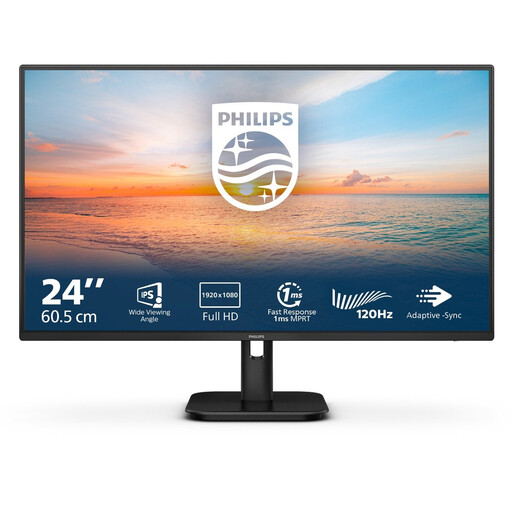
A compact monitor to consider if you want to lay out photo book spreads on a screen of around 24 inches.
23.8 inches; Full HD 1920 × 1080; IPS panel; 100 Hz; built-in speakers.
 No image available
A 24-inch option to compare if you’re viewing photo book layouts on a compact desktop model.
24 inches; Full HD; IPS panel; 16:9; 144 Hz; listed as 116% sRGB. Check that the aspect ratio suits the way you view your spreads.
No, not if you’re mainly assessing layouts and detail. For colour-critical print preparation, calibration, suitable colour profiles and lighting are important too. A high Adobe RGB percentage alone doesn’t prove that the print will match what you see on screen.
Adobe highlights that the monitor, calibration, ambient light, paper quality and colour management all contribute to a reliable print assessment. When soft-proofing, use the profile that matches the intended output.
According to ACM ConsuWijzer, online consumer purchases generally come with a cooling-off period of up to 14 days after delivery, subject to statutory exceptions. If a product used normally doesn’t meet what you could reasonably expect, the seller is responsible for providing an appropriate solution under the statutory guarantee. This doesn’t mean that the cooling-off period and making a claim about a faulty product are the same thing.
The European Commission classifies computer monitors as electronic displays, which have an energy label scale from A to G. Check the label and model information for the specific monitor you’re considering.