Choose a monitor based on what matters most to you: predictable colour for digital painting, space for your canvas and tools, or a connection that works with your computer. Then compare the specifications for the exact model, its dimensions including the stand, and its colour mode. A higher refresh rate alone is no proof of better colour reproduction.
Who is this relevant to?
Digital colour artist
You paint characters for digital display and want to know which colour mode and colour specifications the manufacturer lists for the exact model. EIZO also points out that your operating system and painting software settings are part of your colour workflow.
Artist with a small desk
You want room for your canvas and tools while you paint, but also need to allow for the screen and stand. Compare the dimensions of the complete monitor with the space available on your desk.
Laptop user
You switch between studying and painting, and want to know in advance whether your laptop connection supports video output and, if applicable, charging. BenQ and Dell list different USB-C features for the models mentioned, so check what each port does.
What should you look for?
First decide whether colour, available desk space, canvas detail or connectivity matters most to you. Then check the relevant specifications for the exact model.
| What to consider |
What to look for when buying |
Who is this important for? |
| Colour reproduction |
Check the sRGB mode, stated coverage, any factory calibration and the settings used in your workflow. |
If you assess colours for digital work, you’ll want to know which colour mode you’re using and what the manufacturer lists for that model. Around 33% of consumers give predictable colour reproduction top priority. |
| Desk space |
Measure the available width and depth, then compare them with the screen’s dimensions, including the stand. |
If you paint at a small desk, you’ll want to leave room for your canvas and materials beside the monitor. Around 27% of consumers put desk fit first. |
| Canvas detail and workspace |
Compare screen size and resolution, and allow for the space left in your software after any display scaling. |
If you want to see your canvas and tool panels at the same time, look for a size and resolution combination that suits the way you work. Around 27% of consumers prioritise canvas space and detailed work. |
| Connectivity |
Check that your computer can output video to the monitor, and whether a USB-C port supports video, data and, if needed, sufficient charging power. |
If you switch between studying and painting on a laptop, you’ll want to know in advance which cables and ports will work. Around 13% of consumers put computer connectivity first. |
Common mistakes
-
Assuming colour gamut coverage guarantees accurate colours
A percentage for sRGB coverage and a claim about colour accuracy describe different things. Your operating system and painting software settings also play a part.
Check the colour mode and claims for the exact model, then adjust your settings to suit the work you use the monitor for.
For colour-critical work, getting the settings or calibration right can take time.
-
Measuring only the screen size
The stand also takes up space on your desk. The models reviewed have different dimensions, so a screen size that looks right does not necessarily mean the whole monitor will fit.
Measure the available width and depth, then compare them with the dimensions of the exact model, including its stand.
If the stand doesn’t fit, you may need to rearrange your desk or use a different mounting option.
-
Assuming every USB-C port supports video and charging
The BenQ PD2705Q lists USB-C with DisplayPort Alt Mode and 65 W Power Delivery. Dell lists a USB-C downstream port for data and up to 15 W on the P2425; this is not the same as a confirmed USB-C video input.
Check the function of each port and compare it with your laptop’s capabilities.
Depending on the connections available, you may need a separate video cable or power supply.
Relevant brands to consider
ASUS
The ProArt PA248QV reviewed here is a compact 16:10 option for anyone considering stated sRGB coverage and factory calibration.
- ASUS lists a 24.1-inch screen, 1920 × 1200 resolution, 100% sRGB and ΔE < 2 for the PA248QV.
- ASUS lists HDMI and DisplayPort for this model, but no USB-C video input. The colour figures are manufacturer specifications.
BenQ
The PD2705Q reviewed here is aimed at anyone looking for a larger QHD workspace and USB-C.
- BenQ lists a 27-inch screen, 2560 × 1440 resolution, 100% sRGB and USB-C with 65 W Power Delivery for this model.
- The stated refresh rate is 60 Hz. Check that the stand fits your desk and that the USB-C features and charging power suit your laptop.
Dell
The P2425 reviewed here is a 16:10 monitor for anyone who combines painting with general study work.
- Dell lists 1920 × 1200 resolution, 100 Hz, 99% sRGB coverage and a height-adjustable stand.
- The USB-C downstream port mentioned is a data port, not a laptop video input. Colour gamut coverage is not a measure of colour accuracy.
Philips
The 27E1N1600AE/00 reviewed here is worth considering if you’re looking for 27 inches, QHD and USB-C.
- Philips lists a 2560 × 1440 resolution and 120 Hz for this model.
- The product information available does not give a basis for ranking this model above the creative models mentioned for colour accuracy.
Monitors on Joybuy
This selection features monitors with sizes, resolutions and connections that may suit digital painting. Check the colour claims, dimensions including the stand, and compatibility with your computer for each model.
 No image available
AOC Gaming Q27G42XNE 27-inch Quad HD monitor
The stated 27-inch size and QHD resolution may be worth considering if you’re looking for a larger workspace for painting details.
The product information lists a resolution of 2560 × 1440 pixels, a VA panel, and HDMI and DisplayPort connections.
View at Joybuy
 No image available
MSI Pro MAX 271UPX12G 27-inch 4K monitor
The 27-inch 4K screen may be a good fit if image detail is a key factor in your choice.
The product information lists a resolution of 3840 × 2160 pixels, a QD-OLED panel and USB-C connectivity.
View at Joybuy
 No image available
INNOCN 2751S PLUS 27-inch QHD monitor
The 27-inch QHD size may suit you if you’re weighing up more screen space for your canvas and panels against the space available on your desk.
The product information lists a resolution of 2560 × 1440 pixels, an IPS panel, a height-adjustable stand, 99% sRGB and ΔE < 2.
View at Joybuy
 No image available
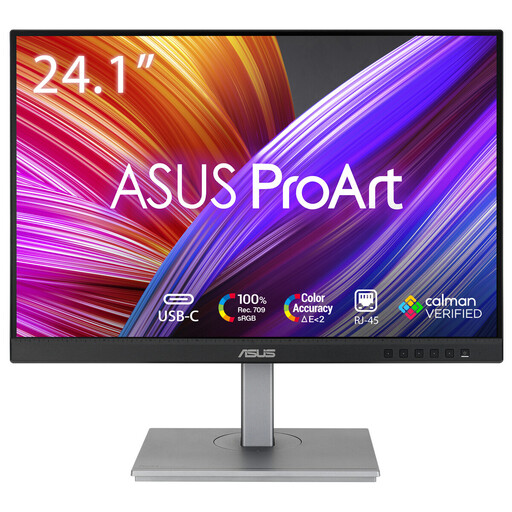
ASUS ProArt PA248CNV 24.1-inch monitor
The 16:10 format and stated colour and USB-C specifications may be useful if you combine painting with studying.
The product information lists a resolution of 1920 × 1200, 100% sRGB, factory calibration and USB-C with 90 W Power Delivery.
View at Joybuy
 No image available
ASUS ProArt PA278CV 27-inch Quad HD monitor
The 27-inch QHD size may be right for you if you’re looking for a larger workspace and have room for the monitor on your desk.
The product information lists a resolution of 2560 × 1440 pixels, 100% sRGB, factory calibration with Delta E < 2, and USB-C with 65 W Power Delivery.
View at Joybuy
Frequently asked questions
Do I automatically need a high-refresh-rate gaming monitor for digital painting?
No, not if you mainly paint still images. First compare colour settings, workspace and connections. Philips lists 120 Hz for smoother motion, but that figure is no proof of better colour accuracy.
Can I connect my laptop with a single USB-C cable?
That depends on the features of the ports on both devices. BenQ lists USB-C with DisplayPort Alt Mode and 65 W Power Delivery for the PD2705Q. Check that your laptop can output video through that connection and that the power is sufficient. Dell lists a USB-C downstream port for data and up to 15 W on the P2425.
How do I get started with consistent colour settings?
Choose a colour mode that suits your digital workflow, and check the settings on your operating system and painting software too. EIZO points out that colour differences between devices cannot automatically be blamed on the monitor alone; calibration may be useful for colour-critical work.
What if I’m not happy with the monitor after buying it, or it breaks too soon?
For a typical online consumer purchase in the Netherlands, ACM ConsuWijzer says you generally have 14 days from delivery to change your mind; check whether an exception applies. The seller must also put things right if a product, when used normally, does not meet what you could reasonably expect.


