
Student who needs to clear the table
If you take your laptop and screen with you after every session, focus on the size, weight and a video connection that works with your laptop. Lenovo lists the ThinkVision M14t Gen 2 as weighing 700 g.


If you need to clear the table after every study session, start with a portable screen that works with your laptop. If you can leave it set up, compare fixed monitors by workspace, sharpness, adjustability and connections. For colour-critical presentations, the stated colour gamut and calibration are relevant, but a manufacturer’s specification isn’t a measurement of the individual screen you receive. Before buying, check your laptop’s video output, the space available on the table and what’s actually included in the box.
If you take your laptop and screen with you after every session, focus on the size, weight and a video connection that works with your laptop. Lenovo lists the ThinkVision M14t Gen 2 as weighing 700 g.
For line drawings, maps and presentations, screen size, resolution and stated colour specifications are all relevant points to compare. Manufacturer specifications aren’t measurements of the individual screen you receive.
If you can leave the monitor in place, compare how you can adjust its position and whether its connections suit your laptop. That way, you won’t have to start from an awkward setup every time you use a shared table.
Choose this option: if you want to pack the screen away after studying or move between tables.
Bear in mind: compared with the fixed models reviewed, you’ll have less physical screen space and more limited height adjustment.
Choose this option: if you can leave the monitor in place and want to view maps, documents or drawings on a larger screen.
Bear in mind: measure the stand and the available table space; a fixed monitor is harder to put away.
Choose this option: if you have a permanent space and want to view lots of detailed images at once.
Bear in mind: a higher pixel resolution doesn’t in itself prove better colour reproduction; also check the scaling settings and space needed for the stand.
| Factor to consider | What should you check? | Who is this important for? |
|---|---|---|
| Packing away and carrying | Compare the size and weight, and check whether your laptop can output video through the intended port. | If I have to take the screen with me after every session, I want to know whether it’ll fit in my bag and connect without hassle. Around 33% of consumers consider portability their main concern. |
| Detail and colour | Compare the screen size, resolution and colour gamut required for your work. BenQ and ASUS list sRGB specifications and factory calibration for the models reviewed; this doesn’t guarantee measured accuracy for your individual screen. | For maps, line drawings or presentations, I want to assess detail and colour specifications without treating a manufacturer’s claim as a guarantee. Around 27% of consumers prioritise design detail and colour. |
| Positioning and adjustability | Measure the available table space and stand dimensions, and check the height adjustment. ASUS lists up to 150 mm of height adjustment for the PA278CV; Lenovo states that the M14t Gen 2 has limited height adjustment of up to 11 mm. | If I share a table with others, I want to be able to position the screen to suit me and adjust it again when needed. Around 20% of consumers focus mainly on positioning and adjustability. |
| Connecting your laptop | Check whether your laptop port outputs video using the required mode, what charging power is needed and whether the cable is compatible. A USB-C port on a monitor doesn’t automatically mean that every USB-C port on a laptop can output video. | For a permanent laptop setup, I want to know whether one compatible connection supports video and the charging function I need. Around 20% of consumers consider the laptop connection their main concern when buying. |
The percentages indicate which main trade-off may be most important to consumers using a shared study table.
Laptop ports vary in what they can do. For example, a Lenovo manual describes a port that doesn’t support DisplayPort Alt Mode and therefore can’t be used with an external screen.
Check the exact laptop port, the power required and the cable supplied for the monitor and laptop models you’re considering.
A shared table also needs to accommodate the stand, cables and other users’ belongings. A portable screen and a fixed monitor require different setups.
Measure the available table space and consider whether you’ll need to pack the screen away after every study session.
sRGB and DCI-P3 figures are manufacturers’ model specifications, not measurements of the screen supplied or your entire workflow.
Check which colour gamut suits your work, and distinguish between a manufacturer’s specification and a measurement of your own screen.
ACM ConsuWijzer explains that the Dutch statutory guarantee doesn’t have a fixed duration of exactly two years.
Keep your proof of purchase and contact the seller about your legal rights if something goes wrong.
The ThinkVision models reviewed offer a portable option and a compact fixed QHD setup with docking.
The ProArt PA278CV reviewed is a fixed 27-inch QHD monitor with specifications for colour, connections and adjustability.
The DesignVue PD2705Q reviewed is a fixed 27-inch QHD monitor with design modes and USB-C.
The UltraFine 27UP850K-W reviewed is a fixed 27-inch 4K option for those who value pixel resolution.
This selection features fixed QHD and 4K monitors for a shared study table, where screen space and connecting to your laptop are important considerations.
 No image available
A fixed QHD option if you have enough table space and want to adjust the screen position.
Joybuy’s product information lists 2560 × 1440 pixels, an IPS panel and an adjustable stand.
 No image available
A fixed 27-inch monitor option if you want to view design and study materials in 4K resolution.
The product information lists 3840 × 2160 pixels and an IPS panel.
 No image available
A fixed 4K option if you’re considering a laptop setup with USB-C; check that the power output suits your laptop.
The product information lists 3840 × 2160 pixels, factory calibration and USB-C with up to 98 W Power Delivery.
 No image available
A fixed QHD option for viewing maps and line drawings; measure the available table space first.
The product information lists 2560 × 1440 pixels and HDMI and DisplayPort connections.
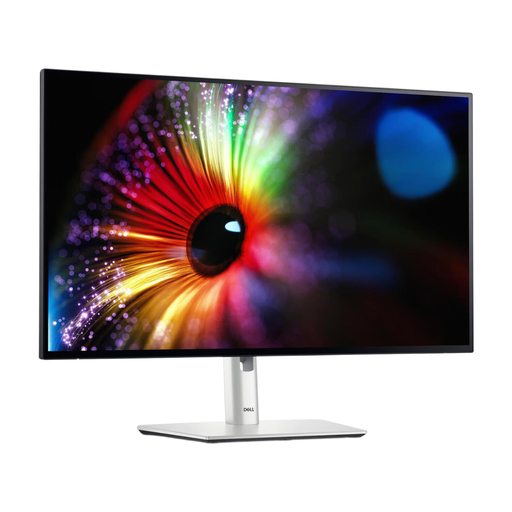 No image available
A fixed QHD option if you want to compare adjustable screen positioning and sRGB specifications.
The product information lists 2560 × 1440 pixels, 100% sRGB and a stand with height adjustment and rotation.
No. Not every USB-C port supports video using the required mode. Check the specifications for the exact port on your laptop, then compare the required charging power and cable. For example, a Lenovo manual describes a port that doesn’t support DisplayPort Alt Mode.
Follow the manual for your exact monitor model, as cleaning instructions can vary depending on the device and its coating. Dell advises unplugging its equipment, not spraying liquid directly onto the device and using a microfibre cloth. Let the surface dry before switching it on again.
For a standard online consumer purchase, you generally have a statutory 14-day cooling-off period from delivery, subject to exceptions outlined by ACM ConsuWijzer. You also have a statutory guarantee. In the Netherlands, this doesn’t have a fixed term of exactly two years; what you can reasonably expect from the product is what matters.
Computer monitors are covered by EU energy-labelling rules for electronic displays. The European Commission describes a scale from A to G and additional model information in EPREL. Compare the label for the exact version, as it doesn’t determine which class you should choose.
The cited rules for display screen work apply to employers and employees, so don’t automatically assume an employer’s obligations apply to a student at a shared table. Adjustability and glare can still be worth considering when setting up your study space.