
Traveller who uploads photos
You want to publish text and photos while travelling, so you’re looking at mobile coverage and upload speeds, not just the advertised download speed.


Start with the connection you already have: for occasional uploads, your phone’s hotspot may be enough, while NS offers free Wi-Fi on almost all Intercity trains. A separate 4G or 5G router is worth considering mainly if you want a dedicated connection for several devices or a separate battery. Before you buy, check your provider’s expected upload speeds and coverage, your data allowance, the exact model variant and its CE marking. A higher theoretical speed does not guarantee a connection on your train route.
You want to publish text and photos while travelling, so you’re looking at mobile coverage and upload speeds, not just the advertised download speed.
You want to work independently during a long train journey, so you’re comparing battery life, charging options and data allowances.
For example, you might write your travel diary on a laptop while also using a phone or tablet. In that case, it’s worth considering whether to use your phone’s hotspot or a router that shares the connection.
Choose this if: you’re travelling on an NS Intercity train with Wi-Fi and your upload doesn’t need to be ready at a specific time. NS offers Wi-Fi on almost all Intercity trains.
Bear in mind: Wi-Fi isn’t guaranteed on every train.
Choose this if: you occasionally want to get a laptop or tablet online using your existing mobile connection, and your provider allows hotspot use.
Bear in mind: some providers restrict tethering or charge extra for it.
Choose this if: you regularly work with several devices or don’t want to use your phone’s hotspot.
Bear in mind: you’ll need an extra device, plus a compatible SIM card and data allowance.
Choose this if: you send lots of files or large ones, and can check 5G coverage and your data allowance for your route.
Bear in mind: 5G support alone doesn’t guarantee better uploads on the train; check the exact model variant too.
| What to consider | What should you check? | Who is this important for? |
|---|---|---|
| Coverage and upload speed | Compare your provider’s expected upload speeds and check coverage along your route. Treat a coverage map as a guide. | If I want to publish text and photos while travelling, I focus on signal and upload speeds. Around 36% of consumers prioritise signal and upload speed most. |
| Data allowance | Check the SIM format, whether the device is SIM-locked, whether hotspot use is allowed, your data allowance and any terms for use abroad. | If I want to upload my diary without unexpected data charges or an unnecessary extra subscription, I compare the data allowance terms first. Around 29% of consumers put data allowances and costs first. |
| Battery and charging | Compare the stated battery life for the exact model variant, check the charging connection and make sure you can recharge while travelling. | On a long journey, I don’t want to rely on a router with a flat battery, so I check the power options. Battery life is the main consideration for around 21% of consumers. |
| Several devices | Count how many devices need to be online at the same time and compare this with the maximum supported by the exact model variant. | If I want to use my laptop and phone over one mobile connection, for example, the number of devices supported is crucial. Around 14% of consumers give sharing with several devices top priority. |
When sending photos, your mobile upload connection is what matters. A theoretical maximum doesn’t tell you how the connection will perform on a moving train.
Compare the stated mobile upload speed and your provider’s expected upload speeds, not just the download or Wi-Fi figures.
Train Wi-Fi isn’t available on every train, and mobile coverage can vary from place to place. So a 5G router won’t guarantee uploads throughout your route.
Check whether Wi-Fi is available on your train and look at your provider’s coverage along the route. Save your work locally if you need to publish it during the journey.
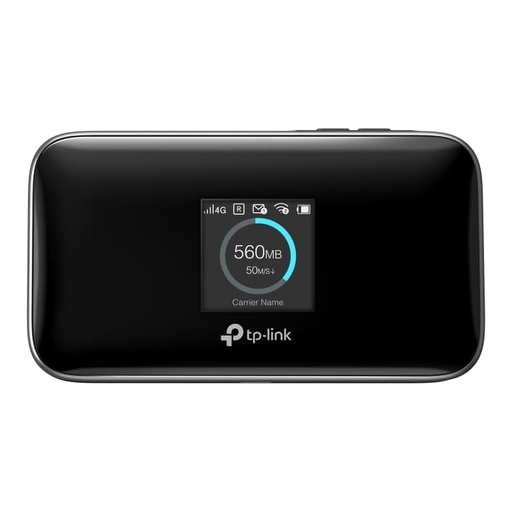
TP-Link lists a 2000 mAh battery and up to eight hours of use for the Dutch M7350 variant. Other TP-Link documentation describes a model variant with a 2550 mAh battery and up to ten hours of use.
Check which model variant you’ll receive, and don’t plan a long journey based solely on a battery-life figure.
These models illustrate different options for mobile internet on the go. A brand mention alone says nothing about availability or suitability for your route.
The M7350 is a compact 4G MiFi router with a screen showing data usage and Wi-Fi for several devices.
According to D-Link, the DWR-933 is an unlocked 4G Cat 6 hotspot with dual-band Wi-Fi for sharing your connection on the go.
The Nighthawk M6 MR6150 is a 5G option for anyone considering a mobile router with 5G.
The Mudi V2 GL-E750V2 is a portable 4G router for anyone looking for configurable VPN features too.
These models are for anyone who wants to share a mobile connection with one or more devices while travelling; the range here includes both 4G and 5G routers.
 No image available
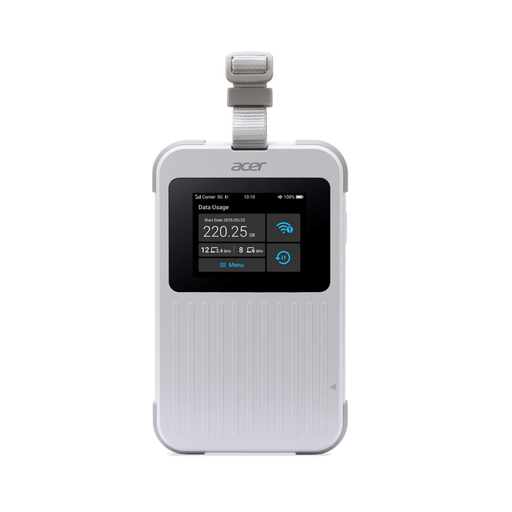
An option for turning a mobile connection into Wi-Fi for your devices while you’re on the go.
The product information lists dual-band Wi-Fi on 2.4 and 5 GHz.
 No image available
A 5G option for anyone who wants to connect several devices through a mobile hotspot while travelling.
The product information lists 5G, Wi-Fi 6E, dual band, nano-SIM and eSIM, and support for up to 32 connected devices.
 No image available
A 4G option for sharing Wi-Fi with several devices while travelling.
TP-Link lists a maximum mobile upload speed of 50 Mbps for the Dutch M7350 variant. Check that the model variant on offer matches; this maximum isn’t a measurement taken on a train route.
Insert an activated SIM card that’s compatible with the exact model variant, set up the Wi-Fi network and password, then test the connection before you leave. Also check in advance which SIM card formats the model supports.
No. A router doesn’t guarantee an upload connection for the whole journey. Compare your provider’s expected mobile upload speed and check coverage along your route; a theoretical maximum isn’t a measurement taken on a train.
The Dutch Authority for Digital Infrastructure (RDI) states that radio equipment sold in the Netherlands must meet the applicable requirements and carry a CE marking. Check this for the model variant actually being sold; the model name alone doesn’t prove compliance.
If you buy as a consumer in the Netherlands, you have statutory rights in addition to any manufacturer’s warranty. If the product breaks sooner than you could reasonably expect during normal use, the seller must offer an appropriate solution, according to ACM ConsuWijzer.
As a rule, Dutch roaming terms apply within the EU, but ACM ConsuWijzer notes that data limits or surcharges may apply in some situations. Check the terms of your own data allowance before you leave; this does not indicate what charges apply in countries outside the EU.