
Vandaag of morgen in huis

Kwaliteit gegarandeerd

Welkomstaanbiedingen ontgrendelen: GRATIS bezorging | Tot 80% korting | Gratis 30 dagen JoyPlus-proefperiode
Download de app
A mobile filing cabinet with drawers can bring greater order to an office, home office, studio or workshop. Documents and materials can be moved easily whenever needed, keeping the working area clear. Yet many models look similar, while differences in dimensions, load capacity, security and assembly can be substantial.
So do not focus solely on colour or the number of drawers. A cabinet that does not fit beneath your desk, rolls poorly or lacks stability will offer little practical value. Below, you will find the key points to check before buying, along with models suited to different situations.
A cabinet with 3 drawers is not automatically more suitable than one with 4 or 5. The internal drawer dimensions, depth and the way you organise your documents are just as important. A compact drawer may not be large enough for standard folders, while small office supplies can easily get lost in deep drawers.
Also check whether the product information clearly states how much weight each drawer can support. The selected metal models, for example, specify a maximum load of 15 kg per drawer. This is a product specification, not a guarantee that the cabinet can safely be filled with any heavy items. Distribute the contents evenly and follow the assembly and usage instructions.
A filing cabinet on wheels should move smoothly, but it must not shift unexpectedly when you open a drawer. Pay attention to:
A cabinet with lockable castors stays more securely in place during use. This does not automatically prevent tipping; heavy items should preferably be stored in the bottom drawers.
A lockable filing cabinet is useful for privacy-sensitive documents, but a lock does not turn a cabinet into a certified security cabinet. Check exactly what is locked: one drawer, several drawers or the entire cabinet. Also look at the supplied key, the type of lock and whether replacement keys are available.
For payroll records, client files or contracts, a lockable mobile office drawer cabinet provides a practical additional barrier. Store highly confidential or legally regulated documents only in accordance with your organisation’s security policy.
Measure the available space before ordering. Consider not only the width and height, but also the extra clearance needed to pull a drawer out fully. A model measuring approximately 39 to 40.5 cm wide will often fit beside a desk, but check the clearance between desk legs, skirting boards and cables.
Height is equally important. A low cabinet of around 54 to 55 cm may fit beneath or beside certain desks. A model measuring approximately 69 cm provides more vertical storage, but may restrict visibility or legroom.
A metal filing cabinet with a steel frame is well suited to everyday use and heavier office supplies. The product descriptions for the JOYFURNOS and Ochama models list steel as the material and specify a maximum load of 15 kg per drawer.
According to its product specifications, the HaluPeit model combines particleboard, steel and a melamine finish. The description states a total load capacity of up to 50 kg and a finish that is moisture-, oil- and wear-resistant. This information comes from the product description; check the current specifications before buying and do not exceed the stated limit.
Fully assembled models reduce installation time. With some cabinets, you only need to attach the castors. Other models arrive with numbered components and an instruction manual. Check that you have enough space to assemble the cabinet and that all required fixings are included.
Full-extension drawer runners make the back of a drawer easier to access. They are practical for files and tools, but smooth operation also depends on correct assembly and evenly distributed contents.
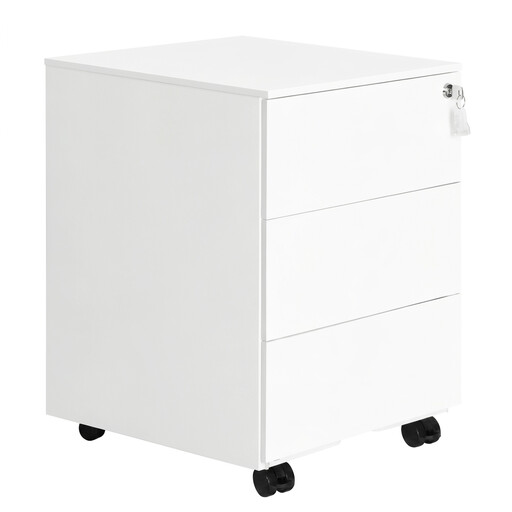
Why it fits: A compact option for a home office or small workspace where documents and stationery need to stay close at hand.
The cabinet arrives pre-assembled; according to the product information, you only need to attach the four castors. The lock restricts access to stored documents.
Steel construction, 3 drawers, full-extension drawer runners and a maximum load of 15 kg per drawer according to the product information.
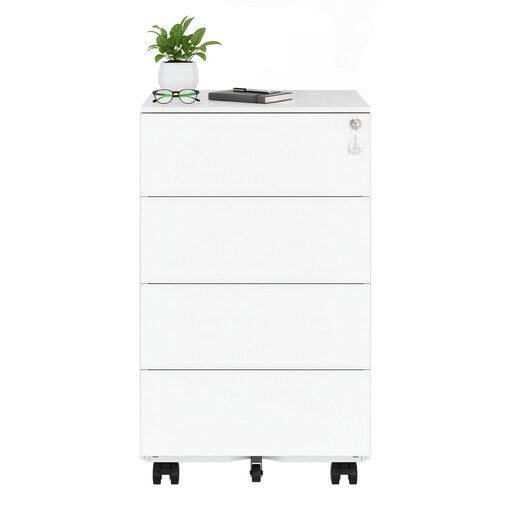
Why it fits: Suitable for an office or home office where you want to separate multiple document categories and prefer a lighter colour.
The product description mentions a lock, steel construction and castors for mobility. On delivery, check exactly how the castors and locking mechanism are fitted.
Dimensions of approximately 45 x 39 x 69.3 cm, 4 drawers and a maximum load of 15 kg per drawer according to the stated specifications.
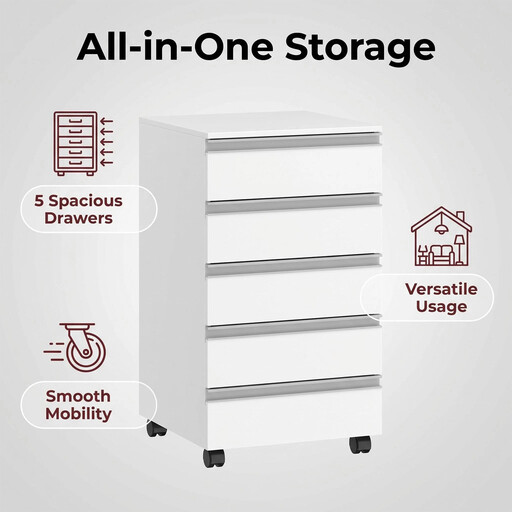
Why it fits: An option for drawings, tools, samples and larger quantities of office or studio equipment.
The description lists 360° swivel castors and two lockable front castors. This supports both mobility and positioning, but a level surface remains important.
5 deep drawers, a top measuring approximately 40.5 x 40.5 cm and a stated total load capacity of up to 50 kg.
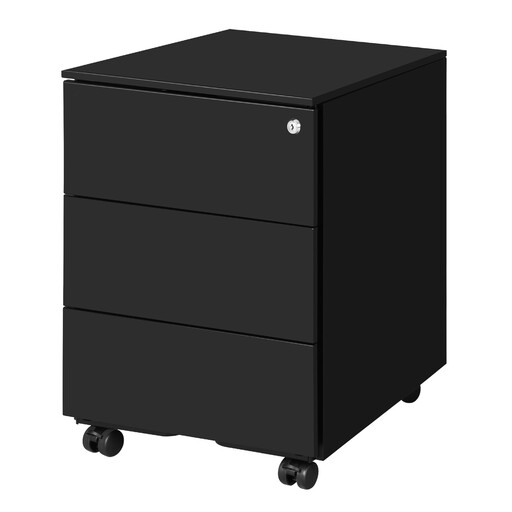
Why it fits: The compact height of approximately 54 cm is ideal for a smaller workspace, studio corner or home office.
According to the product information, the cabinet arrives pre-assembled. Two of the four castors have brakes, while an additional castor improves stability.
Steel construction, 3 drawers, a lock, full-extension drawer runners and a maximum load of 15 kg per drawer according to the product details.
Use this checklist before ordering a filing cabinet or office storage cabinet:
Browse a current selection of filing cabinets with drawers and compare drawer counts, dimensions, materials, colours and mobility based on the available product specifications.
Yes, particularly if you want to keep documents and office supplies beside your desk. Measure the available space beforehand and check whether the cabinet fits beneath or beside the desk. A 3-drawer model generally takes up less space than a taller cabinet with 4 or 5 drawers.
Its lifespan depends on the material, load, assembly, flooring and frequency of use. A steel cabinet may be suitable for everyday use, while the drawer runners and castors require additional attention. Do not exceed the stated load capacity, keep the castors free of dirt and check the fixings regularly.
The cabinet itself uses no electricity. Recurring costs mainly involve maintenance or the possible replacement of castors, drawer runners or a key. If you expect intensive use, it is worth checking in advance whether replacement parts are available.
