
Vandaag of morgen in huis

Kwaliteit gegarandeerd
Download de app
Categorieën

Purchasing a portable air conditioner seems straightforward—until the unit is in your home. Is it too loud for the bedroom? Does it cool the room effectively? And what about installation and energy consumption? The wrong choice can lead to unnecessary expense and frustration. This guide will help you make an informed decision based on factual specifications, ensuring you find a model that's perfect for your needs.
Before we look at specific models, it's important to understand the key parameters. These specifications determine how well a portable air conditioner will perform in your home.
Cooling capacity is expressed in BTU (British Thermal Unit). A higher BTU number means more cooling power. It's crucial to match the capacity to the size of the room you need to cool. A unit that's too weak will run constantly at full power without effectively cooling the room, while an overpowered model will cool the space too quickly and cycle on and off, leading to an uncomfortable climate and wasted energy.
The noise level, expressed in decibels (dB), is one of the most underestimated factors. For an air conditioner for the bedroom or a home office, a quiet portable air conditioner is essential. A difference of just 3 dB represents a doubling of sound intensity. Look for models with a special sleep mode, which often operate below 52 dB.
An energy-efficient portable air conditioner will save you money in the long run. Pay attention to the energy label (e.g., A++). Modern air conditioners use more environmentally friendly refrigerants like R290 (propane) or R32, which have a lower global warming potential (GWP) than older refrigerants.
Based on the criteria above, we have selected a range of models with different specifications, suitable for various situations.
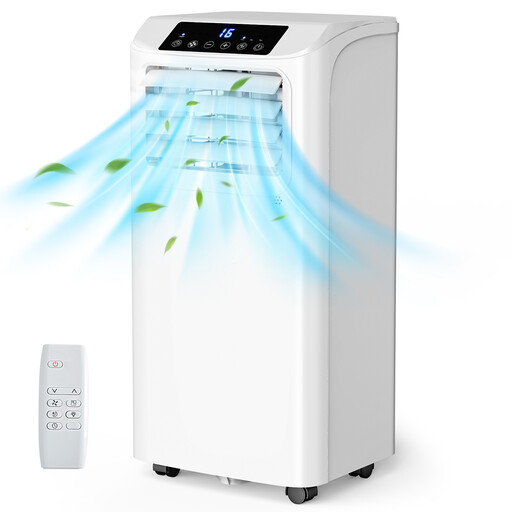
Why this product? This model from Humhold is a classic monoblock portable air conditioner that excels in user-friendliness and a compact design. With 9000 BTU, it's a suitable solution for quickly cooling small to medium-sized rooms.
Pros:
Who is it for? Ideal for users looking for a compact, easy-to-install air conditioner for the bedroom or home office up to 33 m². Its 3-in-1 functionality makes it a versatile appliance for a variable climate.
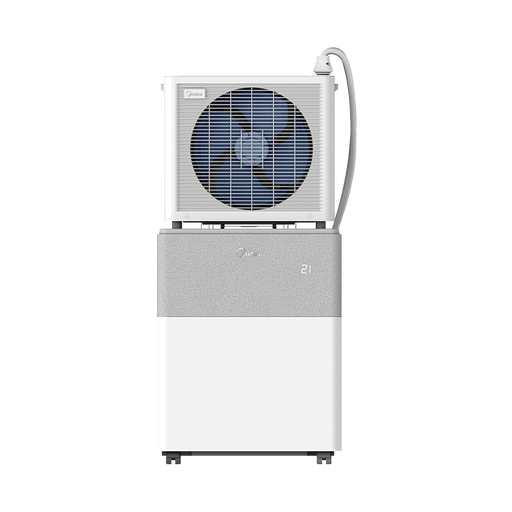
Why this product? The Midea PortaSplit-E is a portable split-system AC. Because the compressor is located in the outdoor unit, this model is exceptionally quiet. Its high energy efficiency and heating function make it a year-round solution.
Pros:
Who is it for? Perfect for those seeking a very quiet portable air conditioner for the living room or bedroom and who value high energy efficiency. The heating function provides added value for use outside the summer months.
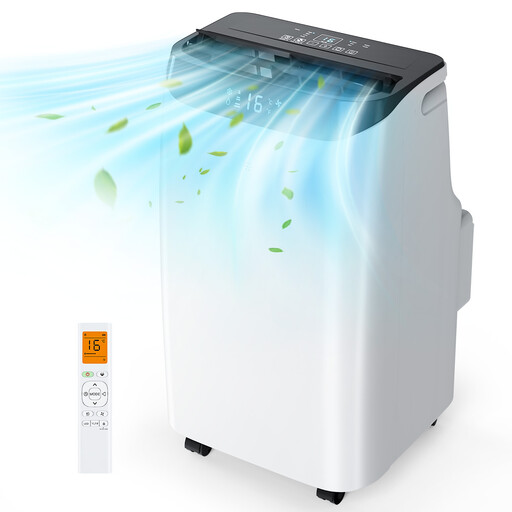
Why this product? This more powerful monoblock model from Humhold delivers 12000 BTU of cooling capacity, ideal for larger living rooms or open-plan spaces. The auto-swing feature ensures better and faster distribution of cool air.
Pros:
Who is it for? An excellent choice for cooling larger spaces like a living room or a studio apartment. The auto-swing function is a clear advantage for those who want to achieve an even temperature quickly.
Choosing a cooling solution is a personal decision that depends on your specific needs and the layout of your home. If your ideal model isn't listed here, or if you're curious about other options like air coolers or fans, explore our full range.
Browse all fans and air conditioners
1. How much noise does a portable air conditioner make? The noise level varies significantly between models, typically ranging from 50 to 65 dB. Models with a sleep mode can be quieter (under 52 dB). A portable split-system AC is the quietest option, with noise levels that can drop below 40 dB, as the noisiest component is located outside.
2. Does a portable air conditioner always need a hose to the outside? Yes, any portable air conditioner that cools using a compressor (both monoblock and split-system) always needs a way to exhaust hot air. For a monoblock model, this is done via a thick exhaust hose. For a portable split unit, this is handled by the outdoor unit. Only so-called 'air coolers', which work by evaporating water, do not require a hose, but their cooling capacity is significantly lower.
3. What does BTU mean for an air conditioner? BTU stands for British Thermal Unit and is a measure of energy. For air conditioners, it indicates how much heat the unit can remove from a room per hour. A higher BTU number means more cooling power. It is important to choose the right BTU capacity for your room's size to ensure efficient operation.