
Vandaag of morgen in huis

Kwaliteit gegarandeerd

Welkomstaanbiedingen ontgrendelen: GRATIS bezorging | Tot 80% korting | Gratis 30 dagen JoyPlus-proefperiode
Download de app
A mixer can make it easier to prepare dough, cake batter, whipped cream, sauces and soups. But it’s not a good idea to focus only on the wattage or the number of accessories. A stand mixer, for example, takes up more space than a hand mixer, while a stick blender is better suited to soups and smoothies.
If you’re looking to buy a mixer, there are three common pitfalls to watch out for:
The right choice depends on what you make most often.
A 5.5- to 7-litre bowl may seem spacious, but its usable capacity may be less than the total bowl volume. For bread dough, the maximum amount of dough or flour is also more important than the number of litres alone.
A family that regularly makes several cakes or pizzas may benefit from a larger stand mixer. For single-person households and occasional bakers, a hand mixer with a separate bowl is often enough.
Multiple speeds give you more control over light and heavy mixtures. A slow-start function helps prevent splashes when you add flour, milk or cocoa. A pulse function is handy for short bursts of mixing.
Consider the controls too. A dial can be easy to use while you’re cooking, while a digital panel may offer extra functions but can be more sensitive to dirt and moisture.
Check whether the set includes a whisk, dough hook and flat beater. For a mixer used for dough and batter, the dough hook and the machine’s stability are especially important. A stainless steel bowl is generally easy to wipe clean and suitable for everyday use.
Also check which parts are dishwasher-safe. The motor housing must not be submerged. Always unplug the appliance before changing accessories or cleaning it. Follow the instructions for maximum quantities and running times.
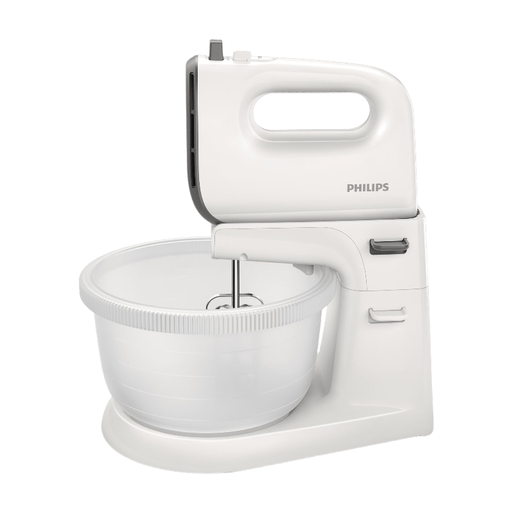
Why it suits this profile: According to the product information, this hand mixer has a 3-litre rotating bowl, 6 speeds and a 450 W motor. That makes it suitable for cake batter, whipped cream and smaller amounts of dough, without needing a large stand mixer on your worktop.
The bowl capacity and number of speeds are clearly stated, so you don’t have to rely solely on a general power claim.
Rotating bowl, 450 W, 6 speeds, with beaters and dough hooks included.

Why it suits this profile: The product information lists a power rating of 1200 W, a 7-litre bowl, integrated scales and automatic speed control. This makes it a good fit for home bakers who often make larger quantities.
As well as the wattage, the bowl capacity, dimensions and integrated scales are specified. Do check that the machine will fit on your worktop before you buy.
1200 W, 7 litres, stainless steel construction, automatic speed control and integrated scales.

Why it suits this profile: According to the product specifications, this stand mixer has a 6.7-litre bowl, a metal body and three essential attachments: a beater, whisk and dough hook. Optional accessories extend its capabilities even further.
The included accessories are clearly listed, so you can tell what comes in the box and what’s available separately.
6.7-litre capacity, metal body, stainless steel bowl and attachments for mixing, whisking and kneading.
We’ve put together a complete, up-to-date list of products that meet these strict selection criteria and current European safety regulations.
Yes, you can use a stand mixer with a dough hook, as long as you stick to the maximum quantity specified in the manual. Check that the appliance is stable and let the motor cool down in line with the recommended running time.
There’s no universal wattage that suits every user. For lighter tasks, a 200 to 450 W hand mixer may be enough. If you often make heavy dough, it’s better to look at the whole design: power, bowl capacity, dough hook, maximum capacity and running time.
A mixer typically uses electricity for only a short time per recipe. Consumption depends on its power rating and total running time. An appliance with a higher wattage won’t automatically use more electricity for every recipe; the actual cost depends on power multiplied by running time.
