
Teachers demonstrating techniques up close
You want to keep your fingers, tools and small clay details visible from a fixed angle at your worktable. The lens, distance and focus are just as important as the video resolution.


For a fixed worktable setup, a mirrorless camera with a suitable lens gives you more options for focusing distance and framing. A compact camera is worth considering if you often move between locations, but check that its fixed lens can capture the whole work surface in focus from your working distance. In either case, test audio clarity, white balance and recording time with your own setup: 4K alone won’t guarantee a clear view of your hands and the details in the clay.
You want to keep your fingers, tools and small clay details visible from a fixed angle at your worktable. The lens, distance and focus are just as important as the video resolution.
You want to record a lesson and make sure your explanations are easy to hear. Check the recording time of your chosen camera and whether you can use an external microphone.
You’re looking for a setup that’s easy to move. Even with a compact camera, check that its fixed lens gives you the view you want from your position at the worktable.
| What to consider | What to look for when buying | Who is this important for? |
|---|---|---|
| Sharp hands and clay details | Test focus and field of view together at the intended camera distance. According to Canon Netherlands, the Canon RF-S 18-45mm has a minimum focusing distance of 0.2 m at 18 mm and 0.35 m at 45 mm when using autofocus. | I want to see fingers and tools clearly without losing the worktable from view. Around 31% of consumers say close-ups are their top priority when buying. |
| Light and colour by a window | Take test shots as the daylight changes. Check the white balance and exposure, and see whether you can add extra light without creating distracting shadows. | If the light changes during the lesson, I want the clay to remain clearly visible. Around 25% of consumers give consistent exposure and colour top priority. |
| Lesson length and clear audio | Test your intended recording time with your chosen settings, power supply, memory card and microphone position. Nikon states a maximum continuous recording time of 125 minutes for the Z 30; this doesn’t guarantee the same duration with every setup. | I want to record a full demonstration and make sure my explanations are easy to hear. Around 25% of consumers prioritise lesson length and clear speech. |
| Quick to set up and easy to carry | Try the camera in its actual mounting position and check that your hands and work surface remain in view. An interchangeable lens gives you different framing options from a fixed lens; also check what mounting equipment you’ll need. | When I film in different locations, I want to be able to move the camera easily. Around 19% of consumers name portability as their top priority when buying. |
The lens needs to focus from your chosen camera distance and show the work large enough in the frame. With some zoom lenses, the minimum focusing distance changes as you zoom.
Test focus and field of view together at the actual distance from the clay, taking both an overview shot and a close-up.
A camera positioned away from the worktable won’t necessarily be in the right place to record your speech. Nikon lists both a built-in and an external microphone option for the Z 30.
Test the audio while working with both hands and speaking at your usual teaching volume.
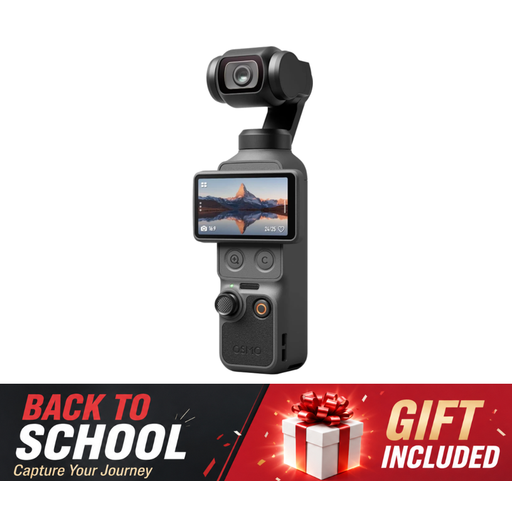
The DJI Osmo Pocket 3 has a fixed lens. DJI lists a minimum subject distance of 20 cm; stabilisation alone doesn’t prove that the whole work surface will fit in the frame from a single position.
Check the framing and focus with both hands above the worktable before choosing this setup.
The EOS R50 is a point of reference for a fixed worktable setup with an interchangeable RF-S lens.
The ZV-E10 II is an interchangeable-lens option if you also want to show subjects in front of the camera.
The Z 30 is worth considering if a long recording time and the option to use an external microphone are important to you.
The Osmo Pocket 3 is a compact option if you regularly move between filming locations.
These cameras are options to consider for mobile video recording or a fixed setup at your workspace. For a clay class, always check the working distance, mounting and audio recording.
 No image available
A compact camera to consider if you’re looking for a mobile recording setup; check the framing from the actual position above the clay.
The product name lists 4K/240fps video, 2× lossless zoom and 107 GB of built-in storage.
 No image available
A compact camera to consider if you move between locations while filming; test whether the fixed lens suits your worktable and recording distance.
The product name lists 4K/240fps video, 2× lossless zoom, 107 GB of built-in storage and a handle with a 1/4″ thread.
No image available
A compact option for mobile recording when you also want to capture spoken explanations; check the framing from your chosen worktable position.
The product name lists 4K/120fps video and an included microphone. DJI lists a minimum subject distance of 20 cm for the fixed lens.
 No image available
A webcam to consider for a fixed PC or Mac setup, if it suits the way you want to film your work surface.
The product name lists 4K video, a 1/2″ sensor, HDR and a microphone with AI noise reduction.
 No image available
A webcam to consider for a fixed computer setup; check that its position and field of view are suitable for showing the clay techniques.
The product name lists 4K video, a 1/2″ sensor and AI tracking. The product information also mentions a built-in microphone.
Not on its own. Check that the lens can focus from the actual camera distance and show the technique large enough in the frame. The minimum focusing distance of the Canon RF-S 18-45mm varies depending on the zoom setting.
Take a test recording and check the white balance in the available light. Canon Netherlands explains that light sources and colour temperatures affect how colours appear; check the exposure on the clay too before recording your lesson.
Test a recording that lasts as long as your lesson, using your intended settings, memory card, power supply and microphone. Nikon lists a maximum of 125 minutes for the Z 30; this isn’t a guaranteed recording time for every setup.
Contact the seller. According to the Dutch government, the Netherlands doesn’t have a fixed legal two-year guarantee period for all products; any additional manufacturer’s guarantee is separate from your statutory rights.
Not without checking the applicable privacy rules. The Dutch Data Protection Authority says that a valid legal basis under the GDPR may be needed when people are identifiable; consent is one possible legal basis. For identifiable pupils under 16, the regulator specifies that parental consent is required. If you film only your own hands, that doesn’t automatically lead to the same conclusion about identifiable participants.