Start by choosing a lens based on how large you want small details to appear in the frame. Then choose a mirrorless camera body that suits the way you want to focus. For consistent pendant photos under artificial light, a fixed setup and adjustable white balance are important. A dedicated macro lens or focus stacking may require extra equipment or post-processing. Manufacturer specifications alone can’t tell you which combination will produce the best results in your lighting setup.
Who is this choice relevant to?
Detail photographer
You want to capture tiny inclusions and components in close-up, so you compare the magnification and working distance of a suitable macro lens first. Nikon, Sony and Canon provide lens specifications to help you weigh up your options.
Seller of regular collections
You want to photograph pendants with consistent framing and colours you can assess accurately. Canon Netherlands describes white balance as a way to account for different light sources and recommends keeping the composition fixed for product photos.
Photographer of layered pendants
You want to keep different depth layers in focus and compare focus stacking, lens compatibility and the steps involved in shooting or post-processing. Nikon, Canon and OM SYSTEM describe focus stacking as a way to combine images taken at different focus points.
What should you look for when buying?
First, decide how large the smallest details need to appear in the frame. Then consider colour control, sharpness at different depths and the equipment you already have for a complete setup.
| What to consider |
What should you check? |
Who is this important for? |
| Detail magnification |
Compare the maximum magnification of the exact lens with the crop you want and the space needed for lighting in front of the lens. |
If I want to fill the frame with tiny inclusions, I start by checking the lens magnification. Around 33% of consumers give detail magnification top priority. |
| Colour and shine |
Check the white balance settings and decide whether you want to shoot in RAW. Assess the exposure using your own pendant and lights. |
For a regular collection, I want to be able to assess colours and framing under my own artificial lighting. Around 27% of consumers prioritise colour and exposure. |
| Sharpness at different depths |
Check whether the camera body offers focus bracketing or focus stacking, how images are combined and whether your chosen lens is suitable. |
For a pendant with several depth layers, I want to weigh up how to keep it sharp from front to back. Around 27% of consumers give depth of field top priority. |
| What’s included in the kit |
Check whether the offer includes a body or a kit, which lens is included and which components you already own. |
If I want to get started with a usable setup, I check what comes with the camera and what else I need. Around 13% of consumers prioritise the cost and completeness of the kit. |
Common buying mistakes
-
Comparing only the camera body’s resolution
How large a small component appears on the sensor also depends on the exact lens. For example, the Canon EOS R50 kit we reviewed includes an RF-S 18-45mm zoom lens; it’s not the same package as a body with a dedicated macro lens.
Decide which detail you want to photograph, then check the lens magnification and what’s included in the kit.
-
Confusing focusing distance with the space in front of the lens
Focusing distance and the clear space between the front of a lens and the subject are two different measurements. For the NIKKOR Z MC 50mm f/2.8, Nikon specifies around 5 cm between the lens and subject at the closest focusing distance.
Check that the working distance of your chosen lens suits your pendant and the position of your lights.
-
Planning to use focus stacking without checking the lens
Supported lenses and image cropping can vary by camera model. OM SYSTEM lists the M.Zuiko Digital ED 60mm F2.8 Macro as compatible with focus stacking on the OM-5 Mark II, and says the combined image is cropped by around 7% at the edges.
Check the camera body, lens and desired final framing together before relying on this technique.
Brands to compare
Canon
Worth considering if you’re looking at the EOS R50 and want to compare a kit zoom with a dedicated RF macro lens.
- Canon lists 24,2 MP for the EOS R50 and describes in-camera depth composition. These are manufacturer specifications.
- The kit we reviewed includes an RF-S 18-45mm zoom lens, not a dedicated macro lens. Check the included lens’s magnification for capturing small details.
Nikon
Worth considering if you want to pair a Z camera with the dedicated NIKKOR Z MC 50mm f/2.8 for capturing small details.
- Nikon specifies 1:1 magnification and compatibility with FX- and DX-format Z cameras.
- Nikon specifies around 5 cm of space in front of the lens at the closest focusing distance. Check whether there’s enough room for your lighting.
Sony
Worth considering if you want to pair an E-mount camera with the dedicated E 30mm F3.5 Macro.
- Sony specifies 1:1 magnification for the SEL30M35 lens.
- Check the camera and lens combination, and whether you’ll have enough room for your lighting setup when shooting close-ups.
OM SYSTEM
Worth considering if you want to use in-camera focus stacking with a compatible M.Zuiko macro lens.
- OM SYSTEM lists the M.Zuiko Digital ED 60mm F2.8 Macro as compatible with focus stacking on the OM-5 Mark II.
- OM SYSTEM says the stacked image is cropped by around 7% at the edges. Also check whether the offer includes the lens you want.
Fujifilm
Worth considering if you want to pair an X-system camera with the dedicated XF30mmF2.8 R LM WR Macro.
- Fujifilm specifies 1:1 magnification and a minimum focusing distance of 10 cm for this lens.
- The minimum focusing distance isn’t necessarily the clear space between the front of the lens and the pendant. Check that your lighting will fit.
Joybuy products
These product options range from digital and compact cameras to a Sony mirrorless camera with a standard zoom lens. For capturing small pendant details, the key is whether the camera and lens you choose suit the framing and workflow you have in mind.
 Image unavailable
Komery W6 digital camera
The product name identifies this as a digital camera. Check that this type of camera suits the lens choice you need for photographing your pendants.
The product name lists 64 MP, 12× optical zoom, 4K and WiFi.
View at Joybuy
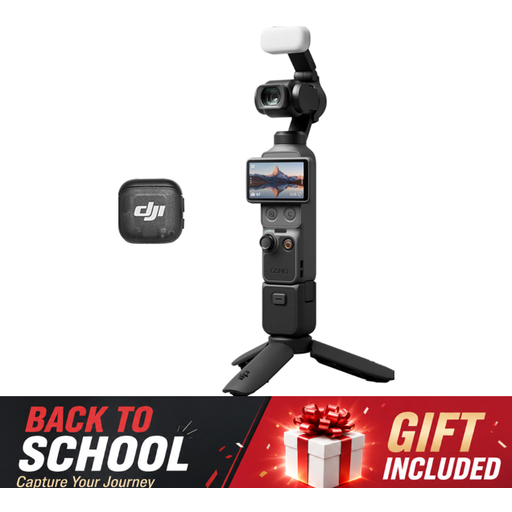 Image unavailable
DJI Osmo Pocket 3 Creator Combo
The product name describes this as a vlogging camera. Compare this type of camera with your need for a mirrorless camera for product photography.
The product name lists a 1-inch CMOS sensor, 4K/120fps video, 3-axis stabilisation and an included microphone.
View at Joybuy
 Image unavailable
DJI Osmo Pocket 3
The product name describes this as a vlogging camera. Compare this type of camera with your need for a mirrorless camera for product photography.
The product name lists a 1-inch CMOS sensor, 4K/120fps video, 3-axis stabilisation and a 2-inch rotating touchscreen.
View at Joybuy
 Image unavailable
Sony Alpha A6100 + 16-50mm f/3.5-5.6 OSS II
This mirrorless camera with a standard zoom lens is a good fit if you want to start with a zoom. Check the lens magnification for capturing the smallest details on your pendant.
The product name lists a 16-50mm f/3.5-5.6 OSS II lens.
View at Joybuy
Frequently asked questions
Do you always need a macro lens to photograph an entire resin pendant?
No, not if the included lens can achieve the framing you want. For small details, compare the maximum magnification of the exact kit lens with that of a dedicated macro lens; the camera body alone doesn’t determine magnification.
How do you get started with consistent photos under artificial light?
For a series of photos, keep the camera in a fixed position, use consistent framing and lighting, and adjust the white balance to suit your light source. If you edit your photos, Canon says RAW gives you the flexibility to change the white balance afterwards.
Do you need to combine focus-stacked images on a computer?
It depends on the camera model. Canon describes in-camera depth composition on the EOS R50, while OM SYSTEM offers focus stacking on the OM-5 Mark II. For the OM-5 Mark II, check which lenses are supported and allow for the crop at the edges mentioned by OM SYSTEM.
What rights do you have when buying online in the Netherlands?
When you buy from a business at a distance, you’re generally entitled to a 14-day cooling-off period, subject to exceptions outlined by the Dutch government. You’re also entitled to a product that meets the required standards. According to the Dutch government, the Netherlands has no fixed statutory warranty period; what applies depends, among other things, on the product and the specific purchase.


