Who is this for?

Independent scale learner

You’re mainly looking for responsive keys and a way to practise your timing; extra sounds or accompaniment matter less. Casio’s manual mentions a metronome and adjustable touch response. ABRSM distinguishes between harmonic and melodic minor scales.

Practising in a shared spare room

You want to practise with headphones at suitable times and possibly put the instrument away afterwards. Check the connection and measure the space where the instrument will go, both when you’re playing and when it’s stored.

Piano technique student

You practise scales as part of playing the piano, and a weighted keyboard and full range of keys matter more to you than a compact design that’s easy to store. Roland describes the FP-10 as a model with 88 keys and a PHA-4 keyboard.

What should you consider when choosing?

Compact keyboard

Best for: practising scales, touch and timing on your own, with an instrument you can move or put away.

Trade-off: a lightweight keyboard action is not the same as the weighted keys of a digital piano.

Digital piano with 88 weighted keys

Best for: practising scales as part of piano technique, when you have enough room for a larger instrument.

Trade-off: measure the space for playing and storage; headphones won’t eliminate the mechanical noise of the keys and pedals.

What to consider What should you check? Who is this important for?
Touch and timing Try the touch response and metronome on the exact model. Also check which minor scale your learning materials require. If I’m practising scales on my own, I want to vary my touch and keep a steady tempo. Around 36% of consumers prioritise practising scales and timing independently.
Practising with headphones Check the type of connection, how to use headphones and which accessories you’ll need. In a shared room, I want to listen through headphones rather than the speakers. Around 29% of consumers prioritise listening privately.
Space and storage Measure the space for playing and storage, and allow for the stand and room to move. If I also need the room for guests, I want to know whether I can put the instrument away after practising. Around 21% of consumers prioritise storage and available space.
Piano feel and key range If needed, ask your teacher which type of keyboard is suitable for your lessons, and try the feel for yourself. If my main aim is to practise piano technique, I’d prioritise weighted keys over a compact design. Around 14% of consumers prioritise piano technique and key range.

Common buying mistakes

  • Assuming illuminated keys are essential for practising scales

    The illuminated keys on the Yamaha EZ-310 are a learning aid. You can also assess how suitable an instrument is for practising scales by looking at the keyboard, touch response and metronome.

    First decide whether you’ll use this type of guidance, then compare the touch response and practice features.

  • Comparing only the number of keys

    A 61-key keyboard and a digital piano with 88 weighted keys differ not only in range, but also in keyboard feel and overall size.

    Choose according to your main aim: practising scales independently and putting the instrument away, or working on piano technique with weighted keys.

  • Assuming headphones and accessories are included

    The Casio CT-S300 manual states that headphones are sold separately. The included power supply and other accessories may also vary between offers.

    Before buying, check what’s in the box, the connections and the recommended power supply for the exact offer.

Brands to consider

Yamaha

The PSR-E383 and EZ-310 are examples of 61-key keyboards with touch response.

  • Yamaha lists illuminated keys and lesson functions for the EZ-310; these extras aren’t essential for practising minor scales.
  • Check which headphone socket and accessories are included with the exact version on offer.

Casio

The Casiotone CT-S300 is worth considering if you want to move or store your keyboard after practising.

  • Casio lists the CT-S300’s dimensions as 930 × 256 × 73 mm and its weight as 3,3 kg. The manual mentions a metronome and adjustable touch response.
  • Headphones are sold separately; also check which power supply and accessories are included with the model on offer.

Roland

The FP-10 is a digital piano for anyone who values weighted keys and piano technique more than a compact design that’s easy to store.

  • According to Roland, the FP-10 has a PHA-4 keyboard with 88 keys, a metronome and headphone playback.
  • Measure the room beforehand to make sure the instrument will fit. Roland’s assessment of the playing feel is a manufacturer’s claim, not an independent comparison.

Joybuy products

Joybuy’s selection of keyboards for practising at home.
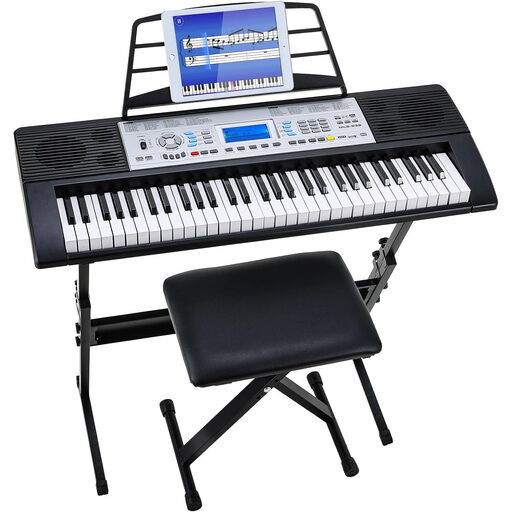
61-key keyboard set with stand and stool

61-key digital keyboard with stand and stool

This set is a good fit if you’re looking for a keyboard setup with a stand and stool, and are interested in guided practice features.

The product title lists 61 keys, a stand and a stool.

The title also mentions 500 sounds, a three-level learning function, two speakers and an LCD screen.

Adult supervision is recommended during assembly and use; make sure the stand is securely assembled.

View at Joybuy

Frequently asked questions

Do I need illuminated keys to practise minor scales?

No, illuminated keys aren’t essential. Yamaha presents them as a learning aid on the EZ-310, while ABRSM distinguishes between harmonic and melodic minor scales. Check which type of minor scale you want to learn, and choose extra guidance only if it suits the way you practise.

How can I practise in the spare room with headphones?

First check the connection on the exact instrument and use compatible headphones. The Casio CT-S300 manual explains how to connect separately sold headphones; Roland describes headphone use with the FP-10. Start at a low volume. Headphones won’t prevent mechanical noise from the keys or pedals.

What if the keyboard turns out to be faulty after normal use?

According to ACM ConsuWijzer, if a product is faulty, you’re entitled to a legal guarantee under the applicable conditions, and the seller is responsible for providing a solution. A manufacturer’s or seller’s guarantee does not replace this legal right; there is no single fixed statutory guarantee period that applies to every keyboard.

Can I try a keyboard bought online at home and return it?

According to ACM ConsuWijzer, when you buy from a business online, you generally have a legal cooling-off period of up to 14 days after delivery, subject to exceptions. Check the applicable returns information beforehand. An online purchase from a private seller isn’t automatically covered by the same distance-selling rules.

Is a CE mark an independent quality mark for a keyboard?

No. According to the European Commission, the CE mark indicates that the manufacturer considers a product to meet the applicable EU product requirements; there is no central EU body that routinely issues a certificate for this. Which rules apply, if any, depends on the product being offered.
