
Vandaag of morgen in huis

Kwaliteit gegarandeerd

Welkomstaanbiedingen ontgrendelen: GRATIS bezorging | Tot 80% korting | Gratis 30 dagen JoyPlus-proefperiode
Download de app
A mini fridge might seem simple to choose: check the dimensions, capacity and price. But many disappointing purchases come down to specifications that are easy to miss in product titles. A fridge may look compact, for example, but need extra ventilation space at the back. A cool box with a warming function might also be compared with a proper fridge, even though the two appliances serve different purposes.
As a Joybuy Product Recommendation Officer, I look beyond the product details to focus on what matters in everyday use. That way, you can quickly see which small fridge, under-counter fridge or portable fridge is right for you.
Measure more than just the alcove or shelf. Check the space needed for the door, hinge, plug and ventilation too. A compressor fridge needs room to release heat. Some models recommend leaving at least a few centimetres of free space around the appliance, so avoid placing a fridge right up against a wall or heat source.
Check which way the door opens too. A reversible door is handy in a student room, office or studio, but check whether you can change the door opening direction by following the instructions.
A small freezer compartment is handy for ice or a limited amount of frozen food. But the capacity and freezing capability tell you more than the words “with freezer compartment” in a product title. For example, the Wiggo WFR-TT82D(B) has a 13-litre freezer compartment and a freezing capacity of 2 kg per 24 hours, according to the product specifications.
Some minibar fridges are described as having a compartment intended mainly for temporarily storing food that has already been frozen. So always check the star rating and stated freezing capacity.
A car fridge or thermoelectric cool box often runs on 12V and sometimes on 220–240V. These models are suitable for drinks, lunch, camping or travelling. However, their cooling performance can depend on the ambient temperature, so they’re not necessarily suitable for storing perishable food for long periods.
A compact compressor fridge for an office or bedroom is a different type of appliance from a portable fridge with cooling and warming functions.
Check the net capacity, not just the rounded figure in the product name. For a few drinks, 4 to 15 litres may be enough. A student room or office where you keep everyday groceries is more likely to need 43 to 107 litres. Also check:
A fridge with a glass door is handy if you want to see what’s inside at a glance, for example when storing drinks. The door may be heavier, though, and needs enough room to open fully.
Compare the height, width and depth with the space available. An under-counter fridge around 84–85 cm high will often fit beneath a worktop, but the depth can vary between models. Check the installation instructions too.
For a bedroom or open-plan office, the noise level in dB is worth considering. The difference between 37 and 41 dB may be noticeable in a quiet room, although your experience will also depend on the surface the fridge is standing on and how often its compressor switches on and off.
The EU energy label runs from A to G. Also compare the stated annual energy consumption in kWh. This figure is more useful than a general claim such as “energy efficient”, because you can compare it directly across models.
Bear in mind that energy consumption can depend on the ambient temperature, settings, ventilation and how the appliance is used. A model with a better energy label won’t automatically cost less to run if it’s much larger or used more intensively.
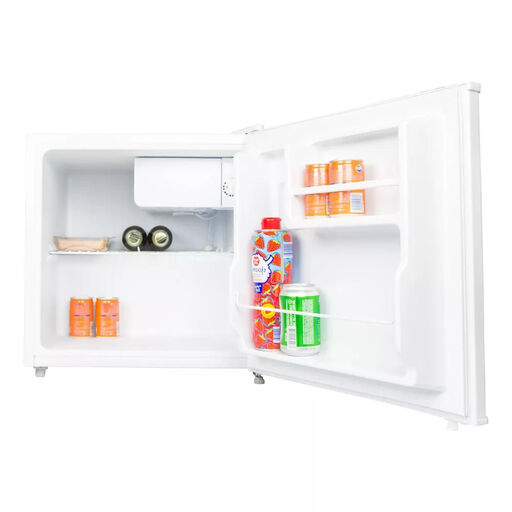
Why it suits this buyer: This model is designed for everyday use in a student room or bedroom, or as a minibar. Its 43-litre capacity gives you space for drinks and a few groceries without taking up as much room as a full-sized fridge.
The product specifications give the capacity, dimensions of 49,2 × 47,2 × 45 cm, noise level of 41 dB and annual consumption of 107 kWh. The description makes clear that the freezer compartment shouldn’t be considered a full-sized freezer.
43 litres of net capacity, mechanical temperature control and a reversible door.
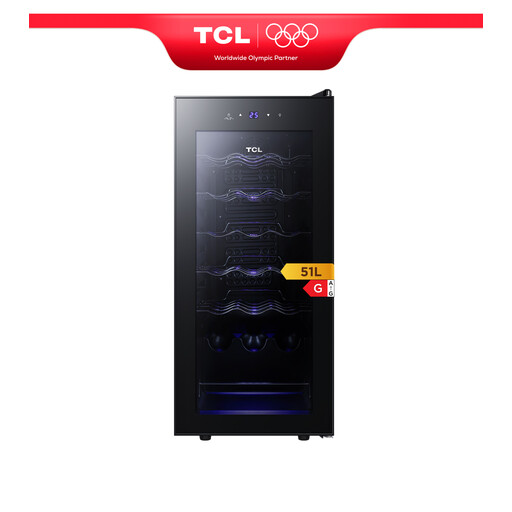
Why it suits this buyer: A good choice for wine lovers who want a dedicated wine cooler rather than an ordinary small fridge. The glass door lets you see what’s inside.
The product specifications list the 51-litre capacity and space for 18 bottles separately. This lets you compare the storage space with your own bottle sizes, rather than relying on the word “compact”.
51-litre capacity, glass door and space for up to 18 bottles, according to the product information.
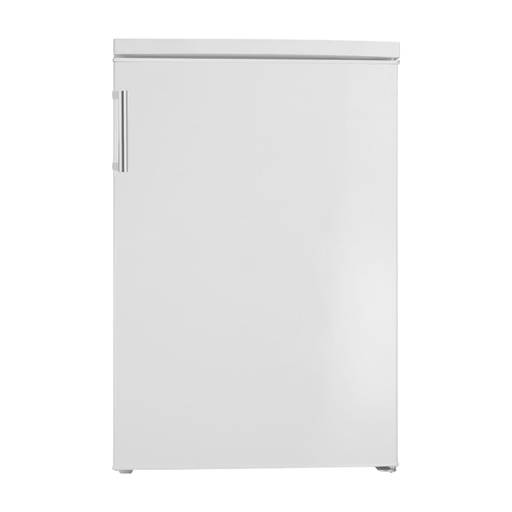
Why it suits this buyer: This under-counter model is suitable for a studio flat, small household or office that needs extra fridge and freezer space. Its total capacity includes 95 litres of fridge space and 14 litres of freezer space.
The key figures are clearly listed: 89 kWh per year, 37 dB, energy class C and a reversible door. The freezer compartment has a stated freezing capacity of 2,4 kg per 24 hours.
133 litres of total capacity, LED lighting, three glass shelves and automatic defrosting in the fridge compartment.
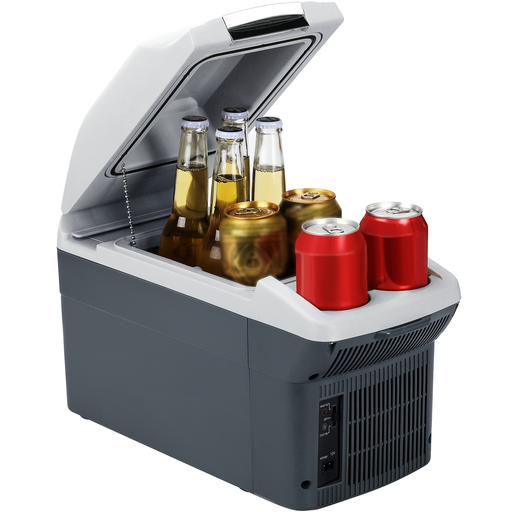
Why it suits this buyer: The 12V connection is designed for use in a car, while camping or on the go. Its 9-litre capacity is suitable for drinks, lunch and snacks.
The product specifications make clear that this model runs on 12V DC and can also be used indoors with an optional 220–240V adapter. Its stated cooling performance depends on the ambient temperature.
Cooling and warming functions, 9-litre capacity, carry strap and two cup holders.
We’ve put together a full, up-to-date list of products that meet these strict selection criteria and the applicable European safety regulations.
Always follow the instructions for your chosen model. As a general rule, keep ventilation openings clear and don’t place the appliance next to a heat source. Also measure the space needed when the door is fully open.
It depends on the annual consumption in kWh, your electricity price and how you use the fridge. Multiply the stated kWh consumption by your current price per kWh to get an estimate. Actual costs may vary depending on the ambient temperature, ventilation and temperature setting.
Lifespan varies depending on the model and how it’s used. Good ventilation, a level surface, regular cleaning and keeping the door seal clear all help the appliance work properly. When buying, check the warranty terms and make sure the instruction manual is available too.
