
Vandaag of morgen in huis

Kwaliteit gegarandeerd

Welkomstaanbiedingen ontgrendelen: GRATIS bezorging | Tot 80% korting | Gratis 30 dagen JoyPlus-proefperiode
Download de app
A mini trampoline for home may seem straightforward at first: choose a size, check the price and start bouncing. In practice, the maximum user weight, suspension system and stability are the main factors that determine whether a model remains comfortable to use. The wrong choice could leave you with a trampoline that is too small, difficult to store or unable to provide enough support during home cardio workouts.
A 40-inch model takes up around 101.6 cm of space. You also need to allow for clearance around it. So don’t just check the diameter: consider the height of the trampoline, ceiling clearance and the distance from walls, furniture and windows.
A larger 48-inch rebounder trampoline provides more room to move, but it is also heavier and takes up more space. For a small living room, a folding mini trampoline may be more practical than a larger model.
The maximum user weight is not a minor detail. A model with a 70 kg limit will not be suitable for every adult, even if the trampoline feels sturdy. You should also allow for sports shoes, clothing and any additional load caused by dynamic exercises.
If you are unsure, choose a model with plenty of capacity to spare. The product information should clearly state the maximum weight the trampoline is designed to support. Always use the trampoline with one person at a time.
A trampoline with a handle can provide extra support during simple exercises, but an adjustable bar is no substitute for a stable surface and correct use. Terms such as ‘quiet’ or ‘low-impact’ do not mean that a product is completely silent or suitable for every user.
Look at the actual design: do the feet have non-slip caps, is there a protective cover around the springs and what type of suspension is used?
Round models measuring approximately 36 to 48 inches are common for use as a fitness trampoline or indoor trampoline. Measure the following in advance:
A folding model is useful in a flat or smaller bedroom, but check that it is easy and safe to unfold. ‘Pre-assembled’ does not mean that you can skip checking the connections before first use.
Steel springs provide a distinct bouncing action. The number of springs varies from one model to another. For example, the SPORTSOUL models in this selection use either 36 or 40 steel springs, while one children’s model uses elastic bands.
According to the product description, elastic bands or bungee cords can provide a quieter rebound. Check regularly for fraying, wear or loose connections. A spring-based jumping mat should have a well-fitted protective cover that limits contact with the springs.
Consider both the total weight capacity and the construction. A steel frame, a polypropylene mat and non-slip feet are more specific points to assess than general marketing terms. Some product listings mention EN ISO 20957-1, GB 17498.1-2008 and ASTM F2276-10(2015). Always check that this information is listed for the specific model.
The standards mentioned are not a reason to overlook safety rules. Place the trampoline on a flat, stable floor, ensure there is sufficient clearance and inspect the frame, mat, springs, bands and protective cover before use.
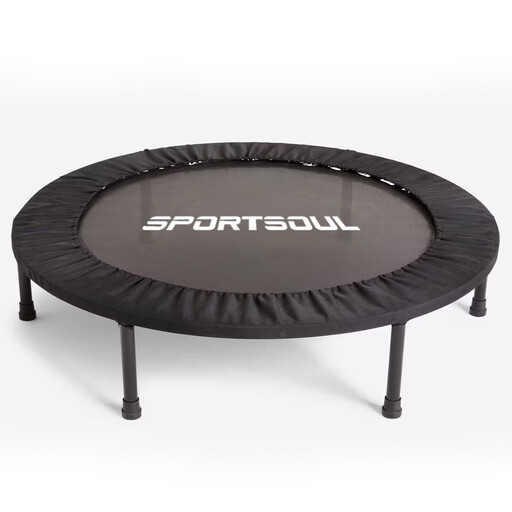
Why it suits this profile: This compact model is designed for straightforward home use and has a maximum user weight of 100 kg. It has a steel frame, a polypropylene jumping mat and can be folded away for storage.
The product information states the 100 kg weight capacity and 40-inch dimensions. This allows you to check the available space and user weight in advance.
36 steel springs, non-slip feet with sound-dampening covers and a net weight of 6.6 kg.
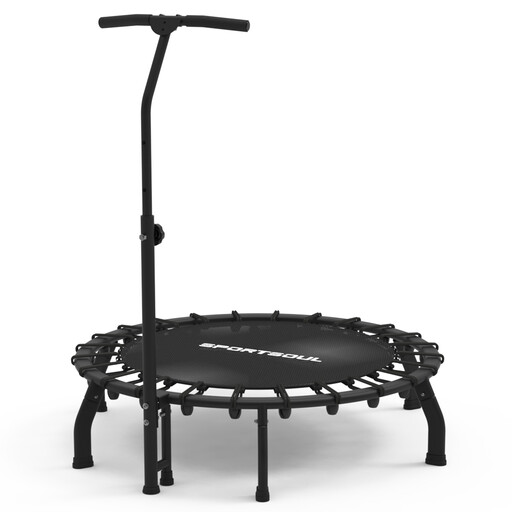
Why it suits this profile: With a stated weight capacity of 120 kg, this model supports more weight than the compact versions. The elastic resistance bands are pre-assembled.
The product specification states both the maximum weight and the band system. This makes comparison easier than relying solely on the term fitness trampoline.
42-inch size, maximum weight of 120 kg and minimal assembly thanks to the pre-assembled bands and jumping mat.
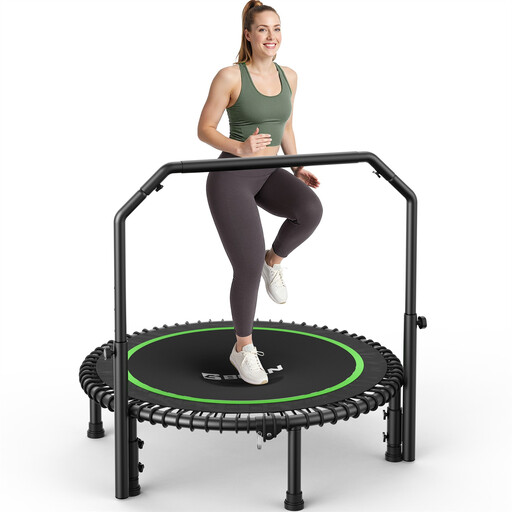
Why it suits this profile: This 102 cm rebounder is designed for adults and has a stated weight capacity of 204 kg. The adjustable handle provides extra support during different exercises.
The stated weight capacity and bungee-cord system are clearly listed in the product specification. Before buying, however, check the assembly requirements and the space around the equipment.
Steel frame, bungee cords, adjustable handle and suitable for indoor and outdoor use according to the product description.
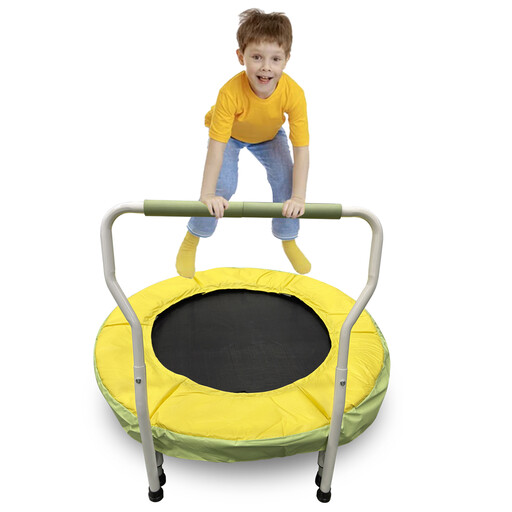
Why it suits this profile: This children’s model has a diameter of 36 inches, an adjustable foam handle and a maximum user weight of 25 kg.
The low weight limit makes it clear that this is not an adult trampoline. According to the product information, the full protective cover encloses all 24 springs.
Adjustable handle, 24 steel springs and a full protective cover. Use only under adult supervision.
A mini trampoline is not designed for high jumps or somersaults without proper preparation. Use the surface for controlled movements and allow only one user at a time. Before every workout, check:
Wear suitable sports shoes and follow the manufacturer’s instructions. If you want to use a trampoline as part of rehabilitation training or while experiencing physical complaints, it is wise to seek appropriate advice from a doctor or physiotherapist first.
We have put together a complete, up-to-date list of products that fully meet these strict selection criteria and the applicable European safety regulations.
Yes, controlled bouncing can be used as part of a home cardio workout. The intensity depends on the pace, jump height and duration. Start gently and first check that the weight capacity and dimensions are suitable for the user.
Allow at least the diameter of the model plus clearance around it. With a 40-inch trampoline, the jumping surface is approximately 101.6 cm wide. Do not place the equipment directly next to furniture or against a wall, and also check the clearance above your head.
Its lifespan depends on how frequently it is used, the user’s weight, storage and maintenance. Regularly inspect the springs or bungee cords, frame, mat and protective cover. Stop using a trampoline if any parts are damaged, stretched or have come loose.
