Which oven suits which baker?

Baking for a crowd

This baker wants to plan batches around serving time, so the main consideration is the usable baking tray and the number of bites required. Tristar lists a baking surface of 45 × 35 cm for the OV-3640; that measurement alone doesn’t tell you exactly how many pastries will fit.

Following a set recipe

This baker wants to choose an oven setting and temperature that suit the pastry and filling. The Netherlands Nutrition Centre notes that most recipes assume conventional top-and-bottom heat, so check the results when using a different setting.

Short on worktop space

This baker needs a suitable spot for a freestanding oven and compares both its external dimensions and the recommended clearance for heat to escape.

What should you look for when buying?

Compact freestanding oven

Best for: when you can plan several batches and have limited space; the Inventum OV207B has a stated capacity of 20 litres.

Trade-off: a smaller baking tray may mean more batches, and even a compact oven needs room for heat to escape.

Medium-sized freestanding oven

Best for: when you’re comparing a mid-sized option, such as the 32-litre Princess 112751 or the 42-litre Severin TO 2058.

Trade-off: the capacity in litres doesn’t tell you how many pastries will fit on the tray or how evenly several trays will bake at once.

Large freestanding oven

Best for: when you want to bake plenty of bites in time for serving and have enough safe space to set it up; Tristar lists a capacity of 60 litres and a baking surface of 45 × 35 cm for the OV-3640.

Trade-off: extra space can be useful for a party, but may not be the best fit for smaller portions afterwards.

What to consider What to look for Who should pay extra attention?
Baking tray and batches Measure the usable tray and your shaped pastries. Then plan a test batch and serving time; Tristar lists a baking surface of 45 × 35 cm for the OV-3640. If I’m expecting lots of guests, I want to know how many bites will fit in each batch with space between them. Around 36% of consumers in this scenario mainly prioritise the baking tray and number of batches.
Oven setting and baking results Compare conventional top-and-bottom heat or fan-assisted cooking with the instructions for your pastry. Check the underside as it bakes, too; a timer won’t tell you whether the pastries are cooked through. When following a set recipe, I want to match the setting to the pastry and filling rather than simply copying the temperature. Around 29% of consumers in this scenario mainly look for a suitable oven setting.
Safe clearance Measure the space and check the placement instructions for the exact model, including the clearance needed for heat to escape. If my worktop is short on space, I want to know whether the oven can be placed there safely. Around 21% of consumers in this scenario mainly need a suitable place to set up their oven.
Use after the party Think about the portions you usually bake after the party, too, and compare any energy-use figures only on a like-for-like basis. Rated power isn’t the same as measured energy use per batch. After the birthday party, I want an oven that also suits my usual portions and is practical to clean. Around 14% of consumers in this scenario mainly focus on long-term suitability.

Common buying mistakes

  • Assuming the capacity in litres tells you how many pastries fit in each batch

    An oven’s capacity doesn’t tell you how many bites will fit on the baking tray with space between them. A smaller tray may mean baking more batches.

    Compare the usable tray with the size of your shaped pastries before planning baking times and serving.

  • Using a recipe temperature unchanged with a different oven setting

    Conventional top-and-bottom heat and fan-assisted cooking don’t necessarily use the same settings. The size of each bite and its filling also affect the baking time, according to Koopmans.

    Follow the instructions for the pastry you’re using and check the colour and underside during a test batch.

  • Measuring only the exterior

    A freestanding oven needs to release heat while in use, so checking only whether its exterior fits on the worktop isn’t enough.

    Read the manual for the exact model and measure the available space again, including the recommended ventilation clearance.

    You may need to find another spot if there isn’t enough room for heat to escape.

  • Assuming a high wattage means higher running costs for your party

    Rated power isn’t a measure of electricity use per batch. Milieu Centraal recommends comparing ovens by their energy use per cycle or per year.

    Compare energy-use figures on a like-for-like basis and take into account the portions you usually bake after the party, too.

Brands to compare

Inventum

The OV207B is a compact 20-litre option, while the 60-litre OV607B offers more oven space.

  • Inventum lists a baking tray and fan-assisted cooking for both models. The OV207B also has separate top- and bottom-heat settings.
  • Capacity doesn’t tell you how many pastries will fit on each tray or how evenly several trays will bake.

Tristar

The OV-3640 is a spacious freestanding oven worth comparing if baking surface is a key consideration for your party.

  • Tristar lists a 60-litre capacity, a baking surface of 45 × 35 cm, convection and an included baking tray for this model.
  • The tray size doesn’t tell you how many pastries it can bake. Also check that the appliance fits in your chosen spot with the required ventilation clearance.

Princess

The 112751 is a medium-sized option with a stated capacity of 32 litres.

  • Princess lists a baking tray, convection, top and bottom heat, a timer and a removable crumb tray for this model.
  • The tray capacity and evenness when baking several trays at once haven’t been established; the included rotisserie doesn’t indicate how many pastries will fit.

Severin

The 42-litre TO 2058 is a medium-sized oven to compare if you want both top and bottom heat and fan-assisted cooking.

  • Severin lists four shelf positions, a baking function and both heating methods for this model.
  • Four shelf positions don’t mean four trays of pastries will bake evenly at once. Check the tray size and placement instructions.

Joybuy products

This selection includes freestanding ovens and air fryer ovens with baking functions. Compare the capacity and listed oven settings with your portions and recipe; also check the applicable CE marking on the specific product listing.

23L air fryer mini oven with dual cooking zones

Air fryer mini oven with dual cooking zones, 23 L

The baking function makes this an option to compare if you also want synchronised cooking zones.

Stated capacity: 23 L. The product description lists 15 programmes and two cooking zones that can be synchronised.

View at Joybuy
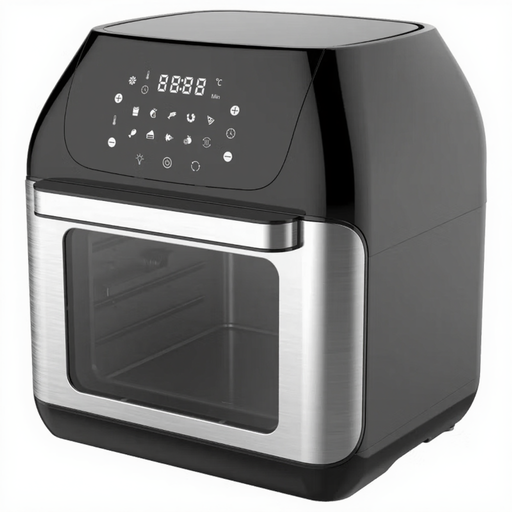
Aigostar AF12 air fryer oven, 12 L

Aigostar AF12 air fryer oven, 12 L, 1500 W

This air fryer oven is a compact option to compare with the portion size you need.

Stated capacity: 12 L. The description lists a timer, touch controls and dimensions of 336,7 × 336 × 368 mm.

View at Joybuy

ROUNY air fryer oven, 6.5 L, with viewing window

ROUNY air fryer oven, 6,5 L

The listed function for baking without turning may be worth comparing with your recipe and portion size.

Stated capacity: 6,5 L. The description lists 360° fan-assisted cooking, a viewing window and rotary controls.

View at Joybuy

Severin TO 2074 mini oven, 30 L

Severin TO 2074 mini oven, 30 L

The listed top and bottom heat and fan-assisted cooking settings can be compared with the setting your recipe calls for.

The description lists a temperature range of 100–230 °C, a capacity of 30 L and dimensions of 50 × 42 × 35 cm. Place the model on a stable, heat-resistant surface and keep the ventilation openings clear.

View at Joybuy

Wiggo WMO-E456(W) mini oven, 45 L, white

Wiggo WMO-E456(W) mini oven, 45 L, white

The available heating settings are worth checking if your recipe calls for top and bottom heat or fan-assisted cooking.

Stated capacity: 45 L; the model is rated at 2000 W. The description lists top heat, bottom heat and convection, and recommends a stable, heat-resistant spot with clear ventilation openings.

View at Joybuy

Frequently asked questions

Do you need fan-assisted cooking for vegetable pastries?

No, not if your recipe calls for top and bottom heat and your oven has that setting. According to the Netherlands Nutrition Centre, most recipes assume a conventional oven; if you use a different setting, follow the instructions for your pastry and recipe.

Can I bake the pastries before the birthday party?

If you need to store the baked bites, cool them quickly and keep them in an airtight container. Don’t leave leftovers out of the fridge for more than two hours. The Netherlands Nutrition Centre says that savoury puff pastry tart can be kept in the fridge for two days; this isn’t a set storage time for every vegetable filling.

Where should I put a freestanding mini oven?

Follow the placement instructions for the exact model and leave enough space for heat to escape. The Netherlands Fire Service recommends plugging high-powered appliances directly into a socket rather than using a cable reel or multi-socket adaptor; if you use a cable reel, unwind it completely.

What warranty applies to a purchase in the Netherlands?

According to the Dutch Government, you’re entitled to a product that works properly, and there’s no fixed statutory warranty period. If a product is faulty, contact the seller; any manufacturer’s warranty is additional.

Is CE marking compulsory for an electric mini oven?

The Netherlands Food and Consumer Product Safety Authority (NVWA) states that CE marking is compulsory for electrical products covered by the relevant regulations. The cited low-voltage rules apply to electrical equipment with a rated AC voltage of 50 V to 1000 V. Check which rules apply and verify the marking for the specific product.
