
Baker making small lunch portions
You want to bake a small treacle sponge and first check that your dish fits, with room for the batter to rise.


For an oven-baked treacle sponge to pack in your lunchbox, choose a mini oven only after checking that your filled baking dish fits and leaves room for the sponge to rise. A compact model with top and bottom heat may be enough for a small dish; if you want to make several portions or cook other dishes, extra capacity and a choice of cooking settings may be more useful. Good Food’s oven recipe uses a 1.5-litre dish and gives a cooking time of 35–40 minutes, so check the timer too, and choose an oven recipe if you want to bake it in the oven.
You want to bake a small treacle sponge and first check that your dish fits, with room for the batter to rise.
You’re looking for a compact freestanding oven and also need to consider the space around the appliance and room for the door to open.
You want to make more than one lunch portion per batch, or use the oven for other dishes too.
First decide how you want to cook your sponge and which baking dish you’ll use. Then compare the usable interior space, where the oven will go and the timer.
| What to consider | What should you check? | Who is this important for? |
|---|---|---|
| Dish size and portion | Measure the filled, ovenproof dish and check the interior space, shelf height and door opening. Allow room for the sponge to rise. | I want to be sure my dish fits and the batter has room to rise; around 36% of consumers give dish size and portion size top priority. |
| Safe positioning | Measure the space available and check the positioning instructions and clearance around the appliance in the manual. Remember to allow for the door as it opens. | If my worktop space is limited, I want to know in advance whether the oven can be placed there according to the manual; around 29% of consumers focus mainly on finding a suitable spot. |
| Portions per batch | Compare the size and positioning of your dish or dishes with the available shelf and baking tray space. Also check which cooking settings the recipe requires. | I want to bake several lunch portions at once or use the oven for more dishes; around 21% of consumers prioritise the number of portions per batch. |
| Controls and cleaning | Check the timer duration, controls and cleaning instructions. A recipe that takes 35–40 minutes needs extra consideration if the timer only runs for 30 minutes. | After baking with syrup, I want to know how to operate and clean the oven; around 14% of consumers give ease of use and cleaning top priority. |
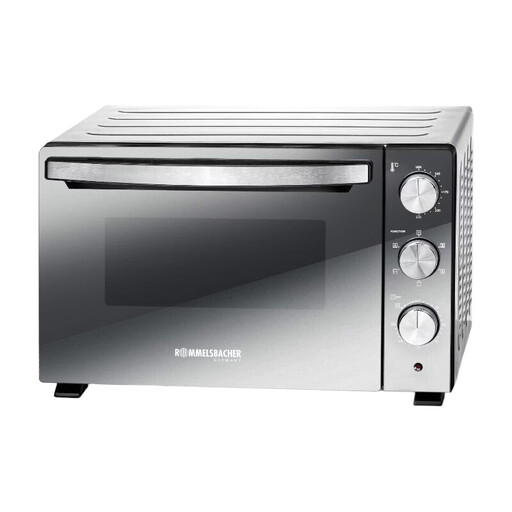
Capacity doesn’t tell you directly whether your baking dish will fit or leave enough room for the sponge to rise. Manufacturers may also specify a maximum dish size; Rommelsbacher lists round dishes up to 20 cm for the BG 950.
Choose your dish first, then compare its external dimensions with the oven’s usable interior space and shelf height.
If the dish doesn’t fit, you may need a different one or have to divide the batter between more batches.
The Rommelsbacher BG 950 timer runs for up to 30 minutes and also has a continuous setting. The Good Food recipe consulted gives a cooking time of 35–40 minutes.
Check the manual to see how the continuous setting works, keep an eye on the sponge and follow your recipe’s instructions.
An oven-baked treacle sponge and a traditional steamed pudding don’t necessarily use the same cooking method.
First choose whether you want to make an oven recipe or a steamed recipe, then select your equipment accordingly.
Steaming may require different cooking equipment or an adapted recipe.
Storage advice for ordinary cake doesn’t automatically apply to a lunch portion served with custard. The Netherlands Nutrition Centre advises not leaving perishable food out of the fridge for more than two hours, and recommends storing custard at 4 °C.
Consider the cake and custard separately, and follow the relevant chilling advice for your complete lunch portion.
If you’re taking a perishable accompaniment with you, you may need to keep it chilled during transport.
The BG 950 is a compact model to consider for a small baking dish. Rommelsbacher lists a capacity of 10 litres, top and bottom heat, and round baking dishes up to 20 cm.
The OV207B is a 20-litre freestanding oven to consider if you’re looking for more space or a choice of cooking settings. Inventum lists six settings and a timer of up to 60 minutes.
The OV-3610 is a compact oven to consider if you’re looking for adjustable top and bottom heat. Tristar lists a capacity of 10 litres and external dimensions of 37.2 × 31 × 27.2 cm.
The 112751 is a 32-litre freestanding oven to consider if you also want to use it for other baking and grilling tasks.
The TO 2052 is a small baking and toast oven to consider in terms of dish size. Severin lists a capacity of 9 litres and a power rating of 800 W.
This selection of Joybuy products includes freestanding ovens for anyone looking for more baking space, top and bottom heat or a range of oven functions.
 No image available
The stated capacity may be useful if you’re considering baking a larger batch; check that the interior space suits your dish.
Capacity: 30 litres. Temperature range: 100–230 °C. The description lists top heat, bottom heat, combined heat and convection.
 No image available
The stated capacity is worth considering if you want to use more than one dish or make several portions; compare the interior space with the dimensions of your baking dish.
Capacity: 45 litres. Power: 2000 W. The description lists six functions, including top heat, bottom heat and convection.
 No image available
The stated maximum baking dish size can help you check in advance whether your dish will fit.
Capacity: 22 litres. Suitable for baking dishes up to 25 cm in diameter. The description lists five heating settings, three shelf positions and a timer of up to 60 minutes.
 No image available
The stated capacity and shelf heights are useful points to consider if you’re looking for an oven for a range of baking tasks.
Capacity: 30 litres. Maximum temperature: 250 °C. The description lists top and bottom heat, fan-assisted cooking and three shelf heights.
 No image available
The description lists baking as one of its functions; check that your dish and amount of batter will fit in the oven.
Capacity: 30 litres. Temperature range: 30–230 °C. The description lists 21 presets, including baking, and six accessories included.
Not necessarily: check the dimensions of your dish and allow room for the batter to rise. The Good Food oven recipe consulted uses a 1.5-litre dish; if you use a smaller one, make sure it’s suitable for the amount of batter and the recipe too.
Not for every recipe: Good Food gives a cooking time of 35–40 minutes for the oven recipe consulted, while the Rommelsbacher BG 950 timer runs for up to 30 minutes and also has a continuous setting. Check the manual for how to use that setting and keep an eye on the sponge as it cooks.
Measure the space available and follow the positioning and ventilation instructions in the manual for the exact model. Remember to allow for the oven door as it opens and leave space around the appliance.
Consider the cake and custard separately, and follow the chilling advice for the perishable accompaniment. The Netherlands Nutrition Centre advises not leaving perishable food out of the fridge for more than two hours, and recommends storing custard at 4 °C.
It depends on how your recipe is made: for an oven-baked version, choose a suitable oven and baking dish, while a traditional steamed pudding calls for a steaming recipe and the necessary cooking equipment. The two methods aren’t interchangeable without adapting the recipe.