
Baker making one large tart for a get-together
Wants their chosen tin and tart to fit in one baking session, so checks the usable dimensions before looking at the capacity in litres.


Choose a mini oven based on the external dimensions of your own tart tin and the usable interior space; the capacity in litres alone won’t tell you whether the tin will fit. A larger oven can be useful if you want to bake one bigger tart, but it will take up more room on your worktop. So measure the space available too, and follow the positioning instructions. Before buying, also check the product markings and documentation for the actual item you’ll receive.
Wants their chosen tin and tart to fit in one baking session, so checks the usable dimensions before looking at the capacity in litres.
Needs an oven that can be positioned safely and may be happy to make a smaller tart or bake in an extra batch.
Wants to bake the tart in advance and also needs a safe plan for storing and serving it.
Choose this option: if fitting one larger tart is your priority and you have enough safe worktop space. Rommelsbacher gives a maximum baking tin diameter of 31.5 cm for the BG 1805/E; Tristar lists a baking surface of 45 × 35 cm for the OV-3640.
Keep in mind: these are different types of measurement, so also check the height and clearance around your own tin. A larger oven takes up more space.
Choose this option: if a medium-sized tart and a smaller worktop footprint suit you better. Severin lists a 42-litre capacity, conventional heat and fan-assisted cooking for the TO 2058; Tefal lists a 33-litre capacity and a baking setting for the Optimo OF464810.
Keep in mind: the capacity and features won’t tell you whether your tin will fit, including its rim and handles. Measure it separately.
Choose this option: if you’re deliberately making a smaller tart or baking in several batches, and you’ve confirmed that your tin will fit.
Keep in mind: a stated size for a round tray doesn’t prove that a quiche tin of the same size, but with higher sides, will fit. Baking in several batches also takes more planning when it comes to serving.
| What to consider | What should you check? | Who is this important for? |
|---|---|---|
| Will the tart fit in one baking session? | Measure the tin, including any protruding rim or handles, as well as its height. Compare these measurements with a stated maximum tin size or usable interior dimensions. An Albert Heijn Allerhande recipe uses a quiche tin measuring Ø 24 cm. | I want to use my tin for a large tart in one go, rather than relying on the capacity in litres alone. Around 36% of consumers prioritise tin size and baking in one batch. |
| Can I bake the pastry base and filling with control? | Compare the available heat settings, temperature control and timer. Follow your recipe and check that the tart is cooked through; a timer alone can’t confirm this. | If I want to keep a close eye on the base and filling, I look at the cooking controls and whether I can check the tart as it bakes. Around 29% of consumers prioritise those controls. |
| Will the oven fit safely on my worktop? | Measure the available space and the oven’s external dimensions. Follow the model’s positioning instructions and allow room for heat to escape, as advised by the Fire Service. | I want to know whether the oven will fit on my worktop and has enough room to release heat before choosing a model. Around 21% of consumers prioritise safe positioning and worktop space. |
| Can I bake ahead for the gathering? | Plan when the tart will be ready, how you’ll store it in the fridge and how much you’ll serve at once. A timer doesn’t replace checking that it’s cooked through. | If I bake ahead, I want to plan the preparation around chilling and serving the tart. Around 14% of consumers make this their top priority. |
The external dimensions of a tin, the usable interior space and the clearance around it are all different measurements. So the oven capacity alone won’t tell you whether your tart tin will fit.
First measure your own tin, including any protruding parts and its height, then compare it with a clearly stated tin size or the usable interior dimensions.
If the tin doesn’t fit, you may need a different baking tin or an extra baking session.
Severin lists fan-assisted cooking for the TO 2058, but its technical table for the TO 2056 doesn’t include this feature.
Compare the full model number and technical details for the exact model you’re considering.
The retailer’s description for the BG 1805/E lists a 60-minute timer, while Rommelsbacher’s data sheet states 120 minutes.
Ask for any disputed feature to be confirmed using the manual or data sheet supplied with the model you’ll receive.
Voedingscentrum advises that savoury tart leftovers shouldn’t be left out of the fridge for more than 2 hours.
Serve smaller portions if needed, and keep the rest covered in the fridge.
Any leftovers left out of the fridge for too long may need to be thrown away.
The BG 1805/E is worth considering if having a clearly stated maximum baking tin size is important to you.
The OV-3640 may be worth considering if you want to compare a stated baking surface with the oven’s footprint.
The TO 2058 is worth considering if you want to weigh up the stated capacity and different heat settings.
The 112754 is a medium-sized option whose features and external dimensions you can compare.
The Optimo OF464810 is worth considering if you want to compare a 33-litre capacity and a baking setting.
The Joybuy products below are freestanding mini ovens with baking functions. Compare their listed dimensions and features with your tart tin, worktop and baking plans.
 Image unavailable
Worth comparing if you want different heat settings for baking and other cooking tasks.
The product description lists a capacity of 30 litres, conventional heat, combined heat and fan-assisted cooking.
 Image unavailable
Worth comparing if you’re looking for a freestanding oven with different heat settings.
The product description lists a 45-litre capacity, conventional heat and convection. Check separately whether your own tin will fit.
 Image unavailable
Worth comparing if a clearly stated maximum tin diameter suits your baking tin.
The product description lists a 22-litre capacity and baking tins up to 25 cm. It also mentions conventional heat and settings combining it with fan-assisted cooking. Measure the height of your tin separately.
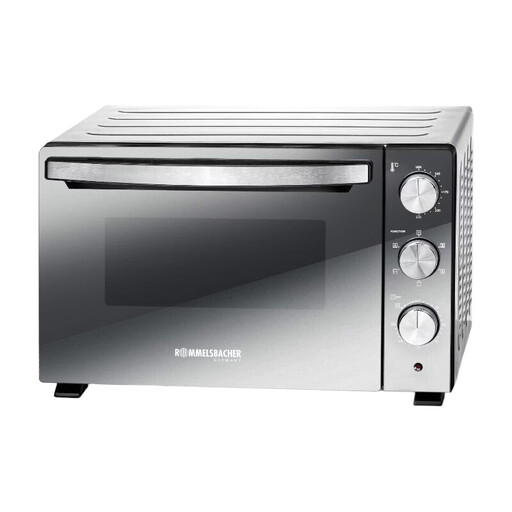 Image unavailable
Worth comparing if you want to consider conventional heat and fan-assisted cooking when choosing.
The product description lists a capacity of 30 litres and conventional heat with fan-assisted cooking. Check the tin size and specifications for the exact model.
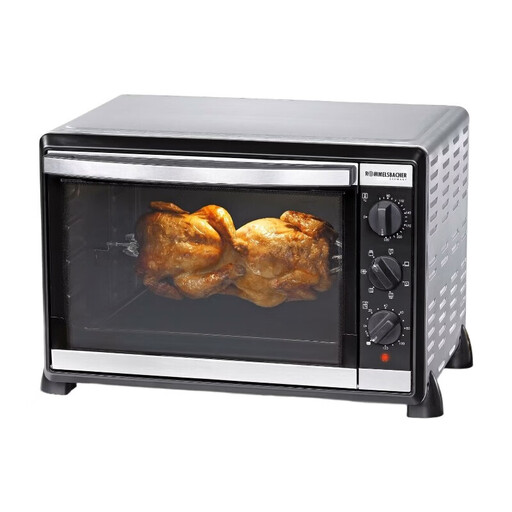 Image unavailable
Worth comparing if you want to use a larger tin in one baking session.
Rommelsbacher lists a 42-litre capacity and baking tins up to Ø 31,5 cm. The product description mentions conventional heat and an adjustable temperature of 80–230 °C. Check the height of your tin and confirm any disputed specifications for the model you’ll receive.
No, the capacity in litres alone won’t tell you whether your tin will fit. The spinach and feta recipe from Albert Heijn Allerhande we consulted uses a tin measuring Ø 24 cm; measure your own tin, including any protruding parts and its height, and compare it with the dimensions of the exact model.
Follow the positioning instructions for the exact model and make sure heat can escape from around the appliance, as advised by the Fire Service. Clean the appliance according to the manual.
Leave leftovers to cool and store them covered in the fridge. For savoury puff pastry tart, Voedingscentrum recommends a maximum of 2 days in the fridge and no more than 2 hours out of the fridge; for spinach leftovers, it recommends 4 °C and a maximum of 2 days.
According to ACM ConsuWijzer, the seller is responsible for the statutory guarantee if a product doesn’t meet the expectations you could reasonably have when used normally. Online purchases also usually come with a 14-day cooling-off period, subject to statutory conditions and exceptions.
According to the Dutch government, electrical appliances sold in the EU must carry a CE marking. Before buying, check the marking and documentation for the specific item; the model name or product page alone won’t confirm this.