
Roasting small portions
You usually roast sweet potato for one or two people and need an oven tray that can handle the portion.


Choose an oven based on the usable baking tray area for your usual portion and the clearance the appliance needs to operate safely. A compact model may be enough for one or two people. If you want to roast other vegetables at the same time, tray area matters more than capacity in litres alone. Also check the heating settings, temperature control and placement instructions for the exact model.
You usually roast sweet potato for one or two people and need an oven tray that can handle the portion.
You want to cook sweet potato with other vegetables at the same time, so you need enough tray space to spread out the ingredients.
You’re looking for a freestanding oven that fits on your worktop, with enough clearance around it for heat to escape.
| What to consider | What to look for | Who is this important to? |
|---|---|---|
| Usable cooking space | Compare the baking tray and internal dimensions with your usual portion and any oven dish you might use. | If I’m roasting for one or two people, I want to be able to spread the portion out on a tray. For around 33% of consumers, having enough usable space for a small portion is the main concern. |
| Roasting ingredients together | Check the usable tray area and whether a baking tray is included; don’t rely on the capacity in litres alone. | For a traybake, I want to fit sweet potato and other vegetables side by side. For around 25% of consumers, being able to cook these together is the priority. |
| Safe placement | Measure the space where you plan to put the oven and check the manual for the required ventilation clearance around the appliance. | In a small kitchen, I want to know in advance whether the oven will fit and have enough clearance around it for heat to escape. For around 25% of consumers, safe placement is their main purchasing concern. |
| Energy use | Where available, compare energy-use figures per cooking session on the same basis; wattage alone doesn’t tell you how much energy is used per meal. | If I use the oven often, I want to compare its energy use per cooking session rather than just its wattage. Running costs are the biggest consideration for around 17% of consumers. |
The capacity doesn’t tell you exactly how many ingredients will fit side by side on the baking tray. If the tray is too small, you may need to roast your food in batches.
Compare the usable tray and internal dimensions with the portion or oven dish you plan to use.
A small baking tray could mean an extra batch in practice.
The rated power isn’t the same as the measured electricity used for one cooking session. Milieu Centraal recommends comparing ovens by energy use per session or per year.
Compare energy-use figures on the same basis, and don’t assume a lower energy use from wattage alone.
An oven also needs space for heat to escape, so checking that it fits on the worktop isn’t enough.
Measure the available space and follow the placement and ventilation instructions in the manual for your chosen model.
Inventum describes the OV207B as a 20-litre freestanding convection oven.
Tefal says the Optimo OF444810 has a capacity of 19 litres, with both a convection setting and a conventional setting.
Tristar describes the OV-3625 as a 28-litre freestanding convection oven.
Severin describes the TO 2068 as an oven with a capacity of around 20 litres and a convection function.
This selection includes freestanding ovens for small portions and larger meals. Check each model’s listed heating settings, available cooking space and required clearance.
 Image unavailable
The listed convection function and 45-litre capacity make this a good option if you’re looking for more cooking space; check that its size suits your kitchen.
Power: 2000 W. Capacity: 45 litres.
 Image unavailable
The convection setting and included baking tray make this model an option for a small portion; check that the stated baking tin size suits your needs.
Capacity: 22 litres. Five heating settings, including convection. Temperature up to 230 °C and timer up to 60 minutes. Suitable for baking tins up to 25 cm in diameter.
 Image unavailable
The listed grill function and baking tray of up to 20 cm may suit a small portion; check the tray size and heating settings for your dish.
Capacity: 10 litres. Temperature setting: 80–230 °C. Top and bottom heat. Baking tray up to 20 cm.
 Image unavailable
The larger capacity and turbo fan are useful if you want to cook more at once; bear in mind the stated external dimensions if you have a small worktop.
Capacity: 65 litres. Power: 2000 W. Six cooking functions and a 90-minute mechanical timer. External dimensions: 60 × 49 × 40 cm.
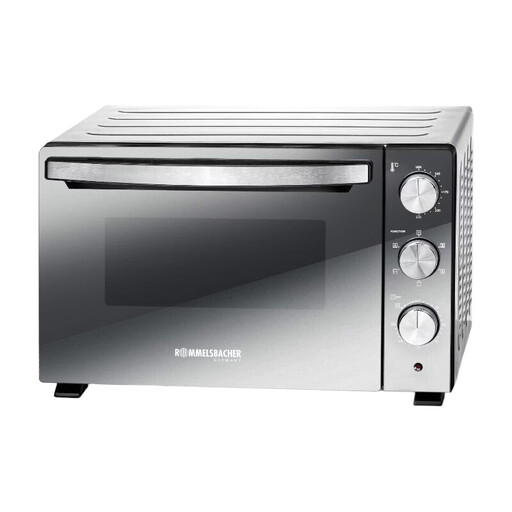 Image unavailable
The convection and 30-litre capacity may suit you if you want to cook vegetables at the same time; check how much worktop space you have available first.
Convection and top and bottom heat. Maximum temperature: 250 °C. External dimensions: 50,5 × 40,3 × 33 cm.
Follow a recipe and adjust the cooking method to suit your oven and how you cut the potato. The Voedingscentrum recommends roasting 1 cm slices of sweet potato in a preheated oven at 200 °C for 20–25 minutes, turning them after 10 minutes. These are recipe instructions, not a guaranteed cooking time for every oven.
Follow the manual for the exact model when positioning and cleaning it. Brandweer Nederland advises allowing heat to escape from around ovens. For the OV207B, Inventum describes cleaning the inside with a soft, damp cloth and a little washing-up liquid; don’t automatically apply this model-specific instruction to other ovens.
No. According to the Rijksoverheid, there is no fixed legal guarantee period in the Netherlands: you’re entitled to a product that works properly and can contact the seller if it’s faulty. A manufacturer’s guarantee may be available in addition. Online purchases generally also come with a 14-day cooling-off period after delivery, subject to legal exceptions; ACM ConsuWijzer explains how this cooling-off period works.
According to the NVWA, an electrical product covered by the Warenwetbesluit elektrisch materiaal (Dutch Commodities Act Decree on Electrical Equipment) must have a CE marking. The relevant low-voltage rules apply to electrical equipment with a rated AC voltage of 50 V to 1000 V. Check the marking and product identity of the individual item being offered; a model listing alone doesn’t confirm that the item has been checked and complies.