
Cooking for a large group
You’d prefer to roast carrots for several guests in one go, so you compare the usable baking tray size before looking at the oven’s capacity in litres.


First, choose a baking tray that can hold the portion of chopped carrots you plan to make: the oven’s capacity in litres doesn’t tell you how much you can roast at once. A larger fan oven may be a good choice if you want to cook the whole party-sized portion in one go and have enough safe space for it. A more compact model is an option if you’re happy to cook in batches. Compare the tray and external dimensions, and follow the instructions for your chosen model when positioning it.
You’d prefer to roast carrots for several guests in one go, so you compare the usable baking tray size before looking at the oven’s capacity in litres.
You can cook in batches if needed, so the oven’s external dimensions and positioning instructions are important factors.
You want a suitable baking tray and oven function, without assuming that a manufacturer’s fan-oven claim guarantees a particular result.
First, compare the baking tray with the portion you want to cook. Then look at the oven function and temperature, and consider the space it needs as well as how you expect to use it.
| What to consider | What should you check? | Who is this important for? |
|---|---|---|
| Space for your portion | Compare the space needed for the chopped carrots with the actual size of the baking tray; don’t use the oven’s capacity in litres as a measure of portion size. | If I’d prefer to roast the planned party-sized portion all at once, I first check how much space the baking tray offers. Around 36% of consumers give portion size their highest priority. |
| Baking tray and oven function | Check whether a baking tray is included and whether you can set the temperature you need, such as 200 °C for a recipe that calls for it. | If you’re looking for a suitable tray and oven function for roasted carrots, you won’t want to mistake features for a guaranteed result. Around 29% of consumers prioritise roasting results. |
| Positioning space and safe use | Compare the external dimensions and follow the model’s instructions for positioning; also check the information about the specific appliance’s CE marking. | If I have limited worktop space, I weigh up where to position the oven against how many batches I can manage. Around 21% of consumers make available positioning space their first priority. |
| Energy use and maintenance | Compare energy use on a like-for-like basis, and check which parts can be removed and how they should be cleaned. | Once the oven meets my cooking needs, I also consider running costs and cleaning. Around 14% of consumers make these their first considerations. |
Milieu Centraal recommends choosing an oven that’s no larger than necessary and comparing energy use per cooking session or per year on a like-for-like basis. The stated power rating in watts does not, by itself, tell you how much energy a complete cooking session uses.
The oven’s capacity in litres doesn’t tell you how many chopped carrots will fit on the baking tray. An oven may seem spacious, but its tray may not be large enough for your party-sized portion.
Measure or estimate how much tray space you need, then compare it with the stated tray dimensions and the included accessories.
A smaller tray may mean cooking the carrots in extra batches.
A larger model needs more space and may not suit the meals you cook on an ordinary day.
Weigh up the party-sized portion against your usual cooking, and consider cooking in batches if that works for your dish.
The rated power and stated functions don’t tell you how much electricity your cooking will use or how the carrots will turn out in your kitchen.
Compare energy use only on the same basis, and treat recipe timings as a guide rather than a guaranteed cooking time for every model.
These models illustrate different trade-offs between baking space, features and size; the features listed apply to the specific versions.
The OV457B is a freestanding fan oven supplied with a baking tray.
The OV-3640 is worth considering if the stated cooking surface size will help you choose the right portion size.
The 112754 combines an oven tray with adjustable heating and a removable crumb tray.
The TO 2058 and TO 2052 show the difference between a larger fan oven and a very compact toast oven.
This selection includes freestanding mini and tabletop ovens with a range of capacities and heating functions for baking and roasting. For each model, check the baking tray dimensions, the space it needs and the features required by your recipe.
 No image available
A freestanding oven for baking and roasting; check that the baking tray is the right size for the quantity of carrots you want to cook.
45 L capacity; top heat, bottom heat and fan function. Stated power: 2000 W.
 No image available
A freestanding oven with a baking tray for anyone weighing up tray size and available space against cooking in batches.
35 L capacity, baking tray, top and bottom heat, 90-minute timer and four shelf positions. Stated power: 1800 W.
 No image available
A more compact option to consider if space is limited; compare the available baking space with the size of your portion.
22 L capacity, temperature adjustable up to 230 °C, five heating settings and an enamelled baking/roasting tray. A baking tin up to 25 cm in diameter is also listed.
 No image available
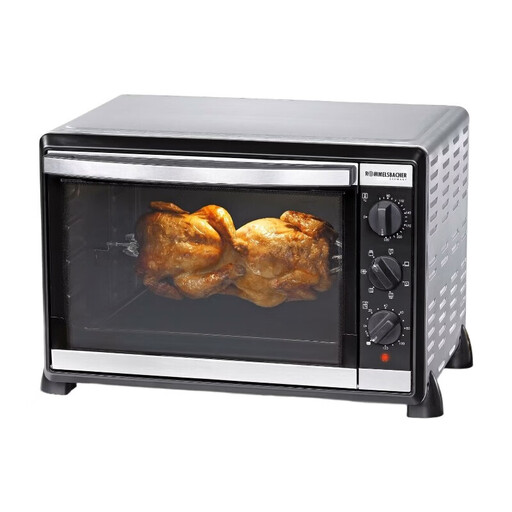
A freestanding oven to compare if you want to consider the stated temperature settings and external dimensions as well as roasting.
42 L capacity, temperature range of 80–230 °C, 60-minute timer and rotisserie function. The stated external dimensions are 41,5 × 51,5 × 36 cm.
 No image available
A freestanding oven with an integrated hob; when choosing an oven for roasted carrots, also consider how much space the appliance needs.
45 L capacity; top heat, bottom heat, fan function and grill. The product name lists 60 cm, 3534 W and a 5-year guarantee.
Compare the space needed for the chopped carrots with the stated dimensions of the baking tray, not just the oven’s capacity in litres. Measure the portion you want to cook and consider how you’ll spread it across the tray.
No. The rated power alone doesn’t tell you how much electricity a complete cooking session will use. Milieu Centraal recommends comparing energy use per session or per year on a like-for-like basis; any extra batches also count.
No. A fan function is a stated oven feature, not a guarantee of the results you’ll get. Follow the instructions for your specific model and keep an eye on the food as it cooks.
Compare the external dimensions with the space available and follow the instructions for positioning and use. The Netherlands Food and Consumer Product Safety Authority states that CE marking is mandatory for electrical products offered on the Dutch market; this doesn’t prove that a specific appliance on sale has been individually checked.
Yes. Check whether the model can be set to the required temperature. For example, Princess lists a range of 90–230 °C for the 112754. The fact that the range includes 200 °C doesn’t, by itself, tell you how long your recipe will take or what result you’ll get.