
Host with one large baking dish
You want to bake all the portions together and need to know whether your own dish will fit through the door and into the usable oven space.


First, measure your filled baking dish and the oven door opening: the stated capacity in litres alone won’t tell you whether the dish will fit. Then compare the oven settings and timer with your recipe, and check how much clearance the model needs around it. A compact oven may be enough for a small dish; for more portions, a roomier model or an oven you already own may be more practical.
You want to bake all the portions together and need to know whether your own dish will fit through the door and into the usable oven space.
You choose the oven setting and timer based on your recipe; cooking times and timer controls can vary between recipes and ovens.
You need space not only for the appliance, but also the clearance specified in the instructions for positioning it.
Start with your dish and recipe; only then compare oven capacity, features and external dimensions.
Choose this when: you’ve confirmed that your dish and portions will fit in a compact oven and you want to use as little worktop space as possible.
Trade-off: its limited dimensions may mean you need a different dish or have to bake in several batches.
Choose this when: the usable space will accommodate your dish and you want to be able to match the oven setting to your recipe.
Trade-off: for longer cooking times, check how the timer works; models with a timer limited to 60 minutes will need your attention.
Choose this when: you need a larger baking dish and the measured internal space will actually accommodate it.
Trade-off: compare the external dimensions and required ventilation clearance with the space you have available; a higher capacity in litres doesn’t prove that your dish will fit.
Choose this when: your existing oven can accommodate the dish and you only make rice pudding for guests occasionally.
Trade-off: don’t compare energy consumption without measurements for the same cooking process.
| What to consider | What should you check? | Who is this important for? |
|---|---|---|
| Dish and portions | Measure the filled dish and compare its width, depth and height with the usable interior space and door opening. | If I want to serve all the portions in one dish, I want to know in advance whether it will fit. Around 36% of consumers consider dish and portion size their most important question when choosing. |
| Oven setting and cooking time | Compare the recommended temperature and oven setting with the controls and timer on the exact model. | When I’m following a specific or lengthy recipe, I want to be able to match the settings and know how to continue cooking. Around 29% of consumers prioritise the oven setting and cooking time. |
| Positioning and ventilation | Measure the available space and follow the instructions on clearance, door opening and connection. | If I have limited worktop space, I want to know whether the oven can be positioned safely with the required clearance around it. Around 21% of consumers name positioning as their main consideration. |
| Cleaning and aftercare | Check which parts can be removed or cleaned according to the instructions, and what any additional warranty covers. | If I want to clean the appliance easily and know who to contact if it develops a fault, I look at maintenance and aftercare. Around 14% of consumers put these points first. |
The stated capacity won’t tell you whether your baking dish will fit through the door or sit on a rack.
Measure your dish and the door opening, then compare them with the usable internal dimensions. You may need a different dish or to bake in several batches.
A recipe may take longer than the timer setting on a particular model.
Compare your recipe with the instructions and check how to continue cooking for longer, following the guidance provided.
External dimensions alone don’t determine whether an oven can go in your chosen spot. Heat needs room to escape.
Measure the available space, including the clearance specified in the instructions for the exact model; you may need to find another place for it.
A paid-for extended warranty is separate from your statutory rights if a product is faulty.
The Dutch government advises you to contact the retailer if you have a problem. Compare in advance what any additional cover offers.
Paid-for additional cover may be an unnecessary expense if you don’t check what it offers on top of your existing rights.
The Inventum OV207B is a freestanding 20-litre convection oven for anyone comparing compact models with different oven settings.
The Princess 112751 DeLuxe is a freestanding 32-litre oven with convection and top and bottom heat.
The Tristar OV-3630 is a freestanding convection oven where top and bottom heat can be set separately or together.
According to Severin, the Severin TO 2058 has a 42-litre capacity, with top and bottom heat and convection, available separately or in combination.
The Rommelsbacher BG 950 is a 10-litre mini oven for anyone using a small baking tin.
This product selection includes freestanding mini ovens and oven combinations with stated capacities of 22 to 45 litres. For each model, check the internal space, settings and positioning requirements before deciding whether it suits your dish and recipe.
 No image available
According to the product description, the removable divider can create one larger oven space for a larger baking dish.
23 litres; two independent cooking spaces; 15 programmes.
 No image available
The product information lists manual temperature and timer controls; check that the settings suit your recipe.
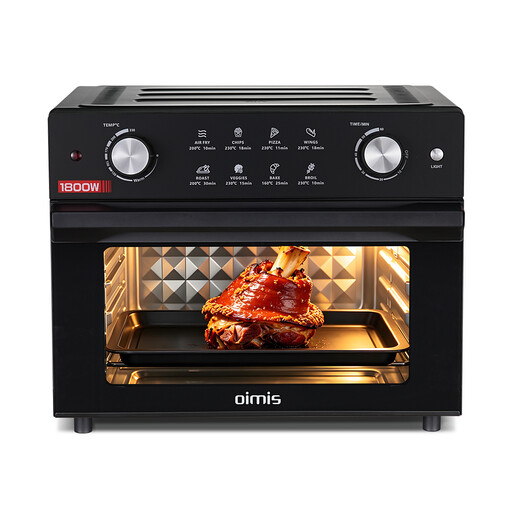
30 litres; accommodates a 13-inch pizza according to the product information; 1800 W.
 No image available
The listed top and bottom heat and convection settings give you options to compare with the oven setting in your recipe.
30 litres; temperature range 100–230 °C; top and bottom heat and convection.
 No image available
The product information lists baking and separate top and bottom heat; compare the features shown with your recipe requirements.
45 litres; six functions, including convection; 2000 W.
 No image available
The product information lists baking tins up to 25 cm; measure your own dish before considering this model.
22 litres; top and bottom heat and convection; five heating settings; temperature control up to 230 °C.
It depends on the recipe. Compare the total cooking time with the timer, and check the instructions for how to continue using the oven as directed if the recipe takes longer.
You can’t tell from the external dimensions alone. The Dutch fire service points out that heat needs to escape from an oven, so follow the positioning instructions and clearance requirements in the manual for the exact model.
The Netherlands Nutrition Centre advises cooling leftovers containing cooked rice quickly, storing them in a sealed container and not leaving them out of the fridge for more than two hours. For cooked rice, the Centre recommends a fridge storage period of two days; also follow the storage instructions for the other ingredients.
No. According to the Dutch government, statutory rights in the Netherlands have no fixed time limit: what matters is what you can reasonably expect from the product. If a product is faulty, contact the retailer; a manufacturer’s warranty or paid-for extended warranty is separate.
Check the product information and applicable conformity documentation for the model being offered. The European Commission explains that specific EU rules on CE marking apply to certain electrical and electronic equipment; a general product rule doesn’t establish whether an individual item meets the applicable requirements.