What should you look for when choosing?
Start with the baking tray and your portions, then decide which oven setting suits your recipe and check the available space and power connection. This will help you avoid letting an appealing capacity in litres or extra features distract you from the practical requirements of your workshop.
| What to consider |
What to look for |
Which consumers? |
| Baking tray and batches |
Measure the usable tray area and compare it with your portions; oven capacity in litres doesn’t determine how many wedges will fit. |
When I’m cooking for a group, I want to know how many wedges fit on one tray and how many batches the workshop allows. Around 36% of consumers prioritise baking capacity and the number of batches. |
| Oven setting and recipe |
Check the full model number to see whether it offers conventional top and bottom heat, fan-assisted cooking or both. Don’t assume a setting is available unless it’s listed for that model. |
When I’m following a recipe, I want to be able to choose the specified oven setting or know how to adjust it. Around 29% of consumers prioritise the match between the recipe and the oven setting. |
| Safe positioning and power connection |
Measure the available space and follow the positioning instructions in the manual. Check the power connection and the CE marking on the specific appliance. |
In a busy workshop space, I want to position the oven so heat can escape and the power connection is suitable for how it will be used. Around 21% of consumers prioritise safe positioning and connection. |
| Cleaning and after-sales support |
Check which parts are included, how they can be cleaned and which retailer to contact if something goes wrong. |
After several batches, I want to know how much cleaning the parts require and who to contact if there’s a problem. Around 14% of consumers care most about cleaning and after-sales support. |
The Netherlands Nutrition Centre recommends using a lower temperature for fan-assisted cooking than for a conventional oven. For example, a potato wedge recipe may specify 200 °C for 25 minutes, but this isn’t a guaranteed setting or cooking time for every mini oven, portion or workshop. Use your own recipe as a guide and check the wedges for doneness and colour during each batch.
Make sure heat can escape from around the oven. Follow the instructions in the manual for your chosen model and take other appliances in the workspace into account. The Fire Service recommends plugging high-powered appliances directly into a socket wherever possible.
Joybuy products
This Joybuy selection includes compact mini ovens with conventional settings or fan-assisted cooking, as well as air fryer ovens and a larger freestanding model. Check that each appliance’s cooking method, baking tray and space requirements suit your workshop; product names and capacity in litres don’t tell you how many wedges will fit on a baking tray.
 No image available
Rommelsbacher BGS 1400 mini oven
A good fit if you want to be able to choose between conventional oven settings and fan-assisted cooking to suit your recipe.
The product description lists a 22-litre capacity, five heating settings, temperature control up to 230 °C, a 60-minute timer and an enamelled baking/roasting tray.
View at Joybuy
 No image available
Rommelsbacher Mini Oven BG 950
Could suit small batches using a recipe based on top and bottom heat.
The description lists a 10-litre capacity, baking trays up to 20 cm and temperature control from 80–230 °C. Check that the baking area is large enough for your portions.
View at Joybuy
 No image available
Mini oven with air fryer function, 23 litres, dual zone
This model may be worth considering if you’re looking at an air fryer oven with two separate cooking compartments rather than a conventional mini oven.
The product description lists a 23-litre capacity, two cooking compartments that can be set to finish at the same time, 15 programmes and a chips programme. No independent baking results for potato wedges are available.
View at Joybuy
 No image available
Wiggo WMO-E4562H(B) freestanding mini oven
Could suit you if you’re looking for a larger freestanding model with several oven settings and have enough safe workspace.
The product name lists a 45-litre capacity, 3534 W and a 5-year warranty; the description mentions top and bottom heat, fan-assisted cooking and dimensions of 46,5 × 59,0 × 36 cm. Keep ventilation openings clear and follow the positioning instructions.
View at Joybuy
 No image available
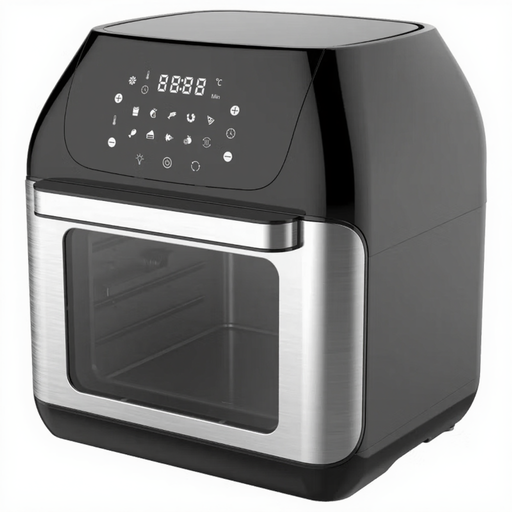
Aigostar AF12 air fryer oven
Could be worth considering if you’re looking for an air fryer oven with preset programmes; the product description doesn’t include independent baking test results for potato wedges.
The description lists a 12-litre capacity, 1500 W, a timer of up to 90 minutes and nine preset menus.
View at Joybuy
Frequently asked questions
How should you plan the cooking time for potato wedges at a workshop?
Use the time in your own recipe as a guide and check that the wedges are cooked through and golden. A recipe from the Netherlands Nutrition Centre uses 200 °C for 25 minutes, but that time hasn’t been set for every mini oven or quantity. Remember to plan for the number of batches you’ll need, too.
Should you adjust the temperature when using fan-assisted cooking?
The Netherlands Nutrition Centre recommends a lower temperature for fan-assisted cooking than for top and bottom heat. Check the setting in your recipe and keep an eye on how the wedges are cooking and what colour they are.
How should you position and plug in an oven in a busy workshop space?
Leave enough space around the oven for heat to escape and follow the instructions in the model’s manual. The Fire Service recommends plugging high-powered appliances directly into a socket wherever possible; if you do use a cable reel, unwind it fully.
Does a mini oven need a CE marking in the Netherlands?
Yes. Electrical products covered by the applicable rules must have a CE marking. The Netherlands Food and Consumer Product Safety Authority explains this requirement; check the marking on the specific appliance you’re being offered. A CE marking is a declaration by the manufacturer and isn’t the same as a mandatory, separate product inspection.
Who should you report a fault to, and is the statutory warranty always two years?
Report a faulty product to the retailer. According to the Dutch Government, there is no fixed statutory two-year warranty period in the Netherlands; what you can reasonably expect from the product is what matters. Any manufacturer’s warranty is separate from this.


