
Baking for a group
You want to make several flatbreads before you set off. So, pay attention to the usable baking tray space and the number of batches you will need, not just the oven’s capacity in litres.


Choose a mini oven based on the usable baking tray size and the number of flatbreads it can bake at a time, not just its capacity in litres. Match the heating settings to your recipe, and check that your picnic spot has a suitable power socket and a safe place to set up the oven if you plan to bake there. The Netherlands Food and Consumer Product Safety Authority says that electrical products must carry the CE mark, so check the conformity information for the specific model before considering an oven as a purchase option.
You want to make several flatbreads before you set off. So, pay attention to the usable baking tray space and the number of batches you will need, not just the oven’s capacity in litres.
You are happy to make smaller batches if the oven fits in your kitchen. When comparing its external dimensions, also allow for the space needed to let heat escape.
You bake at home and take the food with you, perhaps with toppings that need to stay chilled. Plan separately how you will cool and transport them.
First, compare the size of your flatbreads with the usable baking area. Then consider the heating settings, space for the oven and how you will transport the food after baking.
| What to consider | What to look for when buying | Who is this most important to? |
|---|---|---|
| Baking tray and portions | Compare the usable tray size with the dimensions of your uncooked flatbreads, allowing space between them. | If I’m baking for a group, I want to know how many loaves will actually fit on the tray and how many batches I’ll need. Around 40% of consumers put usable baking space first. |
| Oven settings and recipe | Check the temperature range and which settings are available separately, such as top heat, bottom heat or fan-assisted cooking. | If I’m following a recipe with a specific temperature or heating setting, I want to know whether the oven offers that option. Around 30% of consumers prioritise oven settings that suit their recipes. |
| Space and power supply | Compare the external dimensions and stated power rating with the space and socket available. Follow the placement instructions, and fully unwind any cable reel you use. | When my kitchen or baking area is short on space, I want to know whether the oven can be positioned and connected safely. Around 20% of consumers place the greatest importance on space and power supply. |
| Preparing and transporting food | Plan where you will bake and how you will cool hot food; use a cool bag for items that need to stay chilled. | If I’m taking bread and toppings with me, I want to know in advance how to transport and store them separately. Around 10% of consumers prioritise safe preparation and transport. |
An oven’s capacity does not tell you how many flatbreads will fit side by side on the baking tray. You may end up needing more batches than you expected.
Compare the usable tray size with your recipe and the dimensions of your shaped loaves.
A claim that an oven is suitable for camping does not confirm that every picnic spot has the right power socket and a safe place to set it up.
Decide whether you will bake at home or at your destination. If you plan to use it there, check the socket, the placement instructions and the space available.
Freshly baked bread and products that need to stay chilled require different approaches during transport.
Plan separately how to cool hot food, and carry chilled products in a cool bag. The Netherlands Nutrition Centre advises throwing away products normally kept in the fridge if they have been unrefrigerated for more than two hours.
The OV207B is a useful comparison for home baking, with several oven settings and a baking tray included.
The OV-3610 is a useful comparison for small batches and limited space.
The 112751 Hetelucht Oven DeLuxe is a useful comparison if you are looking for more oven space and several settings.
The TO 2058 is a useful comparison for larger bakes or if you want to use an included pizza stone.
This selection includes freestanding mini ovens for baking at home, plus a separate stone-based pizza oven option for flatbread. For every electrical model, check the conformity information for that specific model and follow the instructions for connecting and positioning it.
 No image available
An option for preparing larger quantities at home; the product description lists top heat, bottom heat and fan-assisted cooking.
The product name lists a capacity of 45 L and a power rating of 2000 W. Place the oven on a stable, heat-resistant surface in accordance with the product instructions, and keep the ventilation openings clear.
 No image available
An option if you want to compare different heating settings with your recipe.
The product description lists a capacity of 22 L, five heating settings and dishes up to 25 cm in diameter. The settings described include top and bottom heat, and fan-assisted cooking.
 No image available
A compact option for small flatbreads; the product description lists baking trays up to 20 cm.
According to the product description, the oven has a capacity of 10 L, top and bottom heat, a temperature setting from 80 °C to 230 °C and a 30-minute timer.
 No image available
An option if you are looking for a hob as well as oven space, as listed in the product name.
The product name lists a capacity of 45 L and a power rating of 3534 W. The product description lists top heat, bottom heat and fan-assisted cooking.
 No image available
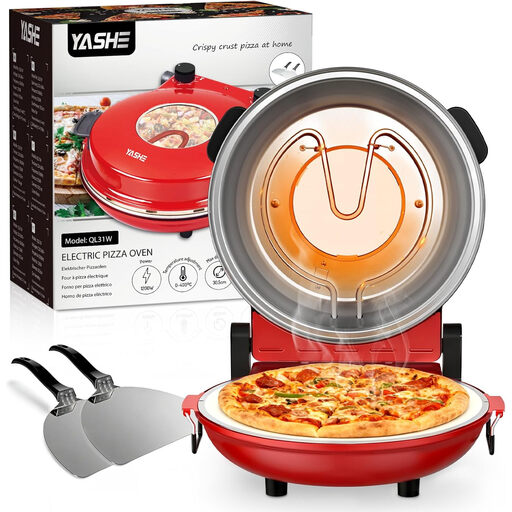
This is a pizza oven, not a mini oven; the product description lists flatbread as a use for the ceramic stone.
The product name lists a power rating of 1200 W and a 30 cm stone. The product description lists top and bottom heating and a maximum temperature of 400 °C.
Compare the usable tray size with the dimensions of your uncooked flatbreads, leaving space between them. The capacity in litres does not tell you how many loaves will fit side by side.
Only if the spot has a suitable power socket and a safe place to set up the oven, and the instructions allow you to use it there. A manufacturer’s claim that it is suitable for camping does not confirm that every picnic spot is suitable. Fully unwind any cable reel you use.
Yes. The Netherlands Food and Consumer Product Safety Authority says that electrical products must carry the CE mark. Check the applicable conformity information for the specific model; general product specifications alone do not confirm this.
Let hot food cool completely as quickly as possible before taking it with you, and carry products that need to stay chilled in a cool bag. The Netherlands Nutrition Centre advises throwing away products normally kept in the fridge if they have been unrefrigerated for more than two hours.
No. According to the Dutch government, there is no fixed statutory guarantee period in the Netherlands; you are entitled to a product that works properly, and if something goes wrong, the seller must provide a solution. A manufacturer’s guarantee is an additional benefit.