
Home baker with limited worktop space
Wants to bake small batches of oat biscuits and needs to make sure the oven’s external dimensions, door clearance and required surrounding space all fit.


In a narrow kitchen, start by checking how much space the oven needs, including the ventilation clearance specified in the manual. Then check whether the baking tray is large enough for your portions. A compact model may be a better fit for small batches, while a larger oven with more cooking settings could suit you if you often make bigger batches and have the space for it. Capacity in litres alone won’t tell you how many biscuits will fit on a tray or how they’ll bake.
Wants to bake small batches of oat biscuits and needs to make sure the oven’s external dimensions, door clearance and required surrounding space all fit.
Wants to bake fewer batches, so compares the usable baking tray size with the space available on the worktop.
Wants to bake other treats as well as biscuits, and pays attention to the difference between fan-assisted cooking and separately adjustable top and bottom heat.
First measure the available space and the required clearance; then compare the baking tray and settings with what you want to bake.
| Consideration | What to look for | Who should prioritise this? |
|---|---|---|
| Will the oven fit safely? | Measure the width, depth, height and door clearance. Allow for the ventilation space specified in the manual; the Dutch Fire Service advises that heat from appliances must be able to escape. | If I have a narrow worktop, I want the oven to fit with the required ventilation clearance. A safe fit is the main concern for around 36% of consumers choosing a mini oven for this purpose. |
| How many biscuits will fit in each batch? | Check the dimensions of the included baking tray and think about how you’ll arrange the biscuits on it. Don’t use the oven’s capacity in litres to estimate the tray size. | If I want to bake fewer batches, I look at the usable tray size rather than just the oven capacity. Tray capacity is the main priority for around 29% of consumers in this buying context. |
| Which cooking settings are useful? | Check which settings the exact model offers. The Netherlands Nutrition Centre’s recipe specifies 180 °C; that doesn’t mean every recipe calls for the same setting. | I want to bake other treats as well as biscuits, so I want a choice of cooking settings. This is the main consideration for around 21% of consumers looking for a mini oven for this purpose. |
| What about cleaning and aftercare? | Check the cleaning instructions for each part and see which accessories are included. Compare any additional warranty terms with your statutory rights against the seller. | After baking, I want to know how to remove crumbs and where to turn if something goes wrong. Cleaning and aftercare are the top priority for around 14% of consumers in this buying context. |
An oven may fit on the worktop but still not have enough space for heat to escape.
Compare the available space with the oven’s dimensions, the clearance needed for the open door and the placement instructions in the manual for the exact model.
The capacity in litres doesn’t tell you how many biscuits you can arrange on the tray.
Check the tray dimensions and whether a baking tray is included. If needed, plan to bake in several batches.
The OV207B is a 20-litre oven for anyone comparing fan-assisted cooking with separate top and bottom heat.
The OV-3615 is a 10-litre mini oven for anyone comparing compact models that come with a baking tray.
The TO 2052 is a 9-litre baking and toasting oven with a listed width of 35,8 cm.
The Vintage 0979/04 is an 18-litre conventional oven with a listed width of 40 cm.
This Joybuy selection includes ovens for baking, from compact mini ovens to larger freestanding models. Compare the external dimensions and baking tray with your available space and portion size.
 No image available
Could suit you if you want to use other baking tins as well as make biscuits, and are looking for a choice of cooking settings.
The description lists a 22-litre capacity, space for tins up to 25 cm Ø, a baking tray, a removable crumb tray and temperature control up to 230 °C.
 No image available
A compact option to compare if you want to bake a small batch and are looking for top and bottom heat.
The description lists a 10-litre capacity, a baking tray measuring up to 20 cm and an adjustable temperature of 80–230 °C.
 No image available
An oven combination to compare if you’re looking for a baking function and a choice of preset programmes.
The product name lists a 30-litre capacity; the description mentions 21 programmes, including Bake, and a temperature setting of 30–230 °C. The listed external dimensions are 456 × 430 × 365 mm.
 No image available
Only compare this larger model if you’ve measured the space available; its listed width is a significant consideration for a narrow worktop.
The product name lists a 45-litre capacity. The description mentions six functions, including top heat, bottom heat and convection, and a width of 59 cm.
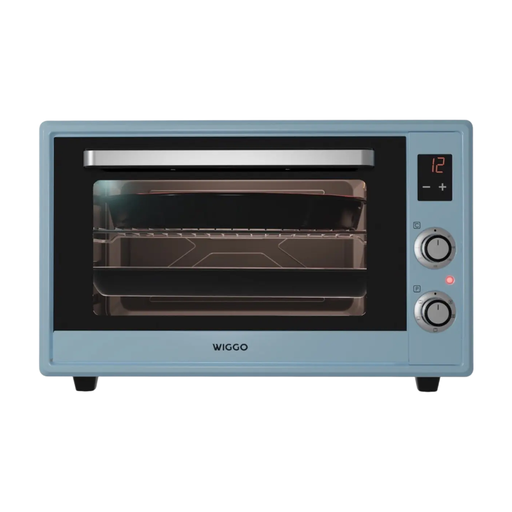 No image available
This is a midi oven, not a mini oven; only compare it if a larger freestanding oven suits the space you have available.
The product name lists a 65-litre capacity and 2000 W. The listed width is 60 cm; the description mentions six oven functions and an optional turbo fan.
It depends mainly on the size of the baking tray and how many biscuits you want to bake at once. Check the tray dimensions and allow for several batches if your portion won’t fit in one go.
Don’t rely on the external dimensions alone: allow for the ventilation space specified in the manual for the model you choose. The Dutch Fire Service advises that heat from appliances, including ovens, must be able to escape.
The recipe from the Netherlands Nutrition Centre that we looked at calls for a preheated oven at 180 °C. This is a recipe instruction, not a guaranteed setting or baking time for every mini oven, so keep an eye on your first batch.
Not automatically: any manufacturer’s or extended warranty is in addition to your statutory rights against the seller. The Dutch Government states that there is no fixed statutory warranty period for all products in the Netherlands.
Applicable European safety requirements apply to electrical equipment placed on the market in the Netherlands. According to Business.gov.nl, after assessing these requirements, the manufacturer must affix the required CE marking and draw up an EU declaration of conformity; a product listing on its own doesn’t prove that the item supplied meets these requirements.