
Bakers with limited worktop space
You’re looking for a small freestanding oven and want to consider not only its external dimensions, but also the space it needs while in use.


Start with your baking tin and where the oven can sit while in use, rather than looking only at its capacity in litres. A recipe from Leuke Recepten uses a 20 × 20 cm square tin, a temperature of 180 °C and a baking time of 25 minutes. So check that the tin will fit through the oven door and sit on the rack, and follow the placement instructions for the model you choose.
You’re looking for a small freestanding oven and want to consider not only its external dimensions, but also the space it needs while in use.
You want to keep using your existing recipe and baking tin. In that case, the tin’s dimensions, the oven opening and the usable baking space matter more than the capacity in litres alone.
You can use a smaller tin or a suitable tray, and want to compare compact ovens by their heating settings, timer and ease of cleaning.
A recipe from Leuke Recepten calls for a 20 × 20 cm tin, a temperature of 180 °C and a baking time of 25 minutes. The Fire Service advises making sure that heat from appliances, including ovens, can escape. So check both that the tin fits and that the oven’s intended position and the instructions for the specific model are suitable.
| What to consider | What should you check? | Who is this important for? |
|---|---|---|
| Space for the oven | Measure the space available and follow the placement instructions for the exact model. The Severin TO 2052 manual says not to place it in a cupboard. | If I have limited worktop space, I want to know in advance where the oven can sit while in use and how much room it needs. Around 31% of consumers say space for the oven is their top buying priority. |
| Baking tin and interior space | Compare the external dimensions of your tin with the oven opening and rack. A capacity figure in litres doesn’t confirm that the tin will fit. | If I want to keep using a particular tin, I need to know whether it will actually fit in the oven. Around 31% of consumers put tin compatibility first. |
| Temperature and baking time | Compare the heating settings, temperature control and timer with your recipe. A stated temperature range doesn’t guarantee temperature accuracy. | If I want to match the oven to my recipe, I look at the temperature and timer. Around 23% of consumers say baking controls are their top buying priority. |
| Cleaning and handling | Check which tray or crumb-collection feature is included and how the model should be cleaned according to its manual. | If you often bake small batches, easy cleaning and handling may be especially important. Around 15% of consumers name ease of maintenance as their top priority. |
A 10-litre oven isn’t automatically suitable for a 20 × 20 cm square tin. A stated maximum size for round tins also doesn’t confirm that a square tin will fit.
Measure your tin and check the oven opening and rack before choosing a model.
If the tin doesn’t fit, you may need a different tin or to bake a smaller batch.
An oven gives off heat and needs room for it to escape. The Severin TO 2052 manual says not to use it in a cupboard; instructions can vary between models.
Choose a place to use the oven in line with the manual for the exact model, and consider storage separately.
The Joybuy product page for the Severin TO 2052 lists 12 litres and 1500 W in one place, but 9 litres and 800 W elsewhere. Severin lists 9 litres and 800 W and says that this model doesn’t have a fan-assisted setting.
If listings contradict one another, compare the full model code and key specifications with the manufacturer’s information.
The TO 2052 is a 9-litre freestanding baking and toasting oven, worth comparing if you’re looking for a compact design and different combinations of top and bottom heat.
The BG 950 is a 10-litre mini oven worth comparing if the stated maximum size for round tins is relevant to you.
The OV-3610 is a 10-litre freestanding mini oven worth comparing if external dimensions, top and bottom heat, and a 60-minute timer matter to you.
The Vintage 3919 is a 10-litre conventional oven worth comparing if the appearance of an appliance on display is also important to you.
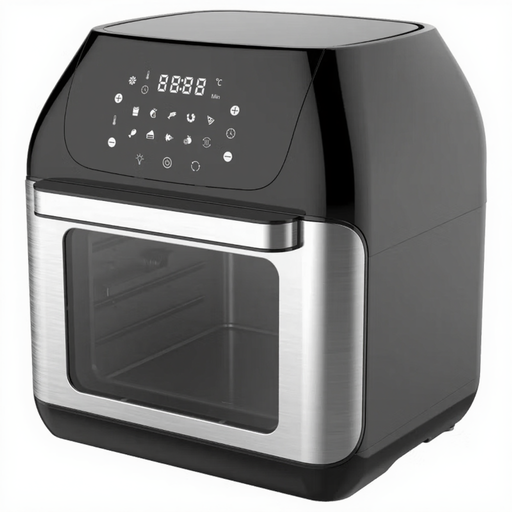
This selection includes oven air fryers and mini ovens with baking functions. Compare the listed settings with your recipe, and check that your tin and the space available for using the oven are suitable for the model you choose.
 No image available
Could suit a recipe that works well with an oven air fryer’s baking programme; check that your tin will fit inside the appliance.
The product information lists a capacity of 12 litres, a temperature setting of 80–200 °C, a timer of up to 90 minutes and dimensions of 336,7 × 336 × 368 mm.
 No image available
An option to compare if you want to make a small batch and an oven air fryer suits your recipe.
The product information lists a capacity of 6,5 litres, a temperature setting of 80–200 °C, a timer of up to 60 minutes and ‘no-turn baking’. It also mentions a viewing window and a stainless steel basket.
 No image available
Worth considering if a round tin fits and you’re looking for an oven with several heating settings; check the interior space and placement instructions for your needs.
The product information lists a capacity of 22 litres, five heating settings, top and bottom heat, a temperature setting of up to 230 °C and a 60-minute timer. It also mentions baking tins up to 25 cm in diameter, a baking tray, rack and crumb tray.
 No image available
Could suit baking with a round tin up to the maximum size stated by Rommelsbacher; that size doesn’t confirm that a 20 × 20 cm square tin will fit.
Rommelsbacher lists a capacity of 10 litres, top and bottom heat, a temperature range of 80–230 °C and a 30-minute timer with a continuous setting. The manufacturer recommends preheating before putting food in the oven.
 No image available
Only compare this model if you have enough space: its stated external dimensions take up relatively large amounts of room, so it may not suit a space-saving setup.
The product information lists a capacity of 30 litres, external dimensions of 50 × 42 × 35 cm, top and bottom heat and a temperature setting of 100–230 °C. It also mentions baking, toasting, grilling and rotisserie functions.
You can’t tell from the capacity in litres. Measure your tin and check the opening and rack of the exact model. The maximum diameter of 20 cm stated by Rommelsbacher applies to round tins and doesn’t confirm that a square tin will fit.
Don’t assume you can: the Fire Service advises that heat from ovens must be able to escape. The Severin TO 2052 manual says not to place it in a cupboard; for another model, follow its own placement instructions.
Follow your chosen recipe, preheat the oven if the recipe says to, and keep an eye on the bars as they bake. The Leuke Recepten recipe suggests covering the tin with baking paper after 15 minutes if needed; keep paper away from the heating elements and follow the oven manual.
No, extra cover isn’t compulsory. According to the Dutch Government, you’re entitled to a product that is fit for purpose when you buy it, and there is no fixed statutory guarantee period in the Netherlands. Compare any paid extra cover with the rights it adds; if a product is faulty, the retailer is your point of contact.
No. According to the European Commission, the manufacturer uses the CE mark to indicate that the product meets the applicable EU product requirements. The mark doesn’t tell you whether your baking tin will fit or how your bars will bake.