
Baker with a favourite loaf tin
Wants to know whether the tin and rising loaf will fit, and whether the oven has the right baking setting. The Inventum and Princess model specifications are examples of different oven capacities and features.


Start by checking the dimensions and height of your filled baking tin: the oven’s capacity in litres doesn’t prove that the tin will fit. Next, choose the heat setting you need, such as top and bottom heat or convection, check the timer and measure the available space, including the clearance specified in the manual. The models mentioned are examples to help guide your choice; for the specific offer, also check the relevant product safety information and required CE marking.
Wants to know whether the tin and rising loaf will fit, and whether the oven has the right baking setting. The Inventum and Princess model specifications are examples of different oven capacities and features.
Is looking for a small oven that will genuinely fit the available space, taking the door and required clearance into account. The Tristar OV-3615 is an example of a 10-litre model.
Wants to cook more than just nut loaf, so compares baking space, heating settings and cleaning. The Inventum and Princess model specifications mentioned here illustrate a range of features and sizes.
Choose this if: you’re short on worktop space and use a small tin that fits with the required clearance.
Trade-off: the small oven cavity limits your choice of tins; check the internal dimensions of the exact model.
Choose this if: you regularly bake in a cake or loaf tin and have enough worktop space for the larger external dimensions.
Trade-off: a larger capacity doesn’t guarantee that your tin will fit; compare the internal dimensions and timer for each model.
Choose this if: you also want to cook with larger tins or prepare other oven dishes, and have a dedicated spot on the worktop.
Trade-off: the Princess 112754 has stated external dimensions of 58 × 43,3 × 37 cm; also allow for the positioning instructions in the manual.
| What to consider | What should you check? | Who is this important for? |
|---|---|---|
| Will the filled baking tin fit? | Compare the tin with the usable internal dimensions and shelf height; also check the clearance around the heating elements. | I want to know first whether my tin and the dish will fit while baking. Around 36% of consumers say tin fit is their top buying priority. |
| Which heat settings and times can you set? | Check that the exact model has the heat setting your recipe needs, the right temperature range and a sufficiently long timer. | If my recipe calls for a particular heat setting and baking time, I want to be able to set them on the model. Around 29% of consumers prioritise adjustable baking heat. |
| Will the oven fit safely on the worktop? | Measure the external dimensions and follow the positioning and heat warnings in the manual. | In a small kitchen, I want to know whether the oven will fit safely without blocking access to the door. Around 21% of consumers prioritise limited worktop space and safe positioning. |
| Will it be easy to use and maintain? | Check which baking tray or rack is included and which cleaning methods are allowed by the manual. | I want to know in advance which accessories I’ll need and how to clean the oven. Around 14% of consumers say this is their top buying priority. |
The capacity doesn’t tell you the usable width, depth or height for your filled tin.
Measure your tin and compare it with the usable internal dimensions and positioning instructions for the exact model.
Severin’s data sheet lists convection for the TO 2056, while the specification field on the product page says ‘no’.
If convection is important for your recipe, ask the seller or manufacturer to confirm which features are available on the version being offered.
The stated power rating doesn’t measure the energy used during a full cooking cycle.
Only compare energy use when the figures are based on the same cooking process and measurement method.
The OV207B and OV307B are examples of freestanding ovens with capacities of 20 and 30 litres respectively.
The OV-3615 is an example of a compact 10-litre oven with top and bottom heat.
The 112754 is an example of a 45-litre freestanding oven with several heating settings.
The TO 2056 is a 30-litre model worth considering when comparing oven space and features.
A selection of mini ovens and freestanding ovens from Joybuy; check whether the features listed for each model suit your nut loaf recipe. For the specific offer, also check the relevant product safety information and required CE marking.
 No image available
An option if you want two separate cooking chambers; check whether its features are suitable for making your loaf.
The product description lists oven, grill and rotisserie functions, as well as two chambers that can be synchronised. It doesn’t explicitly mention a baking function.
 No image available
A spacious option if you’d also like a hob on top of the oven; check your tin’s dimensions separately.
The product description lists a 45-litre capacity, 2000 W, six functions, and top, bottom and convection heat. Baking, grilling and roasting functions are also mentioned.
 No image available
Worth considering if you want to use a tin up to 25 cm in diameter; compare this limit with the external dimensions of your tin.
The product description lists a 22-litre capacity, top and bottom heat, convection settings, a temperature setting of up to 230 °C and a 60-minute timer.
 No image available
A compact option if your tin fits within the stated baking tray size.
The product description lists a 10-litre capacity, a baking tray for tins up to 20 cm, top and bottom heat, and a temperature range of 80–230 °C. The timer can be set for up to 30 minutes at a time.
 No image available
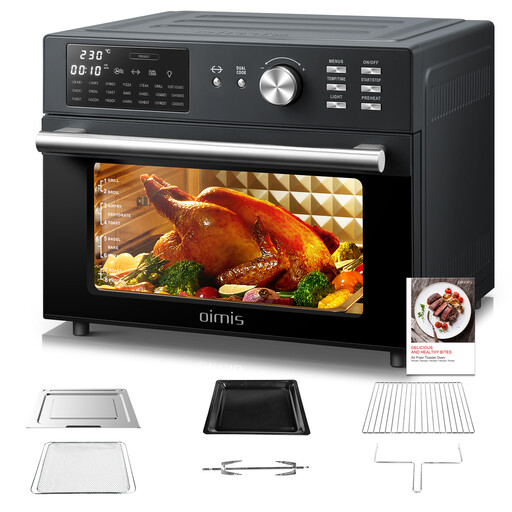
An option if you’re looking for other cooking functions and automatic settings alongside baking; check the tin size for your recipe.
The product description lists 1800 W, 360° air circulation and 21 presets. The functions include baking, roasting and air frying; the title also mentions rotisserie and dehydrating.
Follow your recipe for the right temperature and whether preheating is needed. The Netherlands Nutrition Centre recommends preheating to the temperature stated in the recipe, but also notes that preheating isn’t always necessary. A nut loaf and a vegetarian nut roast may need different cooking methods.
Follow the positioning instructions for the exact model rather than relying on the external dimensions alone. The Inventum manual warns that accessible surfaces can become hot; check the manual for your chosen model to find out how much clearance is required.
The stated power rating isn’t the same as the measured energy used for each bake. To make a useful cost comparison, you’ll need energy use in kWh, a comparable cooking process and baking time, and your own electricity tariff.
A new electric mini oven placed on the market in the Netherlands must carry the required CE marking under the applicable EU product rules. The European Commission and the Dutch government explain that the marking is a declaration by the manufacturer, not independent approval of each individual appliance. Check the information provided with the specific offer.
When you buy from a business at a distance as a consumer, the seller must give you information including details of the cooling-off period, which is usually 14 days according to the Dutch government. You also have rights to repair or replacement if a product is faulty. Check who the seller is and which terms and conditions apply to the specific offer.