
Bakers with limited worktop space
You want to bake a small batch now and then. Check not only that the oven will physically fit, but also that there will be enough clearance around it as specified in the manual.


Start by measuring the available width and depth, and allow for the clearance specified in the manual. Then choose a baking tray that suits the number of biscuits you want to bake. A 9–10-litre oven may suit small batches, while a larger model gives you more oven space but usually takes up more worktop room. Check the settings for the exact model, as retailer and manufacturer listings may contradict each other.
You want to bake a small batch now and then. Check not only that the oven will physically fit, but also that there will be enough clearance around it as specified in the manual.
You may want to bake in fewer batches, so compare the usable baking tray with the external dimensions of a larger oven.
You want to match the oven setting to your recipe. Check which heating settings the exact model has rather than relying on the product title alone.
The Fire Service advises allowing heat from appliances, including ovens, to escape. So measure the space and check the placement instructions for the exact model before comparing the baking tray and oven capacity.
| What to consider | What should you check? | Who is this important for? |
|---|---|---|
| Safe placement | Measure the width and depth, and follow the clearance requirements in the model manual; do not block any ventilation openings. | If I have limited worktop space, I want to know whether the oven will fit with the recommended clearance around it. Around 36% of consumers give placement space top priority. |
| Batch size | Check the baking tray size and the spacing your recipe requires between biscuits. | If I want to bake more biscuits per batch, I look at the usable tray size rather than just the capacity in litres. Around 29% of consumers prioritise batch size. |
| Heating settings | Compare the settings in the manufacturer's documentation with the retailer's description of the exact model. | If my recipes call for a particular heating setting, I want to know in advance whether the model actually has it. Around 21% of consumers choose primarily based on the available settings. |
| Use and maintenance | Compare energy use on a like-for-like basis, for example kWh per comparable baking session; also check the timer and cleaning instructions. | If I use the oven regularly, I pay attention to its electricity use and how much effort it takes to clean. Around 14% of consumers give these practical considerations top priority. |
The capacity in litres does not tell you exactly how many biscuits will fit on the baking tray at once.
Check the dimensions of the supplied baking tray and allow for the spacing your recipe requires.
A smaller baking tray may mean you need to bake extra batches to make the same number of biscuits.
A Joybuy title for the Severin TO 2052 lists 12 litres and 1500 W, while the product description and Severin list 9 litres and 800 W. Severin also states that this model does not have fan-assisted cooking. Information about fan-assisted cooking on the TO 2056 also differs between a retailer listing and the manufacturer.
Check the full model number and compare the retailer's information with the manufacturer's details before choosing a model for a particular setting.
An oven may fit within the available worktop space and still not have enough room to release heat.
Follow the placement instructions in the manual for your chosen model. The Fire Service advises allowing heat from appliances to escape.
The TO 2052 and TO 2056 differ in capacity and external dimensions; compare them based on the space available and how much baking room you need.
The BG 950 is a 10-litre model with top and bottom heat, designed for a small baking space.
The OV-3615 is a 10-litre model for which Tristar lists a baking tray suitable for items including biscuits.
These product options range from compact ovens for smaller baking tins to models with more oven space. Compare the external dimensions and check the manual and baking tray before choosing a model for a narrow worktop.
 No image available
The stated 45-litre capacity may be useful if you need more oven space; first check that the appliance will fit on your worktop with the specified clearance.
The product information lists top and bottom heat, convection and 2000 W. External dimensions are not provided in the available product details.
 No image available
This model may suit anyone looking for a choice of heating settings; compare the stated baking tin size with the batch you want to make.
The product information lists a capacity of 22 litres, baking tins up to 25 cm Ø, five heating settings and an adjustable temperature of up to 230 °C. External dimensions are not provided.
 No image available
The capacity and maximum baking tray size matter if you bake small batches; also measure the space on your worktop and allow for the required ventilation clearance.
The product information lists a capacity of 10 litres, baking trays up to 20 cm, top and bottom heat, a temperature setting of 80 to 230 °C and a timer of up to 30 minutes.
 No image available
The stated capacity and external dimensions help you compare the available worktop space; also bear in mind the model's placement instructions.
The product information lists a capacity of 30 litres and dimensions of 456 × 430 × 365 mm. The stated functions include baking and air circulation.
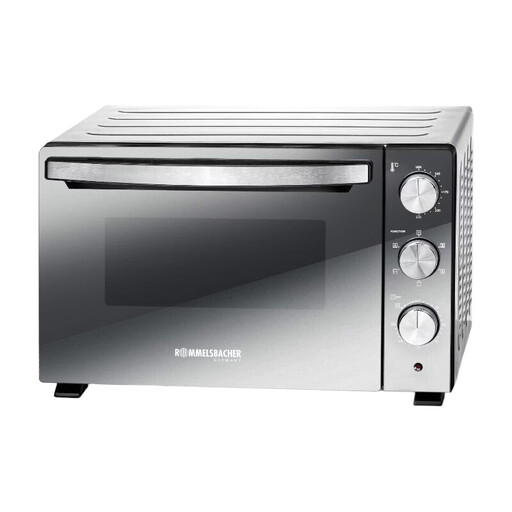 No image available
This model offers more oven space than a compact oven, but its stated width needs extra consideration if you have a narrow worktop.
The product information lists a capacity of 30 litres, a width of 50,5 cm, top and bottom heat, fan-assisted cooking and a maximum temperature of 250 °C. Manual cleaning is required.
Don't assume you can: the Fire Service advises allowing heat from appliances, including ovens, to escape. Follow the manual for your chosen model to check the required clearance; comparing the external dimensions alone is not enough.
First check which heating setting your recipe calls for and whether the exact oven model has it. Follow the recipe and the model manual, and keep an eye on the first batch; this does not guarantee identical baking results.
No, you can't tell from the wattage alone. Milieu Centraal recommends comparing ovens by their electricity use per use or per year; where possible, compare cooking on a like-for-like basis.
According to the Dutch Government, a 14-day cooling-off period applies in many cases to distance sales. Before buying, check the seller's information about the cooling-off period and any exceptions.
Yes. The Dutch Government states that electrical appliances placed on the EU market must carry a CE marking. This is a legal product requirement, but it does not in itself confirm that a specific listing has been individually checked.