
Home baker with a favourite tart tin
You want to know first whether your tin and filled tart will fit. Choose your tin before selecting an oven based on its litre capacity.


Start by measuring the diameter and height of your tart tin, then compare them with the usable interior space; the litre capacity alone doesn’t tell you whether the tin will fit. Next, choose oven settings to suit your recipe and check that you can position the oven safely. A smaller model won’t necessarily use less energy per bake.
You want to know first whether your tin and filled tart will fit. Choose your tin before selecting an oven based on its litre capacity.
You’re looking for a compact oven, but you also need to leave enough room for ventilation and a suitable electrical connection.
You want to weigh up oven settings and energy use for regular baking, without assuming that a smaller oven uses less energy per bake.
Measure your tin first, then check the oven settings and the space available for positioning it. Compare energy use per bake only when figures are available for the same task and conditions.
| What to consider | What should you check? | Who is this important for? |
|---|---|---|
| Will the tart tin fit? | Measure the tin’s diameter and height, then compare them with the usable interior space and shelf height. Rommelsbacher specifies tins up to Ø 25 cm for the BG 1055/E. | If you use a particular tin, you’ll want to know whether it will fit in the oven with the tart inside. Around 36% of consumers rank tin compatibility as their top buying priority. |
| Which oven setting suits the recipe? | Check whether top and bottom heat are available together, and whether the model also has separate bottom heat or fan-assisted cooking if you want to use those settings. | If you want to match the heat to a recipe, the available settings are especially important. Around 29% of consumers give adjustable baking heat top priority. |
| Can the oven be positioned safely? | Measure the space, including the ventilation clearance specified by the manufacturer, and check that a suitable socket is within reach. | In a small kitchen, you need to be able to leave enough space around the oven. For around 21% of consumers, safe positioning is a top priority. |
| What does the oven require in use? | Where possible, compare energy use for similar cooking tasks; also check which parts can be removed and what the cleaning instructions say. | If you often cook small dishes, you’ll want to consider ease of use and cleaning. Around 14% of consumers rank running costs and maintenance as their main consideration. |
Voedingscentrum generally describes standard recipes as using top and bottom heat. You may need to adapt a recipe when using fan-assisted cooking. Milieu Centraal recommends comparing ovens by electricity use per use or per year, rather than by wattage or capacity alone.
Litre capacity doesn’t tell you whether your tart tin will fit on the shelf or baking tray. Of the models mentioned here, Rommelsbacher explicitly states the maximum tin diameter for the BG 1055/E.
Measure your tin and compare its dimensions with the usable interior space of the exact model before you order.
You may need to clear a different spot on the worktop.
The BG 1055/E is an 18-litre mini oven. Rommelsbacher specifies that it fits tins up to Ø 25 cm.
Inventum describes the OV207B as a 20-litre oven with conventional settings, separate bottom heat and fan-assisted cooking.
Princess describes the 112713 as a 20-litre conventional mini oven.
Tristar describes the OV-3610 as a 10-litre oven for anyone considering a very compact model.
For the TO 2067, Severin specifies a capacity of around 20 litres and space for tins up to Ø 30 cm.
This selection at Joybuy includes mini ovens and ovens for small dishes; check the fit of your tin and the specified positioning clearance for each model.
 No image available
The title states a capacity of 45 litres; compare the usable interior space with your tart tin before deciding.
Product name states: 2000 W and 45 L.
Keep the ventilation openings clear.
 No image available
The title states a capacity of 35 litres; check the interior dimensions to see whether your tart tin will fit.
Product name states: 1800 W and 35 L.
The instructions specify at least 10 cm of clearance on all sides and 30 cm above; don’t place the oven in an enclosed cupboard.
 No image available
If you’re considering this model for a small tart, check the interior dimensions and whether your own tin will fit.
Follow the instructions for the required ventilation clearance.
 No image available
Compare the size of your tart tin with this model’s usable interior space before ordering.
Check the instructions for positioning the oven on a heat-resistant surface and connecting it to an earthed socket.
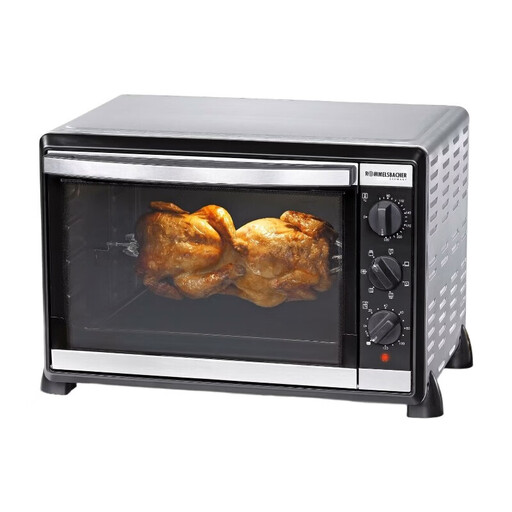 No image available
Check that the interior is suitable for your tin and the height of your filled tart.
The instructions recommend a stable, heat-resistant surface, away from water and flammable materials.
Follow the recipe you’re using. An Albert Heijn Allerhande mushroom quiche recipe says to preheat the oven to 180 °C and bake the quiche on the middle shelf; this isn’t a set temperature for every tart or mini oven. Check that it’s cooked through at the end of the baking time.
In the Albert Heijn Allerhande mushroom quiche recipe, the mushrooms are fried first to let as much moisture as possible evaporate. This is a preparation step for that recipe, not a guarantee that a particular oven will produce a crisp base.
Follow the positioning instructions for your chosen model and leave the specified space for heat to escape. The Fire Service emphasises that heat from an oven needs room to dissipate and recommends plugging high-power appliances directly into a wall socket wherever possible. For the inside of the OV207B, Inventum recommends using a soft, damp cloth with a little washing-up liquid. Check the manual for instructions on cleaning removable parts.
No, you can’t tell from the litre capacity or wattage alone. Milieu Centraal recommends comparing ovens by electricity use per use or per year; use figures based on comparable cooking tasks.
For a faulty product, the seller is responsible for providing an appropriate solution, such as a repair, replacement or refund, depending on the circumstances, according to ACM ConsuWijzer. A manufacturer’s warranty doesn’t replace your statutory rights. For an online purchase from a professional seller, you’ll generally also have a 14-day right to cancel from the date of delivery, subject to the conditions and exceptions set out by the European Union’s Your Europe.