
Baker with a small student kitchen
You want to bake a cake, but have little safe space to position an oven. That means you’ll need to consider its external dimensions, the space needed to open the door and the required ventilation clearance.


First, measure your cake tin and compare it with the oven’s usable interior space; the capacity in litres alone won’t tell you whether the tin will fit. Then choose a setting that suits your recipe and check that you can position the oven safely. If an oven you already own has the right setting and enough space, you don’t necessarily need to buy an extra appliance for this bring-and-share meal.
You want to bake a cake, but have little safe space to position an oven. That means you’ll need to consider its external dimensions, the space needed to open the door and the required ventilation clearance.
You want to take enough cake to the bring-and-share meal. Compare the usable interior space with your own cake tin, and take into account how much your recipe makes.
You want to be able to select the setting specified in the recipe and keep a close eye on the baking time. The right setting depends on the recipe you’re actually using.
Suitable for: one cake tin and limited worktop space, provided the internal dimensions suit your tin.
Trade-off: a smaller interior may leave less room around a large tin; you’ll need to check the external dimensions and space available for positioning separately.
Suitable for: anyone who wants to use a larger tin and has enough room for a bigger appliance.
Trade-off: even with a larger oven, check the usable internal dimensions, timer and positioning instructions.
Suitable for: anyone who already has an oven that fits the tin and offers the setting specified in the recipe.
Trade-off: usable space and settings vary by appliance; a microwave setting alone won’t replace the oven setting for cake.
| What to consider | What should you check? | Who should pay particular attention? |
|---|---|---|
| Cake tin and portions | Measure your tin and compare it with the usable internal dimensions; work out the number of portions from your recipe. | I want to know whether my tin will fit and whether it’ll make enough cake for the bring-and-share meal. Around 33% of consumers put the tin and number of portions first. |
| Safe positioning | Measure the space available, including room for the oven door. Follow the ventilation and connection instructions in the manual for the exact model. | In a small kitchen, I want to position the oven while keeping the required clearance free. Around 27% of consumers prioritise safe positioning. |
| Oven setting and time | Check which settings can be selected separately, how long the timer runs for and what happens when it ends. Follow the recipe you’re using. | I want to be able to select the setting specified in my recipe and keep track of the baking time. Around 20% of consumers make checking the recipe their top priority. |
| Purchase and running costs | Compare an appropriate size and, if available, energy use per baking session on the same measurement basis. Wattage alone doesn’t tell you what it will cost. | If I already have a suitable oven, I want to weigh up whether I need an extra appliance. Around 20% of consumers prioritise purchase and running costs. |
The 24Kitchen lemon drizzle recipe consulted specifies 160 °C using conventional top and bottom heat, with a baking time of around 60 minutes. Follow the instructions for the recipe you’re using; don’t automatically use the same temperature for a different oven setting. Milieu Centraal recommends comparing ovens by their energy use per use or per year, rather than by wattage alone.
The capacity in litres won’t tell you whether your cake tin will fit in the oven. A tin that fits may also need space around it.
Measure the tin and compare its dimensions with the oven’s published internal dimensions. If they aren’t available, check them before making your choice.
If your tin doesn’t fit, you may need a different cake tin or have to bake the cake in several batches.
The 24Kitchen lemon drizzle recipe consulted specifies conventional top and bottom heat. That isn’t automatically the same setting as fan-assisted cooking.
Check which oven settings are available and follow the recipe you’re actually using.
The external dimensions don’t tell you how much clearance the appliance needs while it’s in use. The connection must also be suitable for the version supplied.
Check the manual for the exact model for instructions on ventilation, the surface it should stand on and the connection. If a different plug type is listed, check which version will be supplied.
You may need to find somewhere else to put the oven if the required clearance isn’t available.
The OVCB30 is a 30-litre freestanding oven. Its published internal dimensions can help you work out whether your cake tin will fit.
The TO 2058 is a 42-litre baking and toast oven for anyone looking for more capacity and a choice of heating settings.
The 112754 is a 45-litre freestanding oven with a fan setting and conventional top and bottom heat.
The OV-3640KW is a 60-litre freestanding oven. You don’t necessarily need a larger capacity for one cake.
These Joybuy products are freestanding ovens with convection or fan-assisted cooking functions that you can compare for baking a cake; interior space, oven settings and positioning instructions vary by model.
 No image available
The 35-litre capacity may be useful if you’re baking a cake for several guests at a bring-and-share meal; check that your tin fits in the interior.
35 litres; thermometer, LED display and four-level baking rack.
 No image available
The baking function and capacity make this model worth comparing if you’re looking for an oven for cakes and other dishes.
30 litres; 21 programmes; temperature range of 30–230 °C; 1800 W; rotisserie and dehydrating functions.
 No image available
The convection function and conventional top and bottom heat suit anyone who wants to compare different settings for baking a cake.
45 litres; 2000 W; convection and conventional top and bottom heat.
According to the product information, the oven should stand on a stable, heat-resistant surface and its ventilation openings should be kept clear.
 No image available
This model may be worth comparing if you want to use both convection and conventional top and bottom heat; check how much worktop space you have available.
30 litres; 1200 W; temperature range of 100–230 °C; external dimensions of 50 × 42 × 35 cm.
The product information lists a stable, heat-resistant surface and sufficient ventilation as conditions for use.
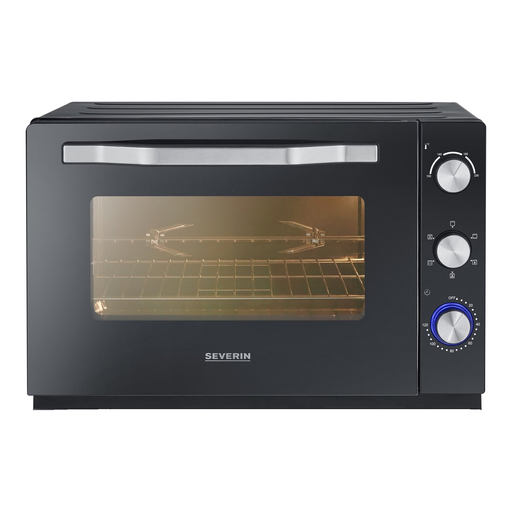 No image available
The listed convection and conventional top and bottom heat functions are worth considering if you’re looking for a compact oven with different settings; compare the interior space with your cake tin.
18 litres; 2000 W; timer up to two hours.
According to the product information, this appliance is not intended for use by children under 8 years old.
Not necessarily. The 24Kitchen recipe consulted specifies 160 °C using conventional top and bottom heat, with a baking time of around 60 minutes. Follow the recipe you’re actually using and don’t automatically use the stated temperature for fan-assisted cooking.
Measure your cake tin and compare its dimensions with the usable interior space of the exact model. Allow room around and above the tin too; capacity in litres alone doesn’t prove that it will fit.
Follow the manual for the exact model and leave the required ventilation clearance free. An Inventum manual for a different model in the OV range specifies 10 cm of clearance on all sides; don’t assume this measurement applies to the OVCB30 or another oven without checking.
You can’t tell from the wattage alone. Milieu Centraal recommends comparing ovens by their energy use per use or per year. To work out the cost of one baking session, you’ll also need a suitable estimate of how long you’ll use the oven and your applicable electricity tariff.
According to ACM ConsuWijzer, a standard online purchase of a product usually comes with a statutory cooling-off period of up to 14 days after delivery, subject to legal exceptions. If a product breaks during normal use sooner than you could reasonably expect, the seller must put things right free of charge under the statutory guarantee; there isn’t simply a fixed two-year period that applies to every oven.