
Baker of small batches
You occasionally bake a tray of ginger biscuits and want a freestanding oven that’s practical to keep on a shared worktop.


First, choose an oven that fits the available space and has a baking tray suited to the quantity you want to make; the capacity in litres doesn’t tell you how many biscuits will fit at once. A compact model suits smaller batches, while a roomier one gives you more space for baking equipment but takes up more worktop space. Follow the recipe for the temperature and oven setting. When converting a recipe to a fan oven, the Netherlands Nutrition Centre recommends reducing the temperature by around 10%. The Netherlands Food and Consumer Product Safety Authority (NVWA) states that CE marking is compulsory for electrical products, so check the marking on the exact model before buying.
You occasionally bake a tray of ginger biscuits and want a freestanding oven that’s practical to keep on a shared worktop.
You want a choice of oven settings and parts that are easy to clean after use, as your housemates also use the oven for other dishes.
You want room for larger bakeware, so you compare the oven’s capacity, shelf positions and the worktop space it needs.
Best for: when worktop space is limited and you usually bake small batches.
Consider: check the baking tray size; the capacity in litres doesn’t tell you how many biscuits will fit on it.
Best for: when housemates make different recipes and you want a choice of oven settings.
Consider: compare the external dimensions, removable parts for cleaning and the clearance specified in the manual for the exact model.
Best for: when you also want to use larger baking tins and have room for a bigger appliance.
Consider: a larger oven needs more space; Milieu Centraal points out that larger ovens use more energy.
Your main priority may be the baking results, the space available, cleaning or running costs. The table links these needs to checks to make before you buy.
| What to consider | What should you check? | Which consumers is this most relevant to? |
|---|---|---|
| Oven setting and results | Check that the oven has the setting you need, and follow the setting, temperature and baking time in the recipe. | When I bake ginger biscuits, I want to match the oven setting to the recipe and check the bake at the right time. Around 36% of consumers prioritise oven settings and baking results. |
| Space and batch size | Measure the available space and compare the usable baking tray size; litres don’t tell you how many biscuits will fit on it. | On a shared worktop, I want to keep enough room to work and have a baking tray that suits my batch size. Around 29% of consumers prioritise space and batch size. |
| Cleaning and sharing | Check whether the crumb tray or drawer is removable, and follow the cleaning instructions for the exact model. | When housemates take turns using the oven, I want to be able to remove crumbs easily and understand the controls. Around 21% of consumers prioritise cleaning and shared use. |
| Running costs and aftercare | Compare energy information only on a like-for-like basis, and check where to go if the appliance develops a fault. | I want to know whether the size suits my batches and where I can turn if the appliance develops a fault. Around 14% of consumers prioritise running costs and aftercare. |
An oven’s capacity doesn’t tell you the size of its usable baking tray. If the tray isn’t suited to your batch, you may need to bake the dough in several rounds.
Before buying, check the dimensions of the compatible baking tray and consider how much space you’ll need between portions of dough.
A baking tray that’s too small could mean extra batches.
A fan oven transfers heat more quickly. When converting a conventional recipe for a fan oven, the Netherlands Nutrition Centre recommends setting the temperature around 10% lower. A general setting won’t necessarily suit every recipe.
Start by following the oven setting in the recipe. Only adjust it when converting the recipe for a fan oven, and check towards the end that the edges aren’t getting too dark.
The fire service stresses that heat from electrical appliances needs to escape; the clearance required depends on the model.
Measure the space again, following the ventilation instructions in the manual for the exact oven.
The features below apply to the models listed, not necessarily to the entire brand. Compare the baking tray size and space needed with your kitchen.
The OV-3652 is a compact freestanding model to consider when comparing ovens for smaller batches.
The OV307B is an example to compare if several housemates use the oven for different recipes.
The 112751 is a medium-sized model to consider if oven settings and a removable crumb drawer are important to you.
The TO 2058 is a larger baking and toast oven to compare if you want to use bigger baking tins.
The TEO3000S is a 30-litre alternative to consider alongside other medium-sized ovens.
This selection includes freestanding ovens and a built-in oven for those with suitable cabinet space. Check each model’s dimensions and features to make sure they suit your kitchen and baking needs.
 No image available
A freestanding mini oven could suit you if you’re not looking for a built-in model; compare the space it needs with the layout of your shared kitchen.
The product name lists 45 L and 2000 W. Check the baking tray size and whether this exact model carries the required CE marking.
 No image available
This mini oven could suit you if you’re looking for a worktop model; compare the space it needs and the baking tray size with your batch.
Check the placement and ventilation instructions, and whether this exact model carries the required CE marking.
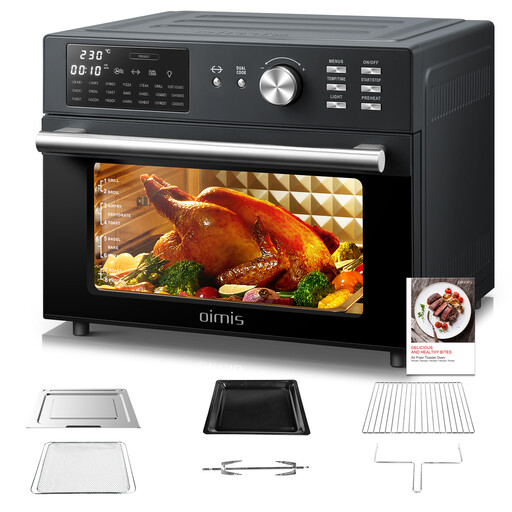 No image available
This oven could suit you if housemates also want to prepare other types of food; check that its features work with the recipes you use.
The product name lists 30 L, 21 presets, a rotisserie and dehydrator function, 1800 W and space for a 13-inch pizza. Also check whether this exact model carries the required CE marking.
 No image available
The integrated hotplate sets this model apart from an oven without one; consider whether this extra feature suits the way you’ll use it and the space available.
The product name lists 45 L and 3534 W. Check the baking tray size and whether this exact model carries the required CE marking.
 No image available
This oven is only suitable if the shared kitchen has the right space for a built-in model; it isn’t a freestanding worktop oven.
The product name lists 60 cm, 71 L, Air Fry, EcoClean Direct and energy class A+. Check the installation dimensions and whether this exact model carries the required CE marking.
Start by following the specific recipe and checking which oven setting it calls for. When converting a recipe from a conventional oven to a fan oven, the Netherlands Nutrition Centre recommends reducing the temperature by around 10% and checking towards the end that the bake isn’t getting too dark. This isn’t a fixed temperature for every recipe.
Make sure the oven can release heat and follow the clearance and cleaning instructions in the manual for the exact model. Let hot parts cool before cleaning; a removable crumb tray or drawer can make tidying up after use easier.
Yes. The Netherlands Food and Consumer Product Safety Authority (NVWA) states that CE marking is compulsory for electrical products sold on the Dutch market. This doesn’t automatically mean that a separate inspection is required. Check the marking on the exact oven model.
No. According to ACM ConsuWijzer, your statutory guarantee applies alongside a seller’s or manufacturer’s warranty. If a product develops a fault sooner than you could reasonably expect under normal use, the seller must put it right in line with the applicable conditions.