
Baking for a group lunch
You want to have enough ginger biscuits ready in time, so you’re checking the usable baking tray space, the gaps between biscuits and how many batches you’ll need.


Start by checking the usable baking tray space and how many biscuits you want to bake before lunch. The oven’s capacity in litres won’t tell you how many biscuits will fit on the tray with enough space between them. A compact model may be sufficient if you can fit extra batches into your schedule. A larger oven, or one with a choice of settings, may suit you better if you need more baking space or more control over the heat. Also measure the clearance needed for ventilation and check the CE marking on the specific appliance.
You want to have enough ginger biscuits ready in time, so you’re checking the usable baking tray space, the gaps between biscuits and how many batches you’ll need.
You may be able to plan for extra batches, but first you want to know whether the oven will fit on your worktop with the necessary ventilation clearance.
You want to choose between fan-assisted and conventional top-and-bottom heat for different recipes, so you’re looking beyond capacity in litres.
Best for: a small worktop, small batches and a schedule that allows for extra baking rounds.
Keep in mind: a small capacity won’t tell you how many biscuits will fit on the tray; check the ventilation clearance too.
Best for: anyone who wants a baking tray and a choice between fan-assisted and conventional top-and-bottom heat, without opting for a particularly large oven.
Keep in mind: capacity and oven settings don’t guarantee a particular number of biscuits or a specific baking result.
Best for: anyone looking for more baking space who has room for a larger appliance.
Keep in mind: allow for the external dimensions and clearance around the oven; a larger capacity isn’t automatically the best fit for small batches.
| What to consider | What should you check? | Who is this important for? |
|---|---|---|
| Biscuits per batch | Check the usable baking tray dimensions and plan where the biscuits will go, leaving space between them; allow for extra batches if needed. | I want to bake enough biscuits for a group lunch without running behind schedule. Around 36% of consumers focus mainly on baking capacity. |
| Heat and settings | Compare the settings on the exact model with your recipe and check which temperatures you can select. | I want to choose a setting that suits my recipe rather than relying on the capacity in litres alone. An estimated 29% of consumers give oven settings top priority. |
| Positioning on the worktop | Compare the external dimensions with the space available and allow for the clearance specified in the manual. | I have limited worktop space and want to position the oven with enough room for heat to escape. Around 21% of consumers focus mainly on positioning. |
| Use and cleaning | Check the size, the energy-use information available and how easy it is to reach the baking tray and crumb tray; don’t estimate energy use per batch from the wattage alone. | I regularly bake small batches and don’t want extra cleaning to do afterwards. Around 14% of consumers focus mainly on running costs and maintenance. |
Capacity in litres doesn’t tell you how many biscuits will fit on the supplied baking tray with enough space between them. If the tray is smaller than you need, baking several batches can take extra time.
Check the usable baking tray dimensions and lay out biscuits in your planned size, leaving space between them, before you choose.
Allow time for successive baking batches and cooling before lunch too.
Feature details can vary between models or contradict one another. For example, Tristar states that the OV-3610 does not have a convection function, while information about fan-assisted cooking on the Severin TO 2056 is contradictory.
Check the function for the full model number in the manual, or ask the manufacturer to clarify before using it as a deciding factor.
A freestanding oven needs room to release heat, so a space that is exactly the same size as the appliance may not be suitable.
Also measure the clearance around the oven specified in the manual for that model.
Wattage alone doesn’t tell you how much electricity a batch will use. Milieu Centraal recommends comparing ovens by their energy use per use or per year, and choosing no larger a size than you need.
Use comparable energy-use figures if they’re available, and take the number of biscuits you plan to bake into account.
The OV207B we looked at is a medium-sized freestanding oven for anyone who wants to choose between fan-assisted and conventional top-and-bottom heat.
The OV-3610 we looked at is a compact oven for small batches and limited worktop space.
The 112754 we looked at offers a larger oven capacity for anyone with room for a bigger appliance.
The TO 2056 we looked at is a baking and toast oven with a capacity of 30 L.
These appliances are suited to baking for a group lunch, from freestanding ovens to combinations with a baking function. Choose based on the temperature settings, the baking tray supplied, the worktop space needed and any cleaning limitations that are relevant to your baking.
 No image available
Could suit anyone looking for a freestanding oven with a baking tray and adjustable temperature for recipes.
Capacity of 35 L, 1800 W, temperature control up to 250 °C, a 90-minute timer and four shelf positions. A baking tray and wire rack are included.
The product information specifies at least 10 cm of clearance on all sides and 30 cm above the oven.
 No image available
Could suit anyone who wants to choose between conventional top-and-bottom heat and fan-assisted cooking for their baking.
Capacity of 22 L, five heating settings, a 60-minute timer and temperature control up to 230 °C. A baking tray is included.
The product description mentions baking tins up to 25 cm Ø; check whether the baking tray suits the number of biscuits you want to make.
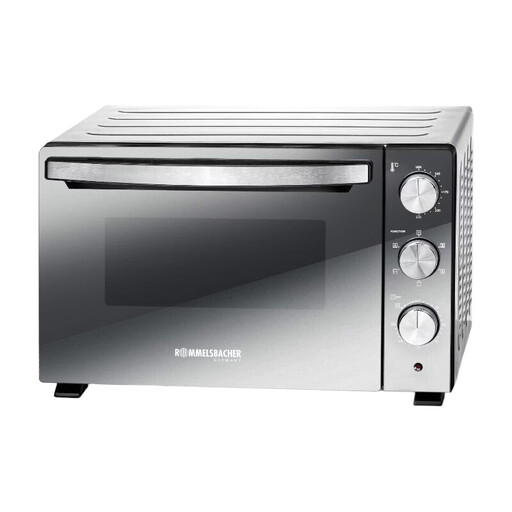 No image available
Could suit anyone looking for a larger oven with both fan-assisted and conventional top-and-bottom heating.
Capacity of 30 L and a maximum temperature of 250 °C. The product information lists fan-assisted and conventional top-and-bottom heating.
The product description says that it must be cleaned by hand.
 No image available
Could suit anyone looking for an appliance with air fryer and oven functions, as well as a baking programme.
Capacity of 30 L, 21 presets, six accessories and a temperature range of 30–230 °C. The product information lists a baking programme.
This is a combination appliance; check that its functions and accessories suit your baking needs.
 No image available
Could suit anyone who wants two hotplates as well as an oven, provided there’s enough worktop space.
Capacity of 30 L, temperature control from 100–230 °C, conventional top-and-bottom heat and fan-assisted cooking. The product title lists a baking function and 1200 W.
The oven comes with two hotplates and measures 50 × 42 × 35 cm, according to the product description.
Use your own recipe as a guide and allow time for preheating, any extra batches and cooling. Arrange the biscuits on the baking tray with enough space between them, and plan around the dimensions of the tray and oven.
Follow the manual’s guidance on clearance around the exact model to allow heat to escape. Remove crumbs and residue once the appliance has cooled safely, and check which removable parts the manufacturer says can be cleaned.
For most consumer purchases made online, you have a statutory cooling-off period of up to 14 days after delivery, subject to exceptions. ACM ConsuWijzer also explains that your statutory guarantee is separate from any manufacturer’s warranty, and that you can contact the seller for an appropriate solution if a product is faulty.
According to the Netherlands Food and Consumer Product Safety Authority, CE marking is mandatory for electrical products covered by the relevant rules. Low-voltage rules apply to electrical equipment with a rated AC voltage of 50 V to 1000 V; check the marking and instructions for the specific appliance.
Voedingscentrum advises against eating raw biscuit dough, as flour can also contain harmful bacteria. This is particularly important for young children, pregnant women, older people and anyone with a weakened immune system.