
Baker with limited worktop space
You want to bake a small batch of biscuits now and then, and first need to work out where a freestanding oven can go with enough room for heat to escape.


Don’t choose based on capacity in litres alone. Start with a freestanding mini oven that fits the available space and can vent heat as described in its manual. Then consider the usable baking tray and the settings you want. A roomier model or one with a fan-assisted setting is worth considering if the extra capacity or feature justifies the space it needs.
You want to bake a small batch of biscuits now and then, and first need to work out where a freestanding oven can go with enough room for heat to escape.
You want enough usable baking tray space and can accommodate a larger oven or bake the biscuits in several batches.
You’re weighing up the oven settings you want and the cost of use against the worktop space it takes up. Wattage on its own doesn’t tell you how much electricity one baking session uses.
First, work out where the oven can be positioned safely. Then compare the baking tray with the batch size you want, and consider which oven settings and running costs matter for your baking habits.
| Buying concern | What should you look for? | Which consumers? |
|---|---|---|
| Will the oven fit in the space? | Measure the width, depth, clearance above the oven and space for the door to open. Follow the instructions for the exact model; the Netherlands Fire Service advises allowing heat from appliances to escape. | If my worktop is narrow, I first want to know whether the oven will fit and have room to vent heat. This is a priority for around 36% of consumers who put safe positioning first. |
| How many biscuits will fit on the tray? | Compare the usable internal dimensions or supplied baking tray with the size of your biscuits and the space they need between them. Capacity in litres doesn’t directly indicate the flat baking surface. | If I’d rather bake more biscuits in each batch, I look at the tray instead of capacity alone. Around 29% of consumers prioritise baking tray space and batch size. |
| Which oven settings do I need? | Check whether each model offers top and bottom heat, a fan-assisted setting and an adjustable temperature. A feature listed on paper doesn’t prove how evenly biscuits will bake. | If I bake regularly, I want to choose the settings that suit my recipe. The settings available are the main consideration for around 21% of consumers. |
| What does regular use cost? | If the information is available, compare electricity use per baking session on a like-for-like basis and include the number of batches needed for your portion. Milieu Centraal advises comparing ovens by their energy use per use or per year. | If I bake often, I want to factor in running costs without mistaking wattage for energy use per baking session. Around 14% of consumers prioritise this cost consideration. |
Depth, space for the door and room for heat to escape also determine whether the oven will work in your chosen spot.
Measure the whole space and check the positioning instructions for the exact model before you buy.
The oven’s capacity doesn’t tell you how many shaped biscuits will fit on the baking tray at once. A smaller tray may also mean baking extra batches.
Check the usable tray dimensions and which accessories are included.
Allow for extra batches if the tray isn’t large enough for the portion you want to bake.
Wattage isn’t a measure of energy use per baking session. Product listings may also differ from the model’s specifications.
Compare energy use per baking session if that information is available, and check the model, capacity and features with the manufacturer. If product information conflicts, ask for clarification before you order.
A commercial manufacturer’s guarantee is separate from your statutory rights against the seller. The Government of the Netherlands states that there is no fixed statutory guarantee period in the Netherlands.
Read the terms of any additional cover and check what it offers beyond your existing rights.
The TO 2052 and TO 2067 illustrate the difference between a very compact oven and a roomier model.
The OV-3615 is worth considering if a small oven for small batches is your priority.
The OV207B is a 20-litre oven with a fan-assisted setting as an extra feature.
The 112713 is a conventional 20-litre oven with separately adjustable top and bottom heat.
The Vintage 0979/04 offers an 18-litre oven with heating elements that can be used separately.
This selection includes freestanding ovens and an air fryer toaster oven for baking. Compare each model’s external dimensions, required clearance and baking tray before choosing one for a small kitchen.
 Image unavailable
Worth considering if you want to use a baking tin up to 25 cm; also check that the oven will fit in your chosen spot.
The product information lists a 22-litre capacity, five heating settings, top and bottom heat, and a temperature setting of up to 230 °C.
 Image unavailable
This compact model may be worth considering for a small baking tin; the stated maximum tray size is 20 cm.
The product information lists a 10-litre capacity, external dimensions of 38,5 × 27 × 23 cm, top and bottom heat, an adjustable temperature from 80 to 230 °C and a 30-minute timer.
 Image unavailable
Given its stated external dimensions, this model is best considered if you have enough worktop space and clearance around the oven.
The product information lists a 30-litre capacity, 21 presets, air circulation, a temperature range of 30 to 230 °C and external dimensions of 456 × 430 × 365 mm. Keep the air inlet and outlet clear.
 Image unavailable
Its stated width makes this model most relevant if your worktop has enough space. Measure the area before choosing.
The product information lists a 45-litre capacity, a width of 59 cm, a hob, top and bottom heat, a fan-assisted setting, a grill and a rotisserie.
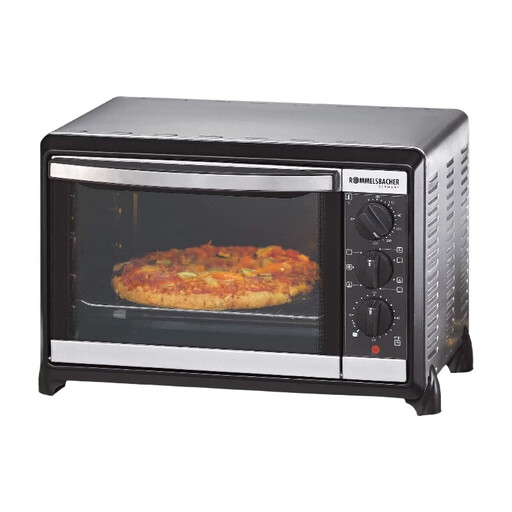 Image unavailable
Check the required clearance carefully: the product information calls for at least 10 cm of space on all sides and above the oven, and advises against placing it under kitchen cupboards.
The product information lists a 10-litre capacity, top and bottom heat, a fan-assisted setting and an adjustable temperature from 80 to 230 °C.
It depends on the positioning instructions for the exact model. Check the manual and allow room for the door to open; the Netherlands Fire Service advises allowing heat from appliances to escape. There isn’t one general clearance that applies to every model.
No. Capacity in litres doesn’t directly indicate the usable baking tray area. Check the dimensions of the supplied tray or the usable internal dimensions, then compare them with the size of your biscuits and the space they need between them.
Follow your recipe and the oven manual. Milieu Centraal notes that preheating isn’t necessary for many dishes, but that the cooking time may change. This isn’t a general instruction for every ginger biscuit recipe.
No. Wattage alone doesn’t tell you how much electricity one baking session uses. Milieu Centraal advises comparing ovens by their energy use per use or per year. Compare figures on the same basis and take the number of batches into account.
Not automatically. According to the European Union’s Your Europe website, CE marking is compulsory only for products covered by applicable harmonised EU rules that require it. The Netherlands Food and Consumer Product Safety Authority describes the low-voltage rules for electrical equipment with a rated AC voltage of 50 to 1000 V. Check the information for the model on offer; a CE logo isn’t an independent test of baking performance.