
Neighbourhood cook making lots of portions
You want to bake lots of flatbreads one after another, so planning the usable tray area and cooking pace is your main priority.


For a neighbourhood gathering, your choice depends on the size of your flatbreads and how many you want to bake one after another. A mini oven with a baking tray is versatile for traybakes and other dishes, while an electric stone oven is better suited to baking individual, thin breads on a stone. Capacity in litres won’t tell you how many pieces of dough will fit: check the usable baking area and allow for worktop space, heat dissipation and the safe storage of perishable toppings.
You want to bake lots of flatbreads one after another, so planning the usable tray area and cooking pace is your main priority.
You want to bake individual, thin breads on a hot stone and are prepared for differences in size and method between appliances.
You have little room around the oven and want to leave enough space for heat dissipation and safe use.
Start by choosing an oven with the baking area you need and a method that suits the way you want to prepare your breads. Then decide whether you’ll also use it for other dishes.
| What to consider | What to look for | Who is this important for? |
|---|---|---|
| Portions per batch | Compare the usable tray or stone area with the size of your dough pieces; don’t judge capacity by the number of litres alone. | If I want to bake several flatbreads for guests one after another, the baking area that suits my needs is the deciding factor. Around 40% of consumers prioritise how many portions will fit in each batch. |
| Baking method and crust | Decide whether you want to bake on a tray or a stone, and check the settings and instructions for your recipe. | If I want to make individual, thin breads on a stone, that method matters more to me than versatility. Around 30% of consumers say baking on a stone is their main priority when choosing. |
| Safe positioning | Measure your worktop and follow the clearance instructions for the specific appliance. | If the oven needs to go in a tight space, I want to leave enough room for safe positioning and heat dissipation. This is the top priority for around 20% of consumers. |
| Other uses and aftercare | Check which features and accessories suit your plans, and what warranty the retailer offers. | If I want to use the oven for other dishes after the neighbourhood gathering, I look for features and included accessories that suit those uses. Around 10% of consumers prioritise versatility and aftercare above all else. |
Capacity in litres and baking tray size are different measurements; the oven volume alone won’t tell you how many pieces of dough will fit.
Check the usable tray size and compare it with your dough pieces. Don’t assume a fixed number of portions will fit without testing them.
A tray that doesn’t suit the size of your dough pieces could mean extra batches and more time spent serving.
A stated maximum temperature or stone size won’t tell you how quickly you can prepare all your flatbreads.
Compare your desired bread size with the usable space, and follow the instructions for your chosen method. Don’t assume pizza cooking times will work for flatbreads.
Making individual breads on a stone can mean more work per bread; also check whether your method requires extra accessories.
Heat needs to escape from electrical appliances, even when they don’t take up much space.
Measure the space where you plan to put the oven and leave the clearance specified in the manual for your chosen model.
Tristar describes the OV-3660 as a mini oven with a baking tray, convection and a stated capacity of 38 litres.
The manufacturer presents the TO 2058 as a mini oven with fan-assisted cooking and a pizza stone.
According to the manufacturer, the BG 1550 is a 30-litre mini oven with several heating settings.
The Ariete 0909 is an electric pizza oven with a stone, designed for a different approach from tray baking.
According to Ooni, the Volt 2 is a compact electric pizza oven with a stone.
This selection includes electric pizza ovens with a stone and mini ovens for baking and other oven uses. For each model, check whether the usable baking area, features and space available suit your plans.
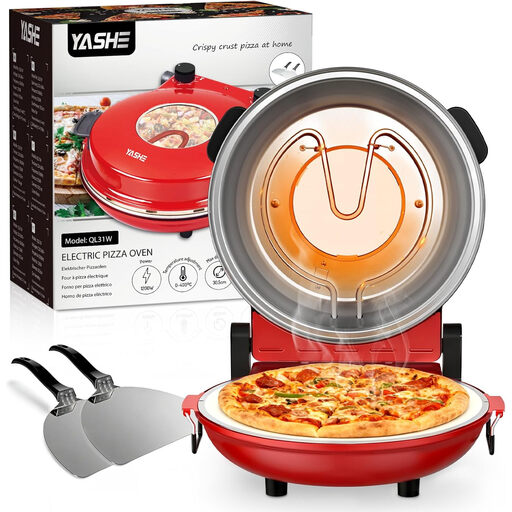 No image available
Suitable for baking on a stone; the product description lists flatbreads as one of its uses.
The title mentions top and bottom heating, a timer and a viewing window. The product description warns that surfaces become very hot during use: wear heat-resistant gloves and don’t touch the casing.
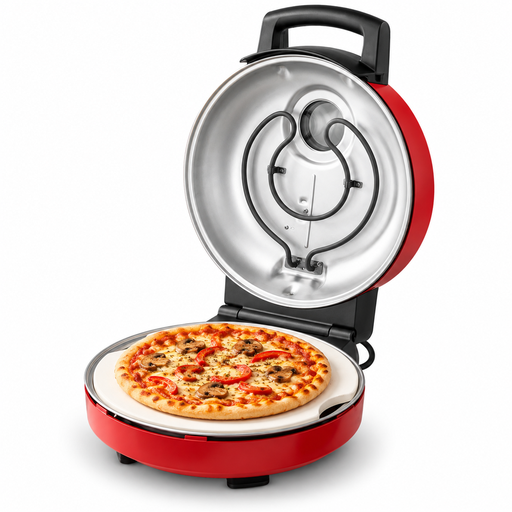 No image available
An option for baking on a stone; the stated stone diameter doesn’t mean dough will fit across the full diameter.
The title lists a maximum temperature of 400 °C, an adjustable thermostat, a viewing window and a 30-minute timer. For outdoor use, the product description recommends a sheltered spot.
 No image available
The description mentions baking and a pizza function, so this model could be a good fit if you want to switch between cooking methods.
The title lists two zones and 15 programmes. According to the product description, the removable divider can be taken out to combine the two compartments into one.
 No image available
A good fit if you want to bake flatbreads on a tray and use the oven for other dishes too.
The product description lists convection, top and bottom heat, a grill and a rotisserie. Keep the vents clear and don’t leave the appliance unattended while it’s in use.
 No image available
An option geared towards baking trays or tins; check whether the stated tin size is suitable for your flatbreads.
The product description lists a capacity of 22 litres, five heating settings including fan-assisted cooking, and an adjustable temperature up to 230 °C. It mentions baking tins up to 25 cm in diameter; this isn’t a stated usable baking tray size.
No. The capacity in litres won’t tell you how many pieces of dough will fit on a tray or usable stone. Compare the size of your dough pieces with the baking area; for example, Rommelsbacher publishes the BG 1550’s baking tray dimensions separately.
Follow the positioning instructions for your model and make sure heat can escape from the oven. The Netherlands Fire Service recommends plugging high-power appliances directly into a socket where possible, and fully unwinding any cable reel in use.
The Netherlands Nutrition Centre recommends setting your fridge to 4 °C and not leaving highly perishable foods out of the fridge for more than two hours; throw them away after that. Plan how much you put out accordingly.
No. According to the Dutch Government, there is no fixed term for the statutory guarantee in the Netherlands; what you can reasonably expect depends, among other things, on the product and the purchase information. If a product is faulty, contact the retailer.