
Bakers planning several batches
If you want to bake a larger quantity to sell, check how many flatbreads will actually fit on the tray or stone. The stated oven capacity alone won’t tell you that.


When baking several flatbreads in each batch, the usable size of the baking tray or stone matters more than the oven’s capacity in litres. Measure your dough and compare it with the baking surface. A compact model may suit smaller flatbreads and limited worktop space, but you may need to plan more batches and test the cooking time with your own recipe. The NVWA also states that food for sale must be prepared, sold and stored safely and hygienically; choosing an oven does not take care of that.
If you want to bake a larger quantity to sell, check how many flatbreads will actually fit on the tray or stone. The stated oven capacity alone won’t tell you that.
For smaller flatbreads and limited worktop space, both the oven’s external dimensions and its usable baking surface matter. Compare the appliance size with the space available, and the tray size with your dough.
If you want to experiment with your own dough, compare the available temperature range and heating settings. Manufacturer specifications don’t guarantee a particular baking result.
A good fit if: you want to bake larger flatbreads or several at once, and baking space matters more to you than a small footprint. Severin lists a 42-litre capacity and a 29 cm pizza stone for the TO 2058; Tefal lists a 33-litre capacity and a baking tray for the Optimo OF4648.
Bear in mind: capacity in litres doesn’t tell you how many flatbreads will fit on the tray, and a larger oven takes up more space. Check the baking surface dimensions and the placement instructions for your chosen model.
A good fit if: you bake small flatbreads in successive batches and have limited worktop space. Princess lists a 10-litre capacity and a baking tray for the 112701; Rommelsbacher specifies that the BG 950 accommodates baking tins up to 20 cm in diameter.
Bear in mind: a smaller baking surface may mean you need more batches. Measure how many flatbreads fit on the supplied tray.
First decide how many flatbreads you want to bake in each batch and how much space you have. Then compare the models’ baking surface, settings and cleaning options.
| What to consider | What should you check? | Who will find this important? |
|---|---|---|
| Baking capacity per batch | Measure your shaped flatbreads and compare them with the internal dimensions of the tray or stone. Check how many will fit with space between them. | For a bake sale, I want to know how many batches to plan for, not just the oven’s capacity in litres. Around 36% of consumers prioritise baking capacity per batch. |
| Worktop space | Compare the external dimensions with the space available, and follow the recommended clearance for your chosen model. | If my worktop space is limited, I want to know whether the oven can sit there safely and practically. Around 29% of consumers prioritise the workspace available. |
| Baking settings | Check the adjustable temperature range, heating settings and timer, then try your own recipe. | I want to be able to adjust the settings to suit my dough and run a test batch. Around 21% of consumers place the most importance on control over the baking process. |
| Cleaning and support | Check which parts are removable, read the cleaning instructions and keep your proof of purchase. | After several batches, I want to know how to clean the tray and oven interior, and who to contact if something goes wrong. Around 14% of consumers prioritise maintenance and support. |
The oven’s capacity in litres doesn’t indicate the usable surface area of the tray or stone. Stated baking dimensions also vary between compact models.
Compare the size of your shaped flatbread with the tray or stone, and plan a test batch before the sale.
A smaller baking surface may mean more batches than you had planned.
The appliance’s external dimensions don’t necessarily tell you how much clearance it needs when in use.
Read the placement instructions for the exact model you’ve chosen before deciding where to bake.
The NVWA states that food at markets and events must be prepared, sold and stored safely and hygienically, even when the seller is a private individual.
As well as choosing an oven, plan how to work cleanly and store ingredients and toppings appropriately.
Allow time and make sure you have suitable facilities for hygienic preparation and storage.
The TO 2058 is a larger baking and toast oven for comparing if you want a bigger stone and a choice of heating options.
The Optimo OF4648 is a mid-sized option if you’re looking for a baking tray, convection and a choice of settings.
The 112701 is a compact option for smaller quantities and limited worktop space.
The BG 950 is a compact oven for which the manufacturer specifies the maximum diameter of baking tins.
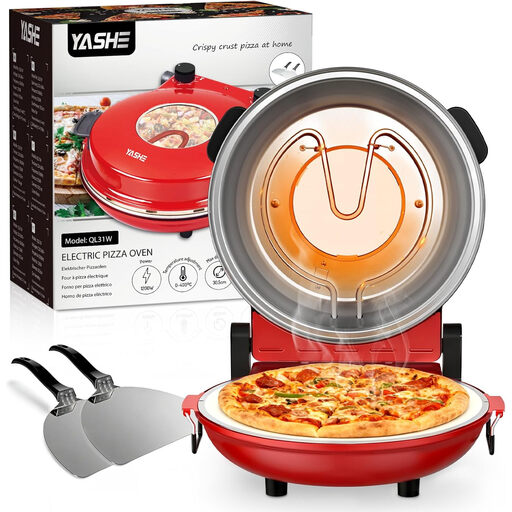
This selection includes pizza ovens and mini ovens for baking flatbreads, from compact options to larger models. Before you buy, check that the usable baking surface suits your dough and baking plan.
 No image available
The product description lists flatbreads as a suggested use. Check that your dough will fit on the stone, and test your recipe in a trial batch.
The product title specifies top and bottom heat and a built-in timer.
 No image available
An option to compare if you’re looking for a larger oven for baking in batches. Measure the usable baking space and compare it with the size of your flatbreads.
Try a batch with your own dough before deciding on the cooking time for your bake sale.
 No image available
A larger oven option to consider if you’re planning several batches. The product title states a 45-litre capacity; also check the usable tray size for your flatbreads.
Compare the external dimensions with your worktop and follow the model’s placement instructions.
 No image available
A mini oven to consider if you’re planning smaller batches. Check the size of the supplied baking tray and how many flatbreads will fit on it.
Test the settings with your own recipe before planning the total baking time.
 No image available
The compact BG 950 may suit small flatbreads and limited workspace. Measure your flatbreads and allow for the possibility of extra batches.
Rommelsbacher lists a 10-litre capacity, baking tins up to 20 cm in diameter, an adjustable temperature range of 80 to 230 °C, top and bottom heat, and a fold-down crumb tray.
Measure one shaped flatbread and the usable tray or stone, then try a batch. This will help you plan your own baking time and how many flatbreads you can bake at once; the oven’s capacity in litres or maximum temperature won’t tell you that on its own.
Check the external dimensions, clearance and electrical connection in the manual for your model. Let the oven cool and follow the cleaning instructions for that model; Rommelsbacher lists a fold-down crumb tray for the BG 950.
The NVWA states that a food safety plan is compulsory for anyone who prepares and sells food several times a year. The NVWA also says that food at markets and events must be prepared, sold and stored safely and hygienically, including by private individuals. This information doesn’t automatically mean that the same plan requirement applies to a one-off sale.
The NVWA distinguishes between prepacked and non-prepacked products: for prepacked products, allergen information must appear on the label; for non-prepacked products, you must provide the information to consumers in another way. Make sure your approach suits the way you sell the flatbreads.
According to ACM ConsuWijzer, your statutory guarantee applies alongside any retailer’s or manufacturer’s guarantee. If a product breaks down sooner than you could reasonably expect when used normally, the retailer must offer an appropriate solution free of charge.