
Baker making Dutch butter cake squares
You want to use a square tin so you can cut neat pieces once the cake has cooled. Rutger Bakt recommends a 20 × 20 cm tin; be sure to measure the rim and any handles on your own tin too.


Choose a mini oven based on the external dimensions of your baking tin, the oven setting required by your recipe and the space the appliance needs—not just its capacity in litres. Rutger Bakt uses a 20 × 20 cm square tin for Dutch butter cake at 170 °C; Koopmans gives a different recipe using a round Ø 24 cm tin, with different temperatures for a conventional electric oven and a fan oven. Measure your tin and follow one recipe, check the placement instructions and, for the exact model, look for the CE marking too: the NVWA states that it is compulsory for electrical products.
You want to use a square tin so you can cut neat pieces once the cake has cooled. Rutger Bakt recommends a 20 × 20 cm tin; be sure to measure the rim and any handles on your own tin too.
You’re looking for a compact oven, but you also need to leave room for heat to escape. Brandweer Nederland advises that heat from appliances, including ovens, must be able to escape.
You want to follow recipes that call for conventional heat or a fan setting. Koopmans gives different temperature settings for each oven mode; Inventum lists both heating options for models including the OV207B.
Start with your baking tin and the oven setting specified in the recipe. Then check that the oven will fit on your worktop with the required clearance around it.
| What to consider | What should you check? | Who is this important to? |
|---|---|---|
| Will the baking tin fit? | Measure the tin, including its rim and handles. Compare its external dimensions with the rack and the door opening. | I want to be able to use my square tin, so I measure any parts that stick out too. Around 36% of consumers prioritise a good fit for their tin. |
| Which oven setting? | Choose a recipe first, then check that the oven offers the required setting and temperature. | When I follow a recipe, I want to be able to set the specified oven mode and temperature; conventional heat and a fan setting are not always interchangeable. Around 29% of consumers prioritise having the right settings for their recipes. |
| Will the oven fit safely? | Measure the available space and follow the placement and ventilation instructions for the specific model. | On a small or shared worktop, I want to know how much clearance the oven needs. Around 21% of consumers prioritise safe placement. |
| Practical after the bring-and-share? | Check which tray and rack are included, and read the cleaning instructions. | I want to use the oven for other things later too, so I look at the accessories and how easy it is to maintain. Around 14% of consumers prioritise usefulness after the bring-and-share and ease of maintenance. |
The capacity in litres doesn’t tell you whether your baking tin will fit through the door or sit on the rack. A stated baking area, such as the one for the Tristar OV-3620, doesn’t confirm that a tin with parts that stick out will fit either.
Measure the outside of your tin and compare it with the model’s usable interior space, door opening and rack.
Recipes may specify different temperatures for conventional heat and a fan setting. For example, Koopmans specifies 180 °C for baking in an electric oven and 165 °C for a fan oven in its recipe.
Use the setting and temperature from the same recipe, and check the cake towards the end of the stated baking time.
An oven that fits on your worktop won’t necessarily have enough room for heat to escape. Brandweer Nederland points out that heat from an oven must be able to escape.
Before you buy, check the clearance specified in the manual for placing the oven.
The OV-3620 is a compact oven worth comparing if conventional heat is all you need and its stated baking area suits your tin.
The OV207B and OV307B are examples of freestanding ovens with conventional heat and a fan function.
The TO 2058 is a larger mini oven to compare if you also want to bake other dishes.
The 112754 is an alternative with a larger stated capacity, for anyone with enough worktop space to accommodate it.
The Joybuy options below include compact ovens with conventional heat and larger baking or air fryer ovens. Compare the listed features with your recipe and the space on your worktop; for the exact model, check the CE marking too, which the NVWA states is compulsory for electrical products.
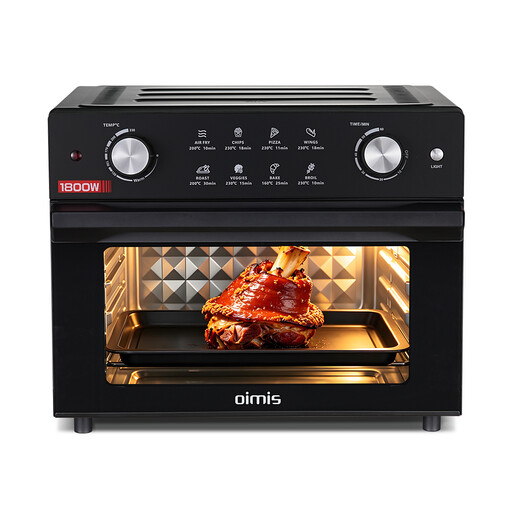 Image unavailable
An air fryer and toaster oven combo to compare if you want to use other cooking methods as well as baking.
The product description lists a capacity of 30 L, space for a 13-inch pizza and manual time and temperature controls; the title specifies 1800 W.
 Image unavailable
A spacious oven to compare if you want to make recipes using different heating settings and have room for a larger appliance.
The product description lists conventional heat, several fan settings and an adjustable temperature of up to 230 °C. The title specifies 2000 W; the description lists a baking tray and rack, and says the oven must be placed on a stable, heat-resistant surface.
 Image unavailable
A compact option to compare if you want to be able to use both conventional heat and a fan setting.
The product description lists a capacity of 22 L, five heating settings and a temperature of up to 230 °C. It also specifies baking tins up to 25 cm in diameter, plus a baking tray and rack.
 Image unavailable
A small oven to consider if your tin’s stated dimensions fit within the available space.
The description lists a capacity of 10 L, conventional heat and an adjustable temperature of 80–230 °C. It also specifies baking trays up to 20 cm, a 30-minute timer, a non-stick coating and a removable crumb tray.
 Image unavailable
A multifunctional oven to compare if you want to use other cooking methods as well as baking.
The description lists a capacity of 30 L, 21 functions, six accessories and an adjustable temperature of 30–230 °C. The stated external dimensions are 456 × 430 × 365 mm; the title specifies 1800 W.
Follow one recipe you’ve chosen rather than combining different tin sizes and settings. Rutger Bakt uses a 20 × 20 cm square tin at 170 °C; a different recipe from Koopmans specifies a round Ø 24 cm tin and 180 °C in an electric oven or 165 °C in a fan oven.
That depends on the placement instructions for the specific model and the clearance around it. Brandweer Nederland advises that heat from appliances including ovens must be able to escape, so checking the external dimensions alone isn’t enough.
Place the baking tin on the rack and set the time and temperature according to your chosen recipe. Allow for the cooling time specified in the recipe, and clean the oven and its parts according to the model’s manual.
If a product is faulty, you’re entitled to a legal guarantee; there is no fixed statutory period in the Netherlands. According to the Dutch government, the retailer must resolve the problem. Any manufacturer’s guarantee is in addition to this.
Yes. The Netherlands Food and Consumer Product Safety Authority states that CE marking is compulsory for electrical products. Check the marking on the exact model you’re considering.