
Cooking for several people at lunch
You want to cook your casserole in one suitable dish, so you’re looking at the usable oven space rather than just the litre capacity.


First, measure your oven dish, including the handles, and compare it with the usable interior space and shelf position of the exact model. The litre capacity alone won’t guarantee that your dish will fit. Then choose the heating settings and positioning that suit your cooking and kitchen. If you’re using raw sausages, always check that they’re thoroughly cooked.
You want to cook your casserole in one suitable dish, so you’re looking at the usable oven space rather than just the litre capacity.
You’re looking for a smaller freestanding oven and are also considering how much space the manual says to leave around the appliance.
You want to use the oven for your lunch dish and other recipes, so you’re comparing the controls and accessories available with each model.
Best for: anyone who wants to cook in a larger dish or prepare several lunch portions. Inventum lists the OV307B as having a 30-litre capacity, fan-assisted cooking and top and bottom heat.
Keep in mind: check both the internal and external dimensions, as well as the positioning instructions. The litre capacity doesn’t prove that your dish will fit.
Best for: anyone using a smaller dish who wants to save worktop space. Severin lists the TO 2067 as having a capacity of around 20 litres, with top and bottom heat that can be set separately or together.
Keep in mind: the smaller oven limits the size of dishes that will fit. The specifications don’t list a fan-assisted setting.
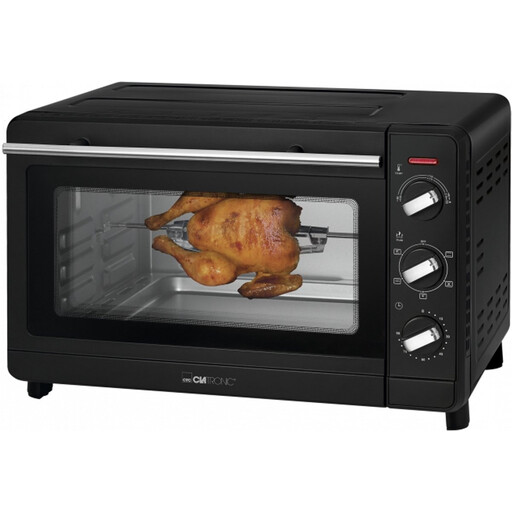
Best for: anyone who wants to cook other baked or grilled dishes as well as a casserole. Princess and Clatronic list fan-assisted cooking for the 112751 and MBG 3728 respectively.
Keep in mind: a rotisserie or pizza stone won’t automatically make an oven more suitable for your dish. Compare the settings and accessories with what you’ll actually use.
| What to consider | What should you check? | Who is this important for? |
|---|---|---|
| Space for your dish and portions | Compare the external dimensions of your dish, including the handles, with the usable internal dimensions and shelf position of the exact model. | If I want to use one dish for several people at lunch, making sure it fits is my first concern; around 40% of consumers focus mainly on dish size and portions. |
| Heating settings | Check which settings the exact model offers and whether the timer suits the recipe. Also check that the sausages are thoroughly cooked. | For a sausage casserole, I want to be able to adjust the cooking and check that it’s done; around 30% of consumers prioritise control over cooking. |
| Positioning on the worktop | Measure the available space and follow the exact model’s positioning instructions for the surface and clearance around the oven. | If I have limited worktop space, the oven needs to sit safely and be able to release heat; around 20% of consumers put positioning first. |
| Use and energy consumption | Choose the size and features to suit how you’ll use the oven. Compare energy consumption on a like-for-like basis, such as per cooking session. | If I use the oven regularly, I want to weigh up its size against the cost of running it; around 10% of consumers focus mainly on running costs. |
The capacity doesn’t tell you whether your oven dish, including its handles, will fit on the shelf.
Measure your dish and check the usable internal dimensions and shelf position of the exact model before choosing.
Having to replace a dish or cook lunch in several batches could mean extra work.
Heating settings vary by model. For example, the specifications for the Severin TO 2067 don’t list a fan-assisted setting.
Check the features for the full model number and choose based on the dishes you actually want to make.
The stated power rating alone doesn’t tell you how much energy one cooking session uses. Milieu Centraal recommends comparing ovens by energy use per session or per year.
Compare figures on the same basis and choose an oven size that suits the amount you usually cook.
The OV307B is a 30-litre freestanding oven with fan-assisted cooking and top and bottom heat, designed for anyone looking for a larger oven.
According to Princess, the 112751 is a 32-litre freestanding oven with convection and a range of settings.
According to Tristar, the OV-3625 is a 28-litre convection oven with top and bottom heat that can be set separately or together.
According to the manufacturer, the TO 2067 is a baking and toasting oven with a capacity of around 20 litres and top and bottom heat.
According to Clatronic, the MBG 3728 is a 30-litre oven with fan-assisted cooking and top and bottom heat.
This selection includes freestanding mini ovens for cooking a casserole, from compact models to ovens with extra settings for other dishes.
 No image available
An option if you’re looking for an oven for casseroles and want to cook other oven dishes too.
The product description lists a 30-litre capacity, top and bottom heat and a fan. The temperature can be set from 100–230 °C, and the timer runs for up to 90 minutes.
The description warns that surfaces can get hot. Place the oven on a stable, heat-resistant surface.
 No image available
An option if the stated oven space and heating settings suit your dish and the way you cook.
The product description lists a 22-litre capacity, top and bottom heat, and fan-assisted cooking. It mentions baking tins up to 25 cm Ø and a timer of up to 60 minutes. Check the dimensions of your own dish.
The description warns that surfaces can get hot and mentions leaving space around the oven for ventilation when positioning it.
 No image available
A compact option if you use a small dish and its limited oven space suits the portions you’re making.
The product description lists a 10-litre capacity, top and bottom heat, a temperature range of 80–230 °C and a timer of up to 30 minutes. The baking tray mentioned is no more than 20 cm; check the size of your dish.
The description warns that surfaces can get hot and specifies a flat, heat-resistant surface.
Measure the outside of the dish, including the handles, and compare it with the usable internal dimensions and shelf position of the exact model. The stated litre capacity doesn’t guarantee that the dish will fit.
Yes, as long as you check that the sausages are thoroughly cooked. Voedingscentrum recommends checking that sausages are fully cooked.
Follow the positioning instructions in the manual for the exact model and make sure the appliance can release heat. The Fire Service advises making sure electrical appliances can get rid of their heat.
Voedingscentrum advises reheating leftovers until they’re piping hot all the way through, stirring them well as they heat. It’s best not to reheat them a second time.
An extended warranty is only worthwhile if it gives you more rights than your statutory rights. The Dutch government explains that you’re entitled to a product that works properly, that there’s no fixed statutory warranty period in the Netherlands, and that you should contact the seller if something goes wrong.