
Bakers with a favourite tart tin
You want to know whether your custard tart tin will fit in the oven and which setting to use for your recipe.


Choose a mini oven after comparing your tart tin’s diameter and whether it will fit with the model’s usable interior space; the capacity in litres alone won’t tell you whether your tin will fit. Match the oven setting to your recipe: fan-assisted cooking isn’t automatically the same as conventional top and bottom heat. For a picnic, cooling the tart completely and transporting it chilled are two separate steps. Before buying, also check the conformity information for the specific appliance.
You want to know whether your custard tart tin will fit in the oven and which setting to use for your recipe.
You’re considering a smaller tart or several individual ones. As well as the oven’s external dimensions, allow space for heat to escape.
You’ll bake at home, and you’re also planning time to cool the tart completely and take it with you chilled.
Start by checking the size of your tin and whether it will fit. Then choose an oven setting to suit your recipe and check that the model can be placed safely where you plan to use it.
| What to consider | What should you check? | Who will find this most important? |
|---|---|---|
| Whether your tart tin will fit | Measure its diameter and height; check the stated maximum tin size and whether it will fit through the oven opening. | I want to be able to use my existing tin before choosing an oven. Around 33% of consumers put fit at the top of their buying priorities. |
| Oven setting and cooking time | Check that the model has the setting specified in your recipe and that the timer suits the way you bake. | I want to choose a setting that suits the recipe and keep an eye on the baking process. Around 27% of consumers put the oven setting first. |
| Safe positioning | Compare the oven’s external dimensions with your worktop and follow the model’s ventilation instructions. | There’s limited space on my worktop, so I also want to know how much clearance the appliance needs. Around 20% of consumers put available worktop space first. |
| Cooling and taking it with you | Allow time for the tart to cool completely and transport it chilled in a cool bag. | I want to fit baking, cooling and chilled transport into my picnic plans. Around 20% of consumers put picnic logistics first. |
Tin sizes and oven settings vary by model. Rommelsbacher states that the BG 950 accommodates tins up to 20 cm and the BGS 1400 tins up to 25 cm; also check the usable interior space and door opening of the exact appliance. According to the Netherlands Nutrition Centre, most recipes assume conventional top and bottom heat. For fan-assisted cooking, the Netherlands Nutrition Centre generally recommends a lower temperature than for conventional baking; follow the instructions for your recipe.
A mini oven won’t keep a custard tart chilled while you’re travelling. The Netherlands Nutrition Centre recommends taking chilled food to a picnic in a cool bag.
Ovens with different capacities can also have different maximum tin diameters. Your tin also needs to fit through the opening and sit in the right position.
Measure your tin and compare it with the model’s stated maximum tin size, usable interior space and door opening.
If your tin doesn’t fit, you may need a different baking tin.
The oven setting can affect the temperature required by a recipe. The Netherlands Nutrition Centre generally recommends a lower temperature for fan-assisted cooking than for conventional baking.
Start with the setting specified in the recipe. If you use a different setting, check the recipe and oven manual, and keep an eye on the tart while it bakes.
An oven cooks the tart, but it won’t keep perishable filling chilled while you’re travelling. The Netherlands Nutrition Centre recommends taking chilled food in a cool bag.
Plan cooling and chilled transport as separate steps. According to the Netherlands Nutrition Centre, chilled food that has been kept unrefrigerated for more than two hours should be thrown away.
Rommelsbacher describes the BGS 1400 as suitable for baking tins up to 25 cm and the BG 950 for tins up to 20 cm.
Inventum lists the OV207B as having a net capacity of 20 litres and several oven settings.
Tristar describes the OV-3610 as a 10-litre oven with conventional top and bottom heat.
Severin says the TO 2067 accommodates cake tins with a diameter of up to 30 cm.
These product picks cover baking in a freestanding oven, from compact models to ovens with a range of cooking functions. Compare the size of your tin with the usable oven space, and check the conformity information for the specific appliance before buying.
 No image available
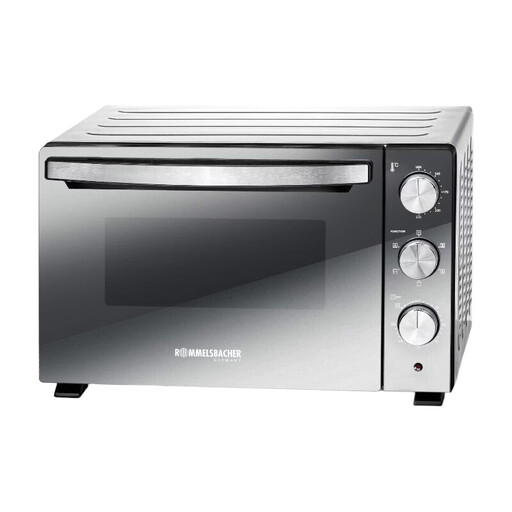
A freestanding mini oven; check that your tart tin fits in the usable oven space.
The product name lists 2000 W and 45L.
Check the conformity information for the specific product before buying.
 No image available
An option to compare if your recipe calls for conventional top and bottom heat and you’d also like a fan-assisted setting.
Rommelsbacher lists a 22-litre capacity, room for tins up to 25 cm, and conventional top and bottom heat with fan-assisted cooking.
Check the conformity information for the specific product before buying.
 No image available
The product name identifies this model as a baking and grilling oven. Check that its oven settings and usable interior space suit your recipe and tin.
Check the conformity information for the specific product before buying.
 No image available
A compact option if you use a small tin and want conventional top and bottom heat.
Rommelsbacher lists a 10-litre capacity and room for baking tins up to 20 cm; the BG 950 doesn’t have a fan-assisted setting.
Check the conformity information for the specific product before buying.
 No image available
A combination oven to compare if you’d like other cooking options as well as baking. Check that the oven space is suitable for your tart tin.
The product name lists 30L, 1800W, 21 presets and space for a 13-inch pizza.
Check the conformity information for the specific product before buying.
Not automatically. First check which oven setting the recipe specifies. According to the Netherlands Nutrition Centre, most recipes assume conventional top and bottom heat; for fan-assisted cooking, it generally recommends a lower temperature. Check that your tart is cooked through.
Follow the positioning and cleaning instructions for the exact model, and make sure heat can escape. Switch off the appliance and let it cool before cleaning it as directed in the manual.
Let the tart cool completely and transport it chilled in a cool bag. The Netherlands Nutrition Centre recommends throwing away chilled food if it has been kept unrefrigerated for more than two hours.
No. The Dutch Government states that there is no fixed statutory guarantee period in the Netherlands. You’re entitled to a product that works as it should and, if there’s a problem, you should generally contact the retailer; a manufacturer’s guarantee is separate.
Electrical equipment within the scope of Directive 2014/35/EU, including equipment operating at mains voltage within the specified range, must meet requirements that include CE marking. Check the information for the specific product on offer; a CE logo isn’t an independent test result for its performance.