First, choose a safe place for your oven. Then compare the usable baking tray with the quantity of crackers you want to bake in each batch: the oven’s capacity in litres doesn’t tell you how large the tray is. A compact model may suit smaller batches, while a larger oven with more heating settings needs extra space. Before buying, check the installation requirements for the exact model.
Who is this guide for?
Bakers with limited worktop space
You want to clear a suitable spot while you’re baking and put the oven away afterwards. The external dimensions and clearance required matter more to you than maximum capacity. The Netherlands Fire Service stresses that heat from ovens needs to escape.
Bakers making larger batches of crackers
You want to spread the dough across a usable baking tray and avoid baking more batches than necessary. So check the tray dimensions, not just the capacity in litres.
Bakers who want a choice of oven settings
You use different recipes and want to choose between settings such as conventional heat and fan-assisted cooking. Bear in mind that changing the oven setting may mean adjusting the baking time or temperature.
What should you consider when choosing?
Compact oven with conventional heat
Best for: small batches and kitchens with limited worktop space.
Trade-off: a smaller baking tray may mean baking more batches; the oven’s external dimensions aren’t the same as the space it needs when in use.
Larger oven with more heating settings
Best for: anyone who values more baking tray space or a choice of heating settings.
Trade-off: also measure the clearance specified in the manual; fan-assisted cooking may require a different recipe setting.
| What to consider |
What to look for |
Who is this important for? |
| Safe positioning |
Measure the space and the oven’s external dimensions; check the manual for the required clearance and ventilation. |
If I have limited worktop space, I want to know in advance where the oven can be used safely; around 36% of consumers prioritise finding a suitable place for it. |
| Baking tray and batch size |
Compare the dimensions of the supplied tray with the amount of dough you want to bake in each batch. |
If I want to bake a larger batch in fewer rounds, the tray’s surface area matters more than capacity alone; around 29% of consumers prioritise batch size. |
| Heating settings |
Check the settings on the exact model and follow the recipe and manual if you change them. |
If I make different recipes, I want to be able to tailor the heating setting to each one; around 21% of consumers prioritise adjustability. |
| Cleaning and energy use |
Check which parts are removable and only compare energy consumption using the same measurement basis. |
If I’m also considering cleaning, energy use and aftercare, I want to weigh up these factors before buying; around 14% of consumers make these practical considerations their main priority. |
Common buying mistakes
-
Measuring only the external dimensions
An oven that physically fits under a cupboard may still need clearance when in use so that heat can escape. The Netherlands Fire Service points out that heat from ovens needs to escape.
Measure the space where you’ll use it, including the clearance specified in the manual for the exact model. Don’t use the oven anywhere that doesn’t meet those requirements.
-
Assuming capacity in litres tells you the tray size
The oven’s capacity doesn’t tell you how large the supplied tray is or how much dough you can spread evenly across it.
Check the tray dimensions and choose a batch size to suit. A smaller tray may mean you need to bake more batches.
If the tray isn’t suitable for the batch size you want, you may need to bake an extra batch or buy a compatible additional tray.
-
Using wattage as a complete comparison of energy costs
The stated power rating isn’t the same as the energy used during a baking session. Milieu Centraal recommends comparing energy use per session or per year; the European Commission excludes small and portable ovens from its oven energy labelling scheme.
Only compare energy consumption on the same measurement basis, and take into account how many batches you’ll need to bake.
-
Assuming similar model names mean the same version
Severin lists the TO 2052 as having a capacity of 9 litres and a power rating of 800 W, while a product listing states 12 litres and 1,500 W. So check the version before deciding based on the model name.
Compare the full model number and key specifications on the product page with the manufacturer’s information.
A different version may have a different capacity, power rating or features from the ones you expect.
Brands to compare
Tristar
According to Tristar, the Tristar OV-3610 is a freestanding 10-litre oven with conventional heat and a supplied baking tray.
- Tristar gives the external dimensions as 37,2 × 31 × 27,2 cm.
- According to the specifications, the OV-3610 doesn’t have a fan-assisted setting; the external dimensions don’t tell you the usable tray size.
Inventum
Inventum lists the OV207B as having a capacity of 20 litres, fan-assisted cooking and separate heating settings.
- The manufacturer lists a baking tray and crumb tray as included.
- A larger oven needs more space when in use; check the tray dimensions for each model. Inventum lists a five-year manufacturer’s warranty, which is in addition to your statutory rights.
Rommelsbacher
Rommelsbacher lists the BG 950 as having a capacity of 10 litres and the BG 1055/E as having a capacity of 18 litres.
- The manufacturer states that the BG 950 fits a baking tin up to 20 cm and the BG 1055/E one up to 25 cm; both models are listed as including a baking tray.
- Capacity doesn’t tell you the size of the usable baking tray. Check the dimensions and features of the exact version.
Severin
Severin describes the TO 2052 as a 9-litre mini baking and toasting oven without a fan-assisted setting.
- Severin gives the external dimensions as 20,6 × 35,8 × 31 cm (h × w × d).
- The manufacturer lists one shelf position; check the version and tray size to make sure they suit your cracker batches.
Ariete
Ariete describes the Vintage 3919/03 as a 10-litre conventional oven supplied with an aluminium baking tray.
- Ariete lists a timer of up to 60 minutes and external dimensions of 37 × 31 × 21 cm.
- The product description doesn’t prove that crackers bake more evenly than in other ovens.
Ovens to explore at Joybuy
These models are options to compare for baking crackers. For each version, check the baking tray, heating settings and the space the oven needs when in use.
 No image available
23 L Dual Zone XXL Air Fryer Mini Oven
The product description lists baking trays and racks among the accessories; check the tray size to make sure it suits the cracker batch you want to bake.
Listed features: 23 L, dual zone, 15 programmes and LED touchscreen.
When in use, keep the air inlet and outlet clear and place the appliance on a stable, heat-resistant surface.
View at Joybuy
 No image available
Wiggo WMO-E456(W) mini oven, 45 L, 2000 W, white
An option to compare if you’re considering a larger oven for baking; measure the space and required clearance beforehand.
According to the product description, this version has conventional heat, fan-assisted cooking and a grill function.
Use the oven on a stable, heat-resistant surface and keep the ventilation openings clear.
View at Joybuy
 No image available
Rommelsbacher BGS 1400 mini oven
A model to compare if you’re looking for different heating settings for your crackers; check the tray size to make sure it suits your batch.
Check the product page to see which settings and included parts come with this version.
Use the oven on a heat-resistant surface with plenty of ventilation.
View at Joybuy
 No image available
Rommelsbacher BG 950 mini oven
An option for small batches of crackers; compare the tray size with the amount of dough you want to bake in each batch.
Check the heating settings and the dimensions of the supplied tray for this version.
The oven, door and interior get hot; use a flat, heat-resistant surface.
View at Joybuy
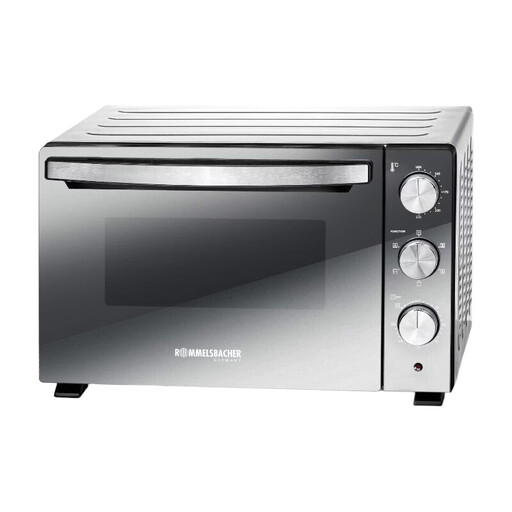 No image available
Rommelsbacher BGS 1500 baking and grilling oven
This oven needs plenty of space because of its external dimensions; measure the space available before choosing it.
External dimensions according to the product information: 50,5 × 40,3 × 33 cm. Allow for the required ventilation clearance too.
Check the heating settings on this version if they’re important for your recipe.
View at Joybuy
Frequently asked questions
Can you put a mini oven in a kitchen cupboard while it’s in use?
Don’t assume you can: heat from an oven needs to escape. The Netherlands Fire Service advises allowing for heat to disperse; check the positioning and ventilation requirements for the exact model, and don’t use the oven anywhere that doesn’t meet them.
Is a 10-litre oven big enough for your crackers?
That depends on the usable baking tray and the batch size you want to bake each time. Compare the tray dimensions with the amount of dough you want to use; the capacity in litres alone won’t tell you how many crackers will fit.
Do you need to adjust a recipe for fan-assisted cooking?
You may do: fan-assisted cooking isn’t necessarily the same as conventional heat. Use the manual and recipe settings as your starting point, check the first batch and adjust the time or temperature only if needed.
Can you compare mini ovens based on wattage?
Wattage alone doesn’t show how much energy is used per baking session. Milieu Centraal recommends comparing energy use per session or per year; use the same measurement basis and take the number of batches into account too.
Does every mini oven have an EU oven energy label?
No. The European Commission lists small and portable ovens as being outside the scope of the oven energy labelling scheme. So the absence of a label doesn’t, by itself, tell you how much energy a particular baking session uses.


