
Bakers who want to make a full recipe batch
You want to space the macaroons out on the tray, so look at the usable baking area and how many batches you’ll need. Koopmans’ recipe divides the mixture into 16 portions on one baking tray.


For a larger batch of coconut macaroons, the usable baking tray matters more than the oven’s capacity in litres alone: Koopmans’ recipe divides the mixture into 16 portions on one baking tray. A compact model is better suited to smaller batches. Follow the oven setting in your recipe and check the tray dimensions, as capacity doesn’t tell you how many macaroons will fit. In the Netherlands, CE marking is mandatory for electrical products, according to the NVWA; check that the exact model on offer meets this requirement.
You want to space the macaroons out on the tray, so look at the usable baking area and how many batches you’ll need. Koopmans’ recipe divides the mixture into 16 portions on one baking tray.
You switch between recipes using conventional heat and fan-assisted cooking, and want to know which settings the oven actually offers. The Voedingscentrum explains that recipes often assume a conventional oven.
You bake smaller batches and need to consider both the oven’s external dimensions and the space needed for heat to escape. The Fire Service advises allowing heat from appliances to dissipate.
Best for: anyone who wants to space out more macaroons per batch and uses recipes for both conventional and fan-assisted ovens. Inventum lists a baking tray, a 20-litre capacity and six oven settings for the OV207B.
Trade-off: measure the usable tray and check your available worktop space; these manufacturer specifications don’t guarantee a particular baking result.
Best for: anyone following a recipe that uses conventional heat and who doesn’t need a fan setting. Princess lists a baking area of 29.5 × 25.0 cm for the 112712.
Trade-off: the stated tray dimensions don’t tell you how many macaroons from your recipe will fit; remember to allow space between them.
Best for: anyone short on worktop space who’s happy to bake smaller batches. Tristar, Severin and Rommelsbacher offer models with a capacity of around 9–10 litres.
Trade-off: compare the baking tray rather than just the capacity in litres. Rommelsbacher recommends preheating the BG 950.
The main choice is whether you want to fit the batch on one tray or prefer a smaller appliance on your worktop. Measure the baking tray and follow the recipe settings.
| What to consider | What should you check? | Who should pay particular attention? |
|---|---|---|
| Baking area and number of batches | Measure the usable tray and see how many macaroons will fit with space between them; the capacity in litres won’t tell you this. | I want to fit a full recipe batch without losing sight of the space needed between the macaroons. Around 36% of consumers rank the baking tray and batch size as their top priority. |
| Oven setting | Check whether the oven offers conventional heat, fan-assisted cooking or both, and follow the recipe temperature. | I want to be able to select the setting in my recipe and check how the macaroons are browning as they bake. Around 29% of consumers rank the correct oven setting as their top priority. |
| Positioning and heat dissipation | Compare the oven’s external dimensions with the space available and follow the positioning instructions. | My worktop space is limited, but I want to position the appliance so that heat can escape. Around 21% of consumers rank fitting an appliance into a limited space as their top priority. |
| Cleaning and aftercare | Check which baking tray and crumb tray are included with the model, and read the cleaning instructions. | I want to know which parts I can remove and clean after baking. Around 14% of consumers rank cleaning and aftercare as their top priority. |
A recipe may call for 16 portions on one tray, but the oven’s capacity alone won’t tell you whether they’ll fit with enough space between them.
Compare the usable baking tray with the size of the macaroons in your recipe and the space they need between them.
An extended warranty may cost extra; compare the cost with what the additional cover offers.
These model examples show a range of baking capacities and oven settings; information about one model isn’t a recommendation for the whole brand.
The OV207B is an example for anyone looking for an included baking tray and a choice of conventional and fan-assisted settings.
The 112712 is a conventional mini oven with a stated baking area that can help you compare it with your baking needs.
The OV-3615 is a compact option to compare if smaller batches and storage space are important to you.
The TO 2052 is a compact baking and toasting oven for anyone mainly looking for a small oven.
The BG 950 is a compact baking and toasting oven to consider for smaller batches.
This selection ranges from compact mini ovens to larger oven combinations for baking. Compare the usable baking tray and oven settings with your recipe. The NVWA states that CE marking is mandatory for electrical products in the Netherlands; check that the exact model on offer meets this requirement.
 No image available
If you’re planning a larger batch, check how much space the baking tray offers; the capacity alone won’t tell you how many macaroons will fit.
The product name states 45 L and 2000 W.
 No image available
An option to compare if you’re looking for a freestanding mini oven; for coconut macaroons, check the usable tray dimensions and oven settings for the exact model.
 No image available
This compact model may be suitable for smaller batches; check the baking tin size against your recipe.
Rommelsbacher lists a 10-litre capacity and baking tins up to 20 cm in diameter, and recommends preheating.
 No image available
If you’re considering an oven combination with a 30 L capacity, first compare the usable baking tray with the batch size in your recipe.
The product name states 30 L and 1800 W.
 No image available
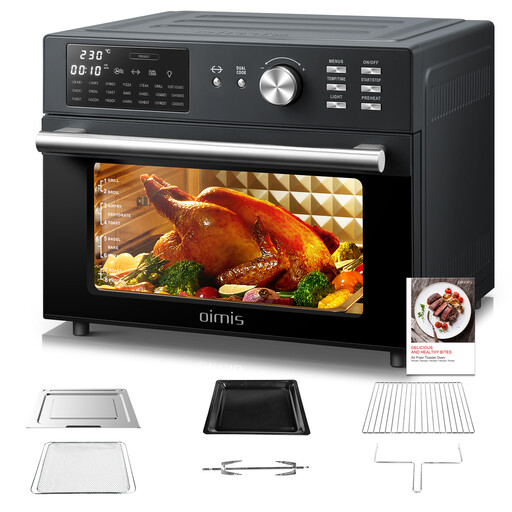
This model is worth comparing if you’re looking for an oven combination with a 30 L capacity; check the tray dimensions and oven settings for your batch.
The product name states 1800 W and 21 preset programmes.
Follow the setting and temperature in your recipe. Koopmans specifies 180 °C for conventional electric ovens and 170 °C for fan-assisted ovens; these temperatures don’t automatically apply to every recipe or mini oven.
Follow the positioning instructions for the exact model and make sure heat can dissipate. The Fire Service advises plugging high-power appliances directly into a socket where possible, rather than using a cable reel or extension lead; if you use a cable reel, unwind it fully. This is safety advice, not a general legal distance requirement for mini ovens.
Cook dishes containing raw egg thoroughly, and wash utensils well after they’ve been in contact with raw egg. The Voedingscentrum advises, among others, pregnant people and young children not to eat dishes containing egg that hasn’t been cooked through.
No. According to the Dutch government, there’s no fixed statutory warranty period in the Netherlands; what you can expect from a product depends on factors including the product itself and the sales information. For distance purchases, you’ll usually also have a 14-day cooling-off period, subject to applicable exceptions.
The NVWA states that CE marking is mandatory for electrical products. According to the European Commission, small and portable ovens are outside the scope of the energy labelling rules mentioned for domestic ovens; the absence of such a label doesn’t in itself prove that a product fails to meet the requirements. Check whether the rules apply to the exact model.