
Baking one large clafoutis
You want to bake one dish in a large tin during your workshop. Measure your dish, including the rim and handles, then compare it with the oven space. Rutger’s recipe uses a dish of around 26 cm.


Start with the recipe and the dish: the recipe we looked at for one large clafoutis uses a dish of around 26 cm, while another recipe uses eight small dishes. Then compare the usable oven space, cooking settings and room for safe placement. The capacity in litres alone does not prove that your dish or the whole batch will fit. Before buying, check that the appliance on offer carries the mandatory CE marking: the NVWA requires this for electrical products placed on the Dutch market.
You want to bake one dish in a large tin during your workshop. Measure your dish, including the rim and handles, then compare it with the oven space. Rutger’s recipe uses a dish of around 26 cm.
You want to make small clafoutis for your participants and work out how many dishes will fit in each batch. The recipe from delicious.magazine uses eight small dishes.
You’re looking for a freestanding oven that will fit in the space available. As well as checking its external dimensions, allow room for heat to escape.
Start with the dish and the number of portions per batch. Then check the settings you need and where the oven can be placed safely.
| What to consider | What to check | Who should pay particular attention? |
|---|---|---|
| Dish fit | Measure the dish, including the rim and handles, and compare it with confirmed internal dimensions or the stated maximum dish diameter. | If you want to bake one large clafoutis, you’ll need to know whether your dish will fit; around 36% of consumers make this their top priority. |
| Portions per batch | Check how many dishes will fit on the rack with space between them; the capacity in litres alone won’t tell you. | If you’re making individual portions for participants, the number of dishes that fit at once matters; around 29% of consumers give this top priority. |
| Cooking settings | Check that the temperature and cooking setting required by your recipe are available, and that the specifications match the exact model. | If you want to follow a recipe’s settings, you’ll need to be able to select the right temperature and mode; around 21% of consumers make this their top priority. |
| Safe placement | Check the placement instructions for the exact model and allow for the required clearance and ventilation. | If your workshop space is tight, you’ll want to know where the oven can sit safely and release heat; around 14% of consumers start by checking the space available. |
An oven’s capacity in litres doesn’t tell you which dishes will fit inside. Rommelsbacher gives a maximum dish diameter of 25 cm for the BG 1055/E, while the large recipe we looked at uses a dish of around 26 cm.
Measure your dish, including the rim and handles, and compare it with the stated maximum size or confirmed internal dimensions.
For the OV-3610, Tristar states a capacity of 10 litres, top and bottom heat, and a timer of up to 60 minutes.
For the OV207B, Inventum states a capacity of 20 litres and six oven settings.
For the BG 1055/E, the manufacturer states a capacity of 18 litres and a choice of settings with or without air circulation.
For the TO 2056, Severin states a capacity of 30 litres and four shelf positions.
Ariete describes the Vintage 0979/13 as a conventional oven with a capacity of 18 litres.
Here are Joybuy models listed with a baking function, including freestanding ovens and an air fryer oven. Compare their stated dimensions, capacity and settings with your dish, batch and workshop space. The NVWA requires electrical products placed on the Dutch market to carry the mandatory CE marking; check this on the appliance being offered.
 No image available
Worth considering if you’re looking for a larger oven space and a choice of cooking settings.
Capacity: 30 litres. Temperature range: 100–230 °C. The product information lists top and bottom heat, fan-assisted cooking and a grill.
Place the appliance on a stable, heat-resistant surface and allow for ventilation; surfaces get hot during use.
 No image available
Worth considering if you need more oven capacity for a planned batch; check how many dishes will fit on the rack.
The product information lists a capacity of 45 litres, six functions, and top and bottom heat with convection.
Place the oven on a heat-resistant surface and keep the ventilation openings clear.
 No image available
Worth considering if you need an oven setting of 180 °C; the product information lists an adjustable temperature of up to 250 °C.
Capacity: 35 litres. The product information lists three heating settings, four shelf positions, a baking tray and a rack.
According to the product information, leave at least 10 cm of clearance at the sides and 30 cm above; do not use the oven in an enclosed cupboard.
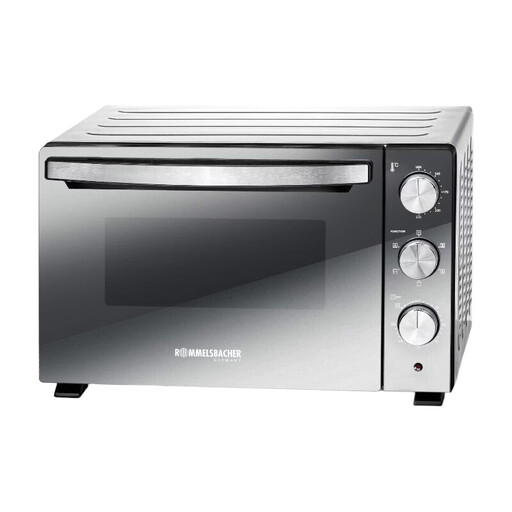 No image available
Worth considering if you’re looking for a freestanding oven with a baking function; compare the internal space with the dish you plan to use.
Capacity: 30 litres. The product information lists a maximum temperature of 250 °C and top/bottom heat with fan-assisted cooking. External dimensions: 50,5 × 33 × 40,3 cm.
The product information states that it is for domestic use. Place the oven away from flammable materials.
 No image available
Worth considering if you’re looking for an appliance with a baking function and several stated cooking options; check your dish size and the space required.
Capacity: 30 litres. The product information lists 21 presets and a temperature range of 30–230 °C. External dimensions: 456 × 430 × 365 mm.
Keep the air inlet and outlet clear during use.
The recipe we looked at for one large clafoutis uses a shallow dish of around 26 cm; the recipe for mini portions uses eight small dishes. First decide which recipe you’ll make during your workshop, then check that the dishes will fit.
Don’t assume that’s safe. The Fire Service advises allowing heat from appliances to escape; follow the placement and ventilation instructions for the exact model.
If a product is faulty, the seller must provide a solution, according to the Dutch Government. There is no fixed statutory guarantee period in the Netherlands; a manufacturer’s guarantee or an extended warranty does not replace your statutory rights.
Yes. The NVWA requires CE marking for electrical products placed on the Dutch market; the low-voltage rules apply to equipment with a rated AC voltage of 50 to 1.000 V. Check the marking on the actual appliance being offered.